montagne
La Soufrière
The highest peak in the Lesser Antilles: 1,467 m of active volcano under permanent surveillance, 3h round-trip ascent through a lunar landscape of fumaroles, Carbet Falls (115 m) and 22,000 hectares of primary tropical forest to explore.
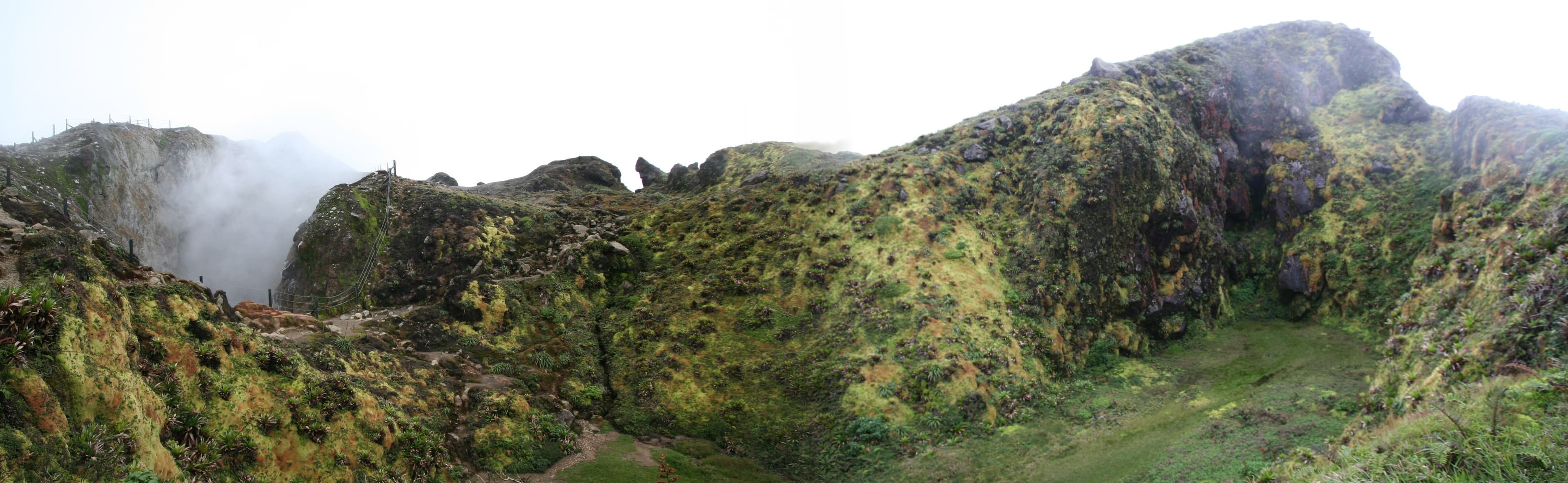
La Soufrière of Basse-Terre — nicknamed 'The Old Lady' by Guadeloupeans — is the highest peak in the Lesser Antilles at 1,467 metres altitude. An active volcano under permanent surveillance by the Guadeloupe Volcanological and Seismological Observatory (OVSG, based in Saint-Claude), it constitutes the geological heart of Basse-Terre and the epicentre of the Guadeloupe National Park (created in 1989, the first French overseas National Park, 22,000 hectares of protected primary tropical forest).
The last major eruption dates from 1976 — a phreatic eruption without lava flow that led to the evacuation of Basse-Terre town (73,000 people) for 3 months and remains a landmark event in Guadeloupean collective memory. Since then, volcanic activity has been limited to sulphurous fumaroles, thermal springs and low-amplitude seismic tremors — without any danger for hikers. The summit, accessible by a marked trail in 1h30 of walking from the Savane à Mulets car park (1,140 m altitude, reachable by car from Saint-Claude), offers one of the most striking landscapes in the Antilles: lunar landscape of fumaroles, sulphur vapours, lichens and mosses, 360° view over Grande-Terre, Marie-Galante, Les Saintes and — in great weather — Dominica to the south.
The 'Soufrière of Basse-Terre' site also includes the Carbet Falls (3 cascades, the second reaching 110 m, among the tallest in the Caribbean), the Bains Jaunes (sulphurous hot pool at 30 °C at 950 m altitude), the Maison de la Forêt trails (starting point for multiple themed hikes) and the Cascade aux Écrevisses (15 min round-trip, swimming in a cool pool). It's the complete Soufrière ecosystem that should be discovered — ideally over 2-3 days to fully enjoy the volcano, the National Park and the nearby coast.
What we love
- ✅Highest peak in the Lesser Antilles: 1,467 m, lunar landscape of fumaroles unique in the Caribbean
- ✅Accessible hike: 3h round-trip, 1.5 km positive elevation, stone-marked trail
- ✅Carbet Falls: three cascades, the 2nd at 110 m — among the tallest in the Caribbean
- ✅Bains Jaunes: sulphurous hot spring at 30 °C, free swimming at 950 m altitude
- ✅Guadeloupe National Park: 22,000 ha of primary tropical forest, exceptional biodiversity
What to know
- ❌Summit often in clouds — set off EARLY (before 7:30 am at car park) essential
- ❌Trail slippery and dangerous in rainy weather, access sometimes forbidden
- ❌Sulphurous smell sometimes strong at crater — light mask recommended for sensitive people
- ❌Access by winding D11 road from Saint-Claude, car required
Situation
Où se situe La Soufrière ?
Ouvrir la carte en grand sur OpenStreetMap →Frequently asked questions
How to climb La Soufrière of Basse-Terre?+
Is La Soufrière dangerous?+
How to visit the Carbet Falls?+
What are the Bains Jaunes and should I go?+
Where to stay near La Soufrière?+
Our verdict
The ascent of La Soufrière of Basse-Terre is the founding nature experience of any stay in Guadeloupe — one of the rare active volcanoes easily accessible to hikers in Europe and the Caribbean. The summit (1,467 m, highest in the Lesser Antilles), the lunar landscape of fumaroles, the panoramic view of the archipelago and Dominica justify the trip on their own. Combine with the Carbet Falls (2nd fall at 110 m, accessible 30 min walk) and the Bains Jaunes (free sulphurous hot swimming). Set off EARLY (before 7:30 am from the car park), equip yourself with walking shoes, windbreaker and water, and base yourself in Saint-Claude (the closest, 700 m altitude) or Deshaies (Caribbean coast 1h away).
Nearby

"Janvier : conditions idéales pour la Soufrière. Partez tôt (6h-7h) du parking de la Savane à Mulets pour profiter du sommet dégagé avant l'arrivée des nuages vers 10h."
Expert on La Soufrière · 1 contributions
 Africa & Americas Desk — Mowando·Editor