site historique
Angkor Wat
World's largest religious monument by area (162 hectares), the Angkor Wat sanctuary is the architectural and spiritual peak of the Khmer Empire — a once-in-a-lifetime visit.
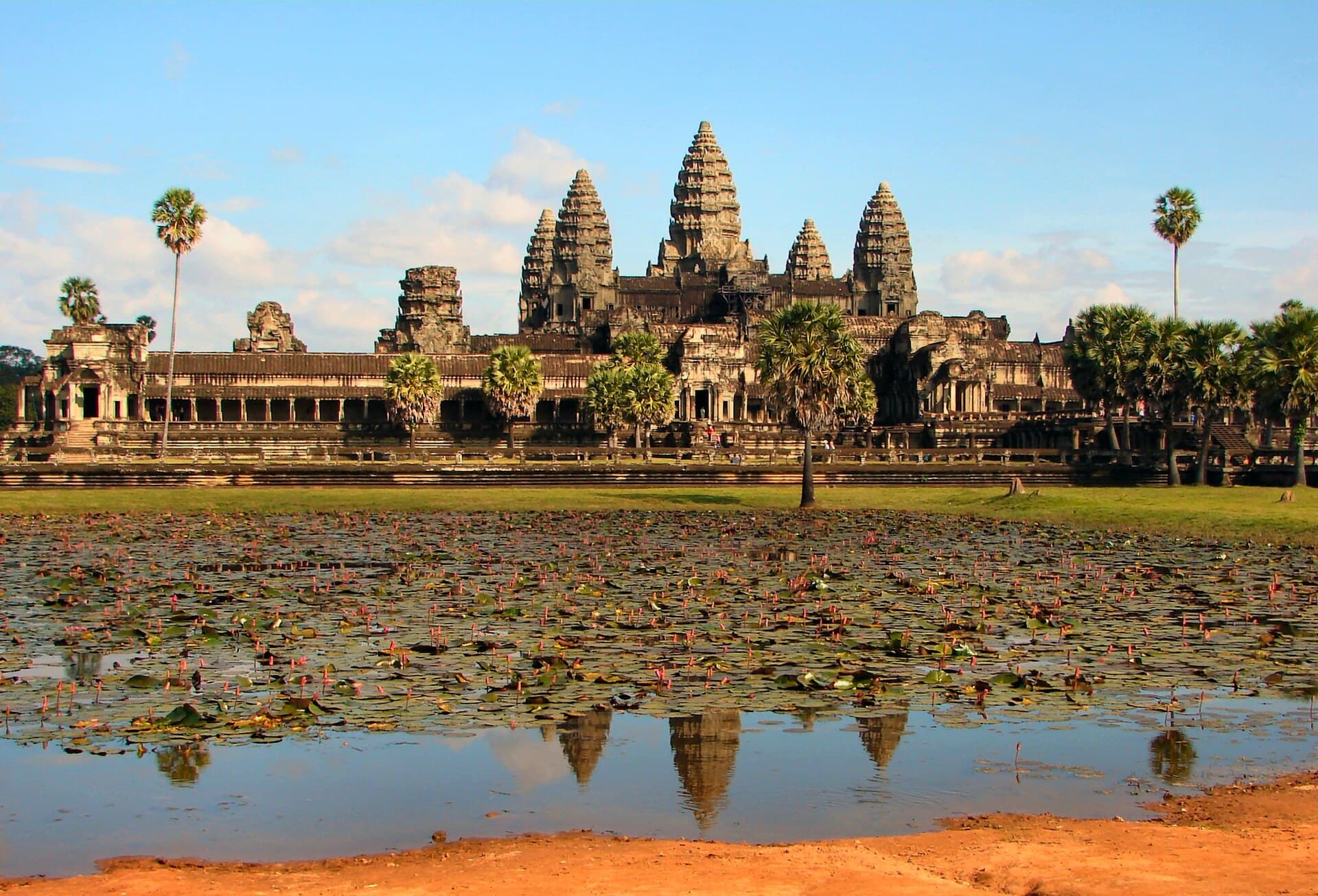
Angkor Wat is the world's largest religious monument by area (162 hectares, i.e. 1.6 km²), built at the start of the 12th century (1113-1150) under the reign of King Suryavarman II as a temple-mausoleum dedicated to Vishnu (the only major Angkor temple oriented west, the direction of death in Hindu cosmology). The central sanctuary, culminating at 65 metres atop the symbolic Mount Meru (the sacred mountain of Hindu gods), sits at the centre of a complex surrounded by 190-metre-wide moats (a true artificial river arm) with a 5.5 km perimeter.
The temple has been listed on the UNESCO World Heritage since 1992 (initially on the endangered heritage list due to the civil war, removed in 2004 after stabilisation), and its image appears at the centre of the Cambodian national flag — the only flag in the world to depict an architectural monument. The national expression "Our Angkor" sums up the deep identity attachment of Cambodians to this site that survived looting, jungle, conflicts and the Khmer Rouge genocide.
The visit focuses on three major elements. First, the outer enclosure: spectacular moats, 350 m paved causeway leading to the west gate, 800-metre-long peripheral gallery carved with the world's longest bas-reliefs (1,200 m² of scenes narrating the Mahabharata, the Ramayana, the churning of the sea of milk — the founding cosmogonic moment of Hindu mythology where gods and demons rotate a mountain to extract the nectar of immortality). Second, the intermediate courtyard with its corner towers and galleries. Third, the central sanctuary — stepped pyramid crowned with five lotus-bud towers, with the central one (65 m) housing the statue of Vishnu (replaced by Buddhas in the 16th century during the temple's conversion to Theravada Buddhism).
The experience unfolds in several moments. Sunrise from the north pond (4:45am arrival, 5:30am rising on average) is the absolute icon — the silhouette of the five towers reflects in the water, in shadow play against a sky shifting from black to orange-pink. The interior visit happens mid-morning (9-11am, when the sunrise crowd has dispersed and before midday heat) — plan 3-4h to walk through the bas-relief galleries and reach the central sanctuary.
The Angkor pass (USD 37 for 1 day, USD 62 for 3 days usable over 10 days, USD 72 for 7 days usable over 1 month) is bought at Angkor Enterprise (Charles-de-Gaulle Avenue, 4 km from Siem Reap centre) — photo taken on site for security. Tip: buy at 4:30-5pm the day before your first visit, your 5pm-5:30pm day is free.
What we love
- ✅World's largest religious monument by area (162 hectares) — unique visual experience
- ✅UNESCO 1992: international-quality conservation and restoration (École française d'Extrême-Orient, Japanese, German, Indian teams)
- ✅Bas-reliefs the world's longest: 800 m of carved gallery narrating Hindu mythology
- ✅Photogenic sunrise with reflections in the north pond — one of Asia's most famous images
- ✅3-day pass at USD 62 grants access to 20+ temples (Angkor Wat + Bayon + Ta Prohm + Banteay Srei + Preah Khan...)
What to know
- ❌Massive crowds at sunrise: 1,500-2,000 simultaneous visitors in high season
- ❌Proper attire required (shoulders and knees covered) — firm checks at upper towers
- ❌Crushing heat March to May (35-38°C, feels 40+°C) — gruelling visit
- ❌The site requires several km of walking per day — not suitable for reduced mobility
- ❌The upper level of the central sanctuary has restricted hours and a queue in high season
Situation
Où se situe Angkor Wat ?
Ouvrir la carte en grand sur OpenStreetMap →Frequently asked questions
Combien coûte la visite d'Angkor Wat ?+
À quelle heure arriver pour le lever de soleil sur Angkor Wat ?+
Combien de temps pour visiter Angkor Wat ?+
Quelle tenue vestimentaire pour Angkor Wat ?+
Faut-il prendre un guide pour Angkor Wat ?+
Peut-on monter au sommet d'Angkor Wat ?+
Our verdict
Angkor Wat is a once-in-a-lifetime experience. The world's largest religious monument by area, architectural testimony of a civilisation at its peak (the Khmer Empire of the 12th century), UNESCO site since 1992 — it's the absolute icon of Southeast Asia and one of the three or four historical wonders of the continent alongside the Great Wall, the Forbidden City and Borobudur. Our advice: plan a full half-day for Angkor Wat alone (5:30am sunrise, breakfast, interior visit of bas-reliefs and central sanctuary from 9am to noon). Buy the 3-day pass at USD 62 to combine with Bayon, Ta Prohm, Banteay Srei and Preah Khan over 3 days. Travel from November to February for the climate (book 3-4 months ahead), rise at 4:30am for sunrise, take a French-speaking guide (USD 25-40/day) at least once to understand the iconographic richness of the bas-reliefs, and don't underestimate the heat — bring 3-4 L of water, hat, SPF 50 sunscreen.
Nearby

"Janvier est le meilleur mois absolu : ciel dégagé, températures parfaites, lever de soleil photogénique. Pic d'affluence."
Expert on Angkor Wat · 1 contributions
 South-East Asia Desk — Mowando·Editor