ville
Split
A Roman palace 215 metres on each side, lived in without interruption for 1,700 years — a living city built inside an imperial residence.
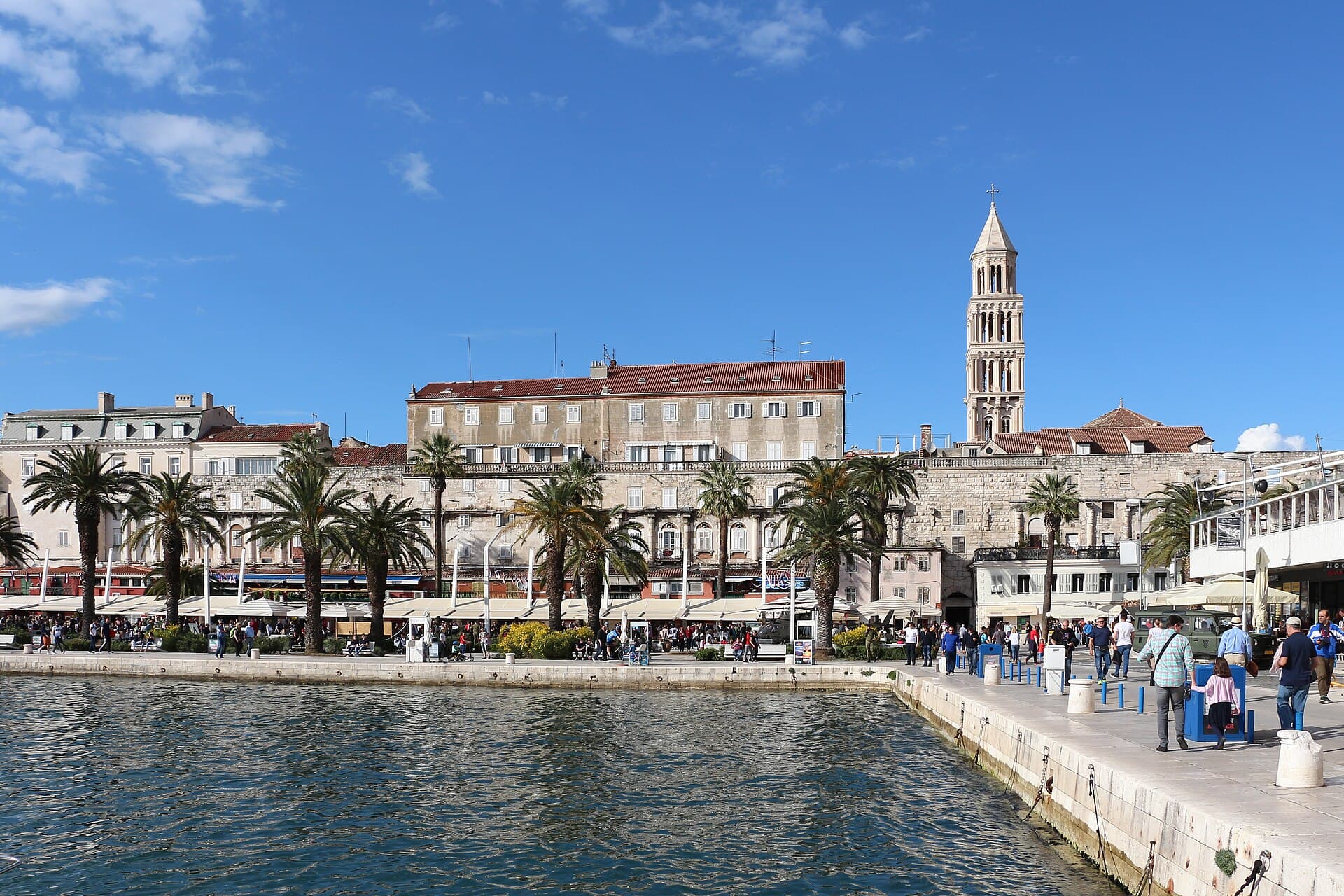
Split is Croatia's second city (180,000 inhabitants) and the capital of Dalmatia. Its uniqueness rests on a fact found nowhere else in the world: its historic core is Diocletian's Palace, a Roman imperial residence built between AD 295 and 305 by the emperor — a native of the region — and continuously inhabited for 1,700 years since. The palace, originally a square plan (215 × 180 metres) ringed by walls 28 metres high, today contains more than 200 buildings, 3,000 residents, dozens of cafés and restaurants, and several major monuments — the Mausoleum of Diocletian (now St Domnius Cathedral), the Temple of Jupiter, the central peristyle, the vaulted basement halls where several Game of Thrones scenes were filmed (Meereen). The whole ensemble has been UNESCO-listed since 1979.
Around the palace stretches the modern city, whose medieval and Baroque centre grew up naturally outside the walls. The Riva — a palm-lined seafront promenade — is Split's social heart: this is where the evening passeggiata unfolds, the Splitčani out walking with their families, drinking aperitifs at the terraces, watching the ferries leave for the islands. The Pazar green market and the Peškarija fish market (between the palace walls and Republic Square) are the best spots to discover authentic Dalmatian cooking.
The wooded Marjan hill (178 m), which closes off the Split peninsula to the west, is the city's green lung: 3 km² of Mediterranean pinewoods, walking trails, cave chapels and spectacular viewpoints over the bay. Split's port is the Adriatic's biggest ferry hub: daily departures to Hvar, Brač, Vis, Korčula, Lastovo and Ancona (Italy). It is the logical entry point for exploring the Dalmatian islands, and one of the liveliest, most affordable urban bases in Croatia for a 3- to 5-day stay.
What we love
- ✅Palais de Dioclétien UNESCO : un cœur historique unique au monde, ville vivante dans un palais romain
- ✅Atmosphère méditerranéenne authentique : Riva animée, marchés colorés, vie locale préservée
- ✅Hub de ferries idéal pour les îles dalmates (Hvar, Brač, Vis, Korčula)
- ✅Prix 30-40 % moins chers que Dubrovnik pour des prestations équivalentes
- ✅Mont Marjan : poumon vert, sentiers, plages à 15 min à pied du palais
What to know
- ❌Foule croissante en juillet-août — Split découvre le surtourisme depuis le succès de Game of Thrones
- ❌Festival Ultra Europe (mi-juillet, 100 000 spectateurs) sature la ville pendant 3 jours
- ❌Peu de plages de sable proches du centre — surtout galets et rochers (Bačvice est l'exception)
- ❌Logistique ferries en haute saison : à réserver plusieurs jours à l'avance pour les voitures
Situation
Où se situe Split ?
Ouvrir la carte en grand sur OpenStreetMap →Frequently asked questions
How many days do I need in Split?+
Is Diocletian's Palace free to visit?+
How do I get from Split to Hvar or the other islands?+
When should I visit Split? Avoid Ultra Europe?+
Which neighbourhood to stay in?+
What are the best beaches near Split?+
Our verdict
Split is one of the Mediterranean's finest urban discoveries. Diocletian's Palace — a living city built inside a Roman palace of AD 305 — is an architectural experience without equal in the world. The atmosphere is far more authentic than Dubrovnik's: 3,000 residents still live inside the walls, cafés and restaurants are full of Splitčani, the Riva keeps its social function as the evening passeggiata. Add Marjan hill for nature, Bačvice beach for swimming, and above all the role of ferry hub to Hvar, Brač, Vis and Korčula — one of the best bases imaginable for exploring Dalmatia. Visit in May-June or September, allow 3 nights on land and at least 4-5 extra nights on the islands.
Nearby

"Très calme, hôtels fermés sur les îles."
Expert on Split · 1 contributions
 Mediterranean Desk — Mowando·Editor