ville
Dubrovnik
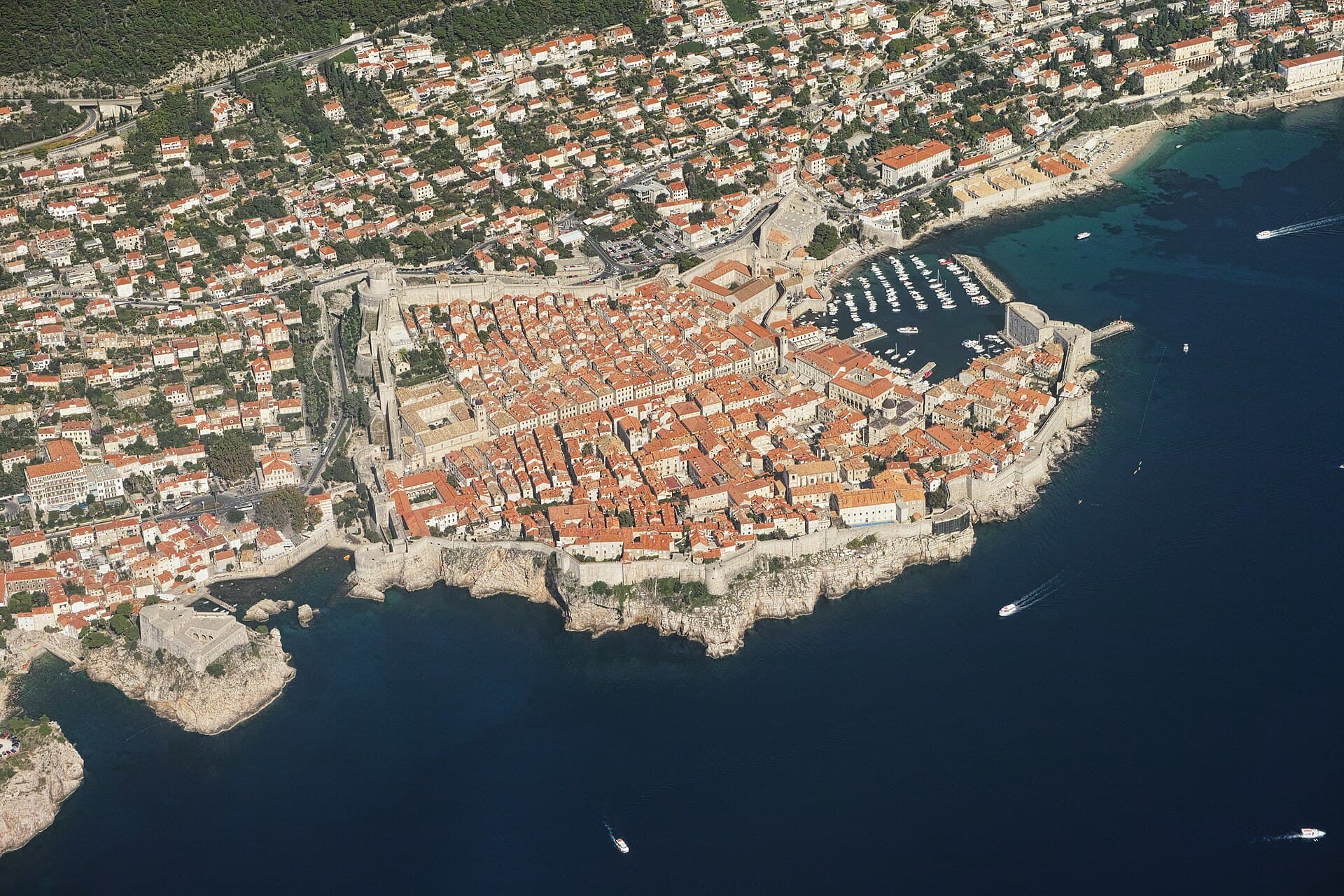
An entire medieval city-state, ringed by 1,940 metres of intact 13th-century walls, perched on a limestone spur above the Adriatic Sea.
Dubrovnik — Byron's "Pearl of the Adriatic" — is one of Europe's most spectacular cities. Once an independent merchant republic (1358-1808) that rivalled Venice for five centuries, it still wears an intact ring of fortifications 1,940 metres long, up to six metres thick and twenty-five metres high, wrapping a historic core of just twenty-one hectares. That extreme urban density — Renaissance palazzi, Franciscan and Dominican monasteries, Onofrio's fountains, St Blaise's church, the Rector's Palace, the Assumption Cathedral — makes the walled city an open-air museum, UNESCO-listed since 1979.
The Stradun (or Placa), the central artery polished smooth by seven centuries of footsteps, crosses the old town east to west for 300 metres, framed by almost identical Baroque façades — the legacy of the devastating 1667 earthquake that forced a unified reconstruction. The city walls take roughly two hours to walk in full, delivering the most iconic views of red-tiled rooftops, the crystalline Adriatic and the green island of Lokrum 600 metres offshore. The cable car up Mount Srđ (412 m) climbs in four minutes to a panoramic view of the city, the Elafiti Islands and, on a clear day, the Italian coast far across the water.
The Game of Thrones series turned Dubrovnik into a global pilgrimage site: the city stood in for King's Landing in seasons 2 through 8. That new fame has compounded tourism pressure — up to 10,000 visitors a day inside the walls for 1,200 permanent residents, with four cruise ships docked simultaneously in July-August. The municipality has imposed visitor quotas and arrival regulation since 2018, but the challenge remains acute. To experience Dubrovnik at its best, come in May-June or September, sleep inside the walls and explore the city early in the morning (7-10am) or in the evening (6-10pm), once the cruise crowds have returned to their ships.
What we love
- ✅Vieille ville UNESCO d'une beauté exceptionnelle, remparts intacts de 1 940 m à parcourir à pied
- ✅Téléphérique du Mont Srđ : vue panoramique sur la ville, les îles Élaphites et l'Adriatique
- ✅Pèlerinage Game of Thrones pour les fans de la série (King's Landing)
- ✅Base idéale pour les excursions : îles Élaphites, Mljet, Monténégro (Kotor), Bosnie (Mostar)
- ✅Cuisine méditerranéenne raffinée : huîtres de Mali Ston, poisson grillé, vins du Pelješac
What to know
- ❌Surfréquentation extrême : jusqu'à 4 paquebots/jour et 10 000 visiteurs/jour intra-muros en juillet-août
- ❌Prix les plus élevés de Croatie : hôtels et restaurants 30-50 % plus chers que Split ou Zadar
- ❌Chaleur étouffante en juillet-août dans les ruelles de pierre claire (32-36 °C, peu d'ombre)
- ❌Peu de vie locale intra-muros — la majorité des résidents a quitté la vieille ville pour Lapad ou Gruž
Situation
Où se situe Dubrovnik ?
Ouvrir la carte en grand sur OpenStreetMap →Frequently asked questions
How many days do I need in Dubrovnik?+
How do I avoid the crowds in Dubrovnik in high season?+
How much does the walk around the walls cost?+
What are the main Game of Thrones filming locations in Dubrovnik?+
How do I reach Montenegro or Bosnia from Dubrovnik?+
Where to stay in Dubrovnik: inside the walls or Lapad?+
Our verdict
Despite the overtourism, Dubrovnik remains one of Europe's most beautiful cities. The intact 13th-century walls, the marble-smooth Stradun, the Renaissance palazzi and the view from Mount Srđ deliver an architectural spectacle without equal in the Mediterranean. The main constraint — the mass cruise-ship arrivals between 10am and 5pm in high season — is easily sidestepped by sleeping inside the walls and exploring at the hours when the city empties out. Visit in May-June or September, book your hotel 4-6 months ahead, and pair Dubrovnik with a day trip to the Elafiti Islands (Lopud, Šipan) or Mljet for breathing room. A city to see at least once in a lifetime — just not in the heart of summer.
Nearby

"Très calme, hôtels fermés sur les îles."
Expert on Dubrovnik · 1 contributions
 Mediterranean Desk — Mowando·Editor