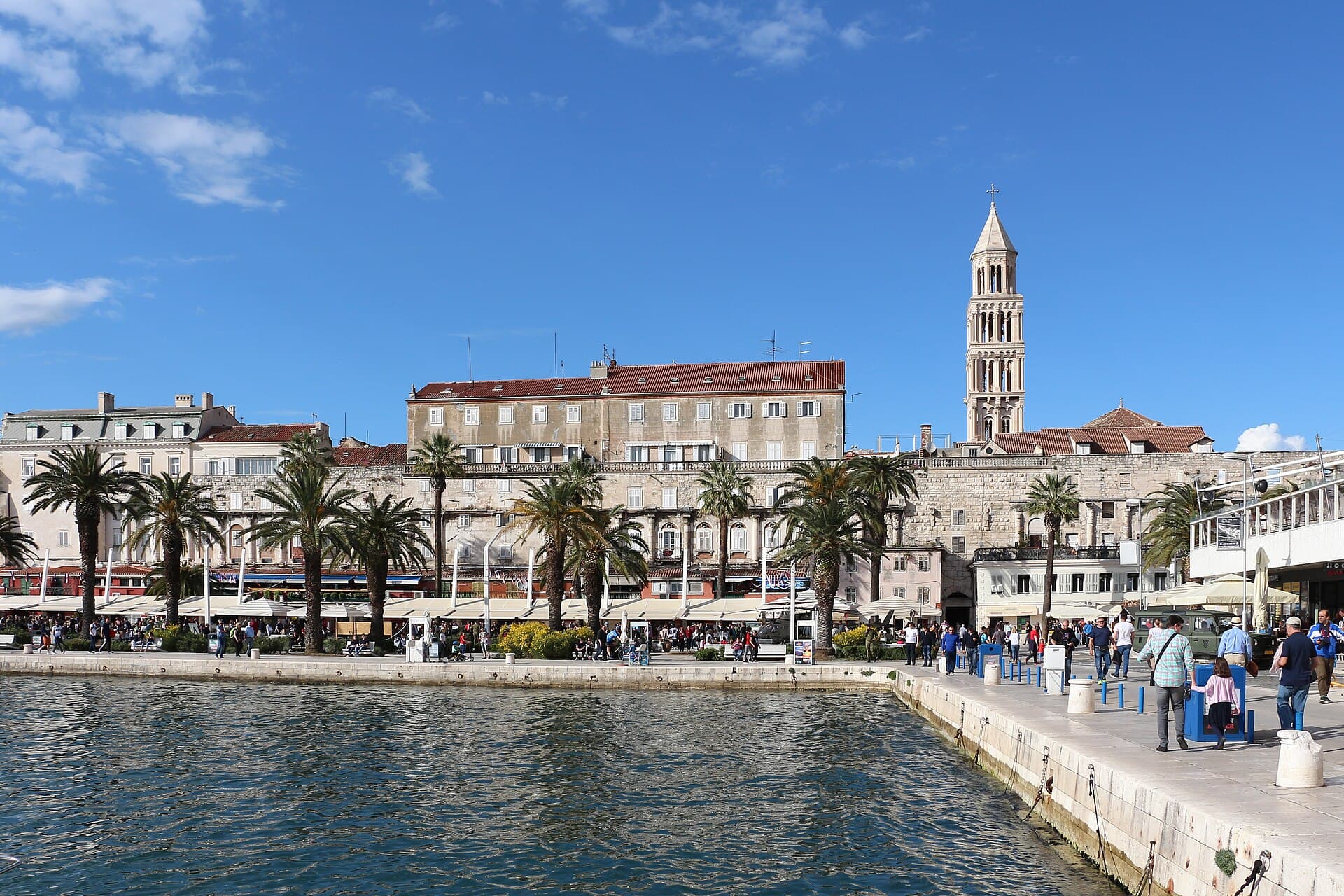
Split unfolds in four circles: Diocletian's Palace, the historic quarters around it, Marjan hill and the ferry-accessible islands.
Diocletian's Palace is the absolute experience. Enter through the Golden Gate (north, the most monumental), cross the cardo to the peristyle — the colonnaded court that was the ceremonial heart of the imperial residence. There you find St Domnius Cathedral (the former mausoleum of Diocletian converted into a cathedral in the 7th century — a paradoxical situation since Diocletian had persecuted Christians), the bell tower (climb to 57 metres for the view, €5), and the Temple of Jupiter (later a baptistery). Then descend into the basement halls (€5) — perfectly preserved subterranean spaces that formed the palace substructures and where the Meereen scenes in Game of Thrones were filmed. Allow half a day to explore properly.
The historic city beyond the walls stretches around the palace. Republic Square (Trg Republike, nicknamed "Prokurative") is a neo-Renaissance square bordered by red arcades, a small-scale copy of Venice's St Mark's Square. People's Square (Narodni trg, "Pjaca") is the medieval heart of the city. The Pazar green market and the Peškarija fish market (between the palace walls and the Riva) are unmissable — absolute local life, exceptional produce. The Archaeological Museum (one of Croatia's oldest, 1820) holds the collections of nearby ancient Salona, the Roman provincial capital.
The Riva (Obala hrvatskog narodnog preporoda, its formal name) is the palm-lined seafront promenade, 250 metres bordered with cafés and restaurants. This is where the evening passeggiata unfolds — a must at 7-9pm, especially in May-June and September when the light is golden. At the western end, Sustipan square offers a park, chapels and a maritime cemetery.
Marjan hill (178 m) closes off the peninsula to the west. 3.4 km² of Mediterranean pinewoods, marked walking trails (30 minutes to 3 hours), cave chapels (St Jerome, 4th century), panoramic viewpoints over the bay. The main trail starts west of Veli Varoš and climbs gradually to the summit — allow 1h30 round trip. Kasjuni and Bene beaches halfway up.
Bačvice is the main urban beach, 10 minutes' walk from the palace — one of the few sandy beaches in Croatia, shallow water, ideal for families. This is where picigin was born — a traditional Splitčani sport of bouncing a cork ball between players standing in the water, without letting it fall.
The islands are reached by ferry from the port. Brač (50 minutes, iconic Zlatni Rat beach at Bol), Hvar (1 hour by catamaran, Europe's sunniest island), Vis (2h30, the most authentic, closed as a military base until 1989, the Biševo blue caves), Korčula (2h, medieval, said to be Marco Polo's birthplace). For a day trip from Split, Brač + Zlatni Rat beach is the most accessible option.
Land excursions: Trogir (UNESCO, 30 minutes by bus, medieval island town), Salona (Roman ruins, 30 minutes by bus, the former provincial capital), Klis (fortress — Meereen in Game of Thrones), Krka National Park (1h30 by bus, waterfalls).
Read also
- Central Dalmatia: Split, Hvar, Korčula — Diocletian's Palace, Hvar's lavender fields and Marco Polo's birthplace.
- Croatia — Complete country guide: entry rules, budget, when to visit, regions.
- Hvar, Europe's sunniest island — An hour by catamaran from Split: lavender, nightlife and the Pakleni Islands.
- Dubrovnik, Pearl of the Adriatic — UNESCO walls and Renaissance palaces, 4 hours by bus south of Split.