ville
Zadar
A Roman and Venetian Old Town at the tip of a peninsula, where contemporary art has installed an organ played by the sea — one of Dalmatia's loveliest surprises.
Zadar is Croatia's fifth city (75,000 inhabitants) and the historic capital of Northern Dalmatia. Too often overlooked by travellers heading straight from Plitvice to Split, it ranks nonetheless among the loveliest urban discoveries on the Croatian coast — a unique blend of Roman heritage, Venetian urbanism and contemporary art that makes it a stop in its own right on any Dalmatian itinerary.
The Old Town stretches across a narrow 600-metre peninsula, almost entirely surrounded by water, separated from the mainland by a canal. At the historic core, the Roman Forum from the 1st century AD (one of the largest on the eastern Adriatic coast), the pre-Romanesque Church of St Donatus (9th century, circular plan, one of Europe's oldest and most original religious buildings), the Cathedral of St Anastasia (12th-13th centuries, Romanesque), the Venetian walls and their monumental gates (Land Gate, UNESCO-listed in 2017 as part of the "Venetian Defensive Works of the 16th-17th Centuries").
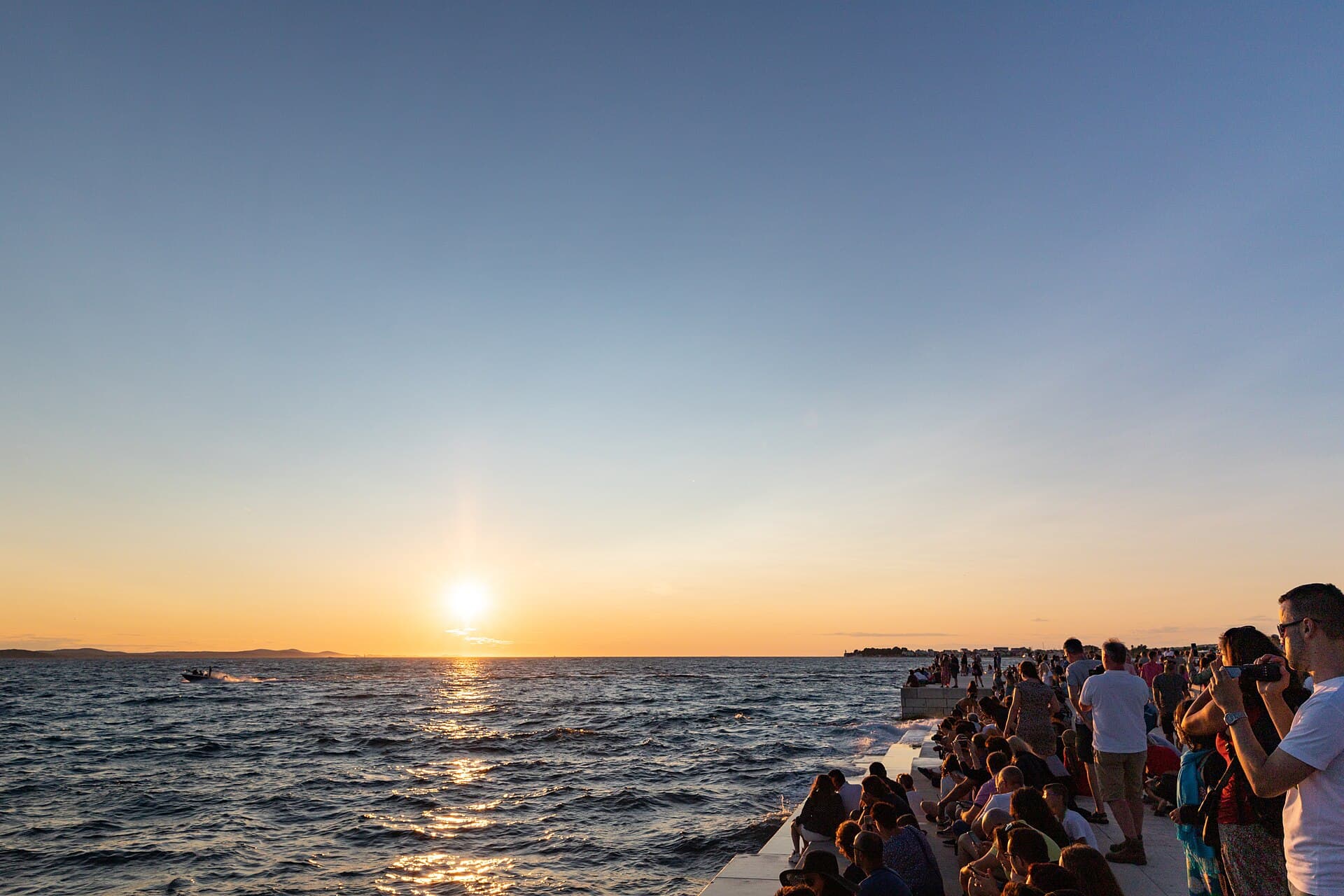
Zadar's contemporary uniqueness rests on two artistic installations conceived by architect Nikola Bašić and inaugurated in 2005. The Sea Organ (Morske orgulje), embedded in the steps of the promenade descending to the Adriatic: 35 polyethylene tubes hidden under the stone, activated by the waves and air pressure, continuously produce a haunting, random melody — a unique sound-art work created by the elements. Beside it, the Greeting to the Sun (Pozdrav Suncu), a 22-metre diameter disc made of 300 photovoltaic panels that charge by day and stage a luminous spectacle at nightfall, synchronised with the positions of the planets. The two installations frame what Alfred Hitchcock is said to have called, in 1964, "the most beautiful sunset in the world" — more beautiful, he added, than the one in Key West, Florida.
What we love
- ✅Vieille ville romaine et vénitienne exceptionnellement préservée et bien restaurée
- ✅Orgue marin et Salutation au Soleil : œuvres d'art contemporaines uniques au monde
- ✅Couchers de soleil parmi les plus beaux d'Europe (selon Hitchcock et l'unanimité touristique)
- ✅Prix 30-40 % moins chers que Split, 50 % moins chers que Dubrovnik à équipement équivalent
- ✅Excellente base pour Plitvice (1h30), Krka (50 min), Kornati en bateau, îles de Pag et Ugljan
What to know
- ❌Moins de notoriété que Split ou Dubrovnik — risque de passer trop vite si vous suivez un itinéraire pressé
- ❌Pas de plages de sable proches du centre (galets et rochers) — préférez Borik ou l'île d'Ugljan
- ❌Activité du port industriel à l'est de la vieille ville un peu visible depuis la promenade
- ❌Climat continental plus marqué qu'en Dalmatie du Sud (bora plus violente en hiver)
Situation
Où se situe Zadar ?
Ouvrir la carte en grand sur OpenStreetMap →Frequently asked questions
How many days do I need in Zadar?+
When to watch the sunset over the Sea Organ?+
How do I get to Zadar from London or Zagreb?+
What to taste in Zadar? Maraschino?+
Do I need a car in Zadar?+
Zadar or Split as Dalmatia base?+
Our verdict
Zadar is one of the loveliest surprises on the Croatian coast, too often overlooked by travellers who race from Plitvice to Split without stopping. The unique combination of Roman heritage (Forum, St Donatus), Venetian urbanism and two globally recognised contemporary art installations (Sea Organ, Greeting to the Sun) makes it a stop worth at least two nights — one for the Old Town and the legendary sunset (an absolute must from the tip of St Chrysogonus), the other for day trips to Krka National Park (50 minutes), Plitvice (1h30), the Kornati Islands by boat or Ugljan island by fast ferry. Visit in May-June or September, sleep inside the peninsula to enjoy the evening atmosphere, and taste maraschino — a marasca cherry liqueur produced in Zadar since 1759, beloved of Napoleon, Lord Nelson and Queen Elizabeth II. A stop that will stay in your memory.
Nearby

"Très calme, hôtels fermés sur les îles."
Expert on Zadar · 1 contributions
 Mediterranean Desk — Mowando·Editor