ville
Pula
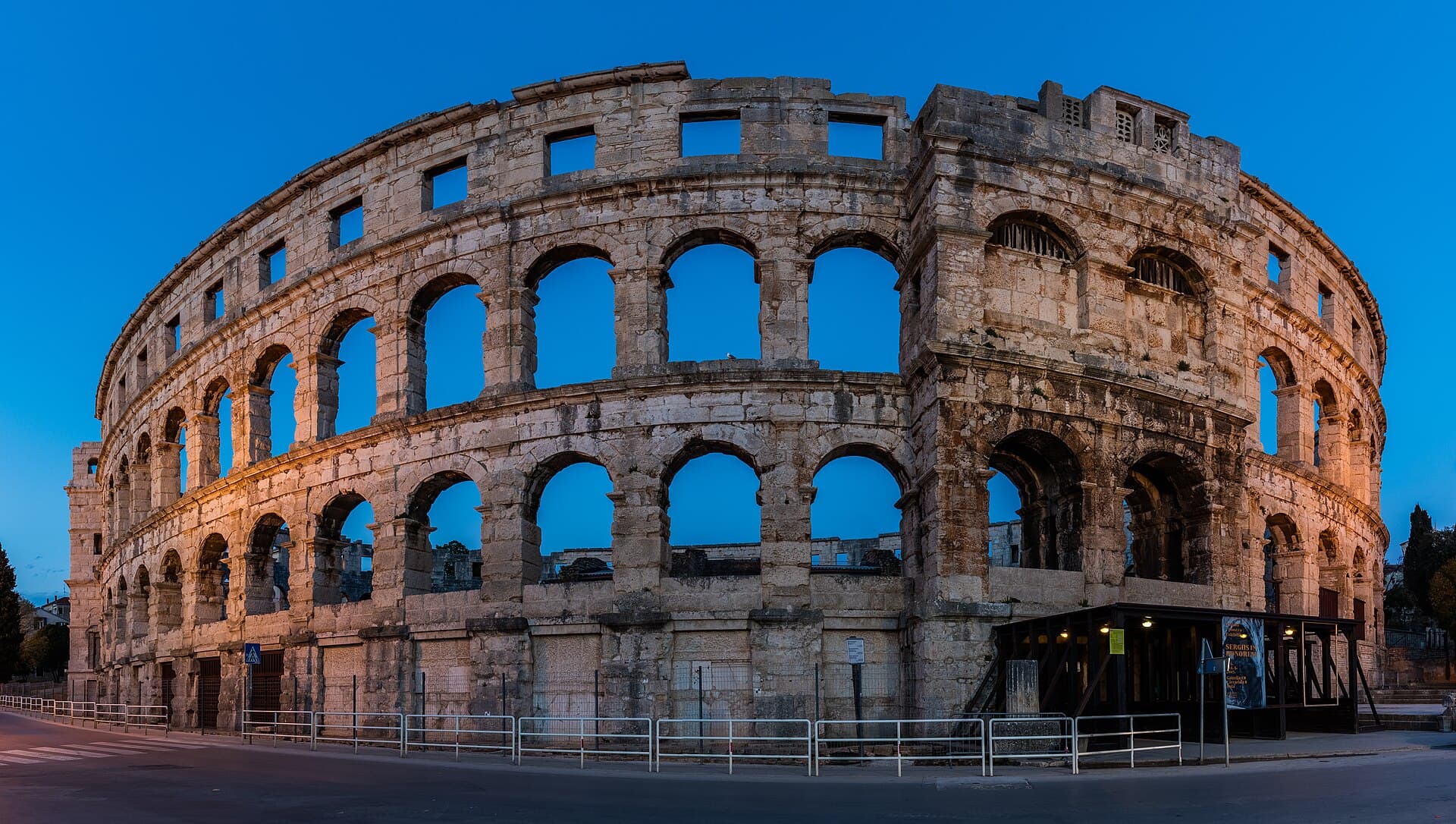
A 1st-century Roman amphitheatre, perfectly intact on all its tiers — one of the six best-preserved in the world, still used today for concerts.
Pula (Pola in Italian) is Istria's largest city (55,000 inhabitants) and one of Croatia's most history-laden. Founded by the Romans in the 2nd century BC on a site already settled by the Illyrians, it was a major Roman colony under the name Colonia Pietas Iulia Pola — provincial capital of Istria for five centuries. The city today retains a Roman heritage of exceptional density: amphitheatre, Temple of Augustus, Arch of the Sergii, two urban gates (Hercules Gate, Twin Gate), forum, wall fragments — a true open-air Roman museum.
The centrepiece is, without question, the Roman amphitheatre — known locally as the Arena — built between 27 BC and AD 68 under Augustus, Vespasian and Titus. It is one of the six best-preserved Roman amphitheatres in the world (alongside the Colosseum in Rome, Verona, Nîmes, Arles and El Djem in Tunisia), and the only one to retain its full four tiers of towers — four corner towers overlooking the city. At 132 metres long, 105 metres wide and 32 metres high, the arena could seat 23,000 spectators for gladiator combats (until banned by Honorius in AD 404). Today it hosts concerts and operas every summer (Pula Film Festival since 1954 — the oldest film festival in the world still running, Outlook Festival, concerts by Sting, Andrea Bocelli, David Gilmour, Jamiroquai).
The Old Town wraps around the Roman Forum (still Pula's main square, 2,000 years after its construction), dominated by the Temple of Augustus (2 BC, almost perfectly preserved, turned into a church in the Middle Ages then restored as a Roman temple in the 20th century). Nearby, the Arch of the Sergii (29 BC, a family triumphal arch erected by the wealthy Sergii family to celebrate their part in the Battle of Actium alongside Octavian), the Hercules Gate (1st century BC, one of the city's oldest Roman monuments), the Twin Gate (2nd century AD). The cathedral and the Venetian fortress (Kaštel, 17th century) crowning the central hill (Istria History Museum) add a Byzantine-Venetian layer.
Pula was also one of the main military ports of the Austro-Hungarian Empire (1813-1918) — naval base of the Imperial and Royal Navy (k.u.k. Kriegsmarine) with major shipyards still visible. This is where the battleships of the Austrian fleet were built before the First World War. The dry submarine U-Boat U-9 and the Naval History Museum bear witness to that era.
What we love
- ✅Amphithéâtre romain exceptionnel : l'un des 6 mieux préservés au monde, 4 tours d'angle intactes
- ✅Patrimoine romain dense : Forum, temple d'Auguste, arc des Sergii, portes urbaines
- ✅Concerts dans l'arène chaque été : Pula Film Festival, Outlook, Sting, Bocelli, etc.
- ✅Porte d'entrée idéale pour l'Istrie (vols directs aéroport PUY, Rovinj à 35 min, Motovun à 1h)
- ✅Cuisine istrienne d'exception : truffes, huile d'olive primée, pâtes maison, vins de malvasia
What to know
- ❌Ville portuaire moins charmante que Rovinj — atmosphère plus urbaine et industrielle
- ❌Vieille ville un peu défraîchie par endroits (restauration en cours)
- ❌Fréquentation soutenue en juillet-août pour l'amphithéâtre (concerts, croisières)
- ❌Plages éloignées du centre (15-20 min en bus vers Verudela, Stoja, Pješčana Uvala)
Situation
Où se situe Pula ?
Ouvrir la carte en grand sur OpenStreetMap →Frequently asked questions
How many days do I need in Pula?+
How much is entry to the Pula amphitheatre?+
How do I get to Pula from London or Paris?+
Is Brijuni National Park worth the trip?+
What are the best beaches near Pula?+
Pula or Rovinj as Istria base?+
Our verdict
Pula is the ideal gateway to Istria and one of Croatia's most history-laden destinations. The Roman amphitheatre — one of the six best-preserved in the world — is worth the trip on its own, and the experience of a concert inside this thousand-year-old enclosure in summer is unique. The city is, however, less charming than Rovinj, and a 1- to 2-night stay is enough to cover the Roman monuments, the Forum, the Venetian fortress and a gastronomic dinner. If you fly into Pula, use the city as a base for 1-2 nights, then move on to Rovinj (35 minutes) for the Venetian charm and the Istrian hinterland. Ideal combination: 1 night in Pula (arrival + amphitheatre + dinner) + 3 nights in Rovinj + 1 day in Motovun for the truffle. Five days for true Istrian immersion.
Nearby

"Très calme, hôtels fermés sur les îles."
Expert on Pula · 1 contributions
 Mediterranean Desk — Mowando·Editor