parc national
Tarangire
The kingdom of baobabs and elephants: 2,500 elephants concentrated around the Tarangire River in dry season, in a spectacular landscape of giant baobabs — one of Tanzania's most beautiful safari experiences.
Tarangire National Park is one of the great secrets of the Tanzanian Northern Circuit. With its 2,850 km² (the country's sixth-largest national park), it occupies a strategic position south-east of Lake Manyara and 130 km south-west of Arusha — 2h30 to 3h by road, making it often the first stop of a classic Northern Circuit. Yet it remains relatively underestimated compared to the neighbouring Serengeti and Ngorongoro, while offering some of Tanzania's most striking spectacles: the largest elephant population in the north (estimated at 2,500 individuals), an iconic landscape of giant baobabs (some over 1,000 years old), and exceptional bird biodiversity (over 550 species, one of East Africa's richest avifaunas).
The ecological particularity of Tarangire is the Tarangire River that crosses the park from west to east for nearly 200 km, the only permanent water source in the region during the dry season. This singularity creates a spectacular phenomenon: during the long dry season (June-October), herds of elephants, wildebeest, zebras, buffalo, oryx and impalas migrate from the surrounding Masai Steppe (a vast 35,000 km² semi-arid plain extending southward) to drink at the river. Animal density around the river then becomes extraordinary — it's possible to observe more than 300 elephants at a single point on the banks.
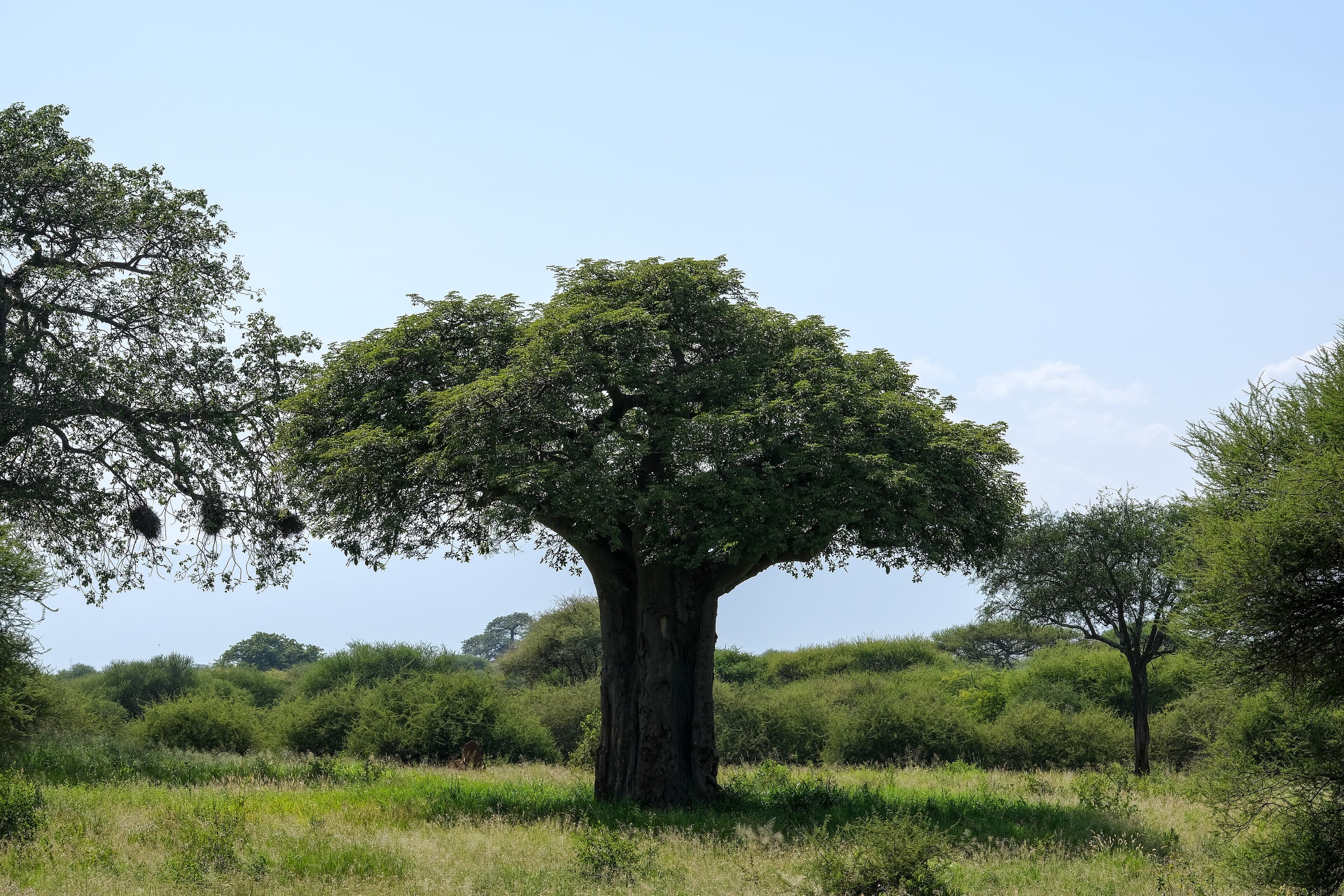
The baobabs (Adansonia digitata) are the visual signature of Tarangire. The park shelters one of East Africa's most beautiful concentrations, with giant specimens reaching 30 metres in diameter at the base and several hundreds or even a thousand years old. These iconic trees, sometimes called 'upside-down trees', store up to 130,000 litres of water in their spongy trunk.
The wildlife of Tarangire is extremely rich. Beyond elephants (estimated population of 2,500, one of the most densely distributed in the world), the park shelters: lions (estimated population of 200, remarkable behaviour: Tarangire lions have learned to climb trees), leopards (present but discreet), cheetahs (rare), wild dogs (very rare), hyenas (spotted and striped), giraffes (Maasai), zebras, blue wildebeest, oryx (remarkable species, rare in Serengeti), thicket antelopes (gerenuk, kudu). The avifauna is exceptional: over 550 species recorded.
What we love
- ✅Largest elephant population in the north (approx. 2,500 individuals), spectacular concentration in dry season
- ✅Iconic landscape of giant baobabs (some millennial) — one of East Africa's most beautiful concentrations
- ✅Less frequented than the neighbouring Serengeti and Ngorongoro — calmer, more intimate safari experience
- ✅Exceptional avifauna: over 550 bird species, one of East Africa's richest
- ✅Hot-air balloon less expensive than Serengeti (450-550 USD vs 550-650 USD)
What to know
- ❌Animals dispersed in green season (November-March): elephants leave the river to migrate to the Masai Steppe
- ❌No rhinos (local extinction in 1970s-80s), Big Five impossible to complete on Tarangire alone
- ❌Intense dry heat in September-October (up to 32 °C midday)
- ❌Significant distance from Arusha (2h30-3h road) for a single night
- ❌Often included in Northern Circuit packages as a brief stop (1 night) — lack of time to fully enjoy
Situation
Où se situe Tarangire ?
Ouvrir la carte en grand sur OpenStreetMap →Frequently asked questions
How many days to spend at Tarangire?+
When to see the maximum elephants?+
What is the best lodge?+
Is the Tarangire balloon flight worth its price?+
Can you do bush walks at Tarangire?+
Are the Big Five at Tarangire?+
Is Tarangire suitable for families with children?+
Our verdict
Tarangire National Park is one of the most beautiful stops on the Tanzanian Northern Circuit, and probably the most underestimated. The combination of its largest elephant population in the north (2,500 individuals concentrated on the river in dry season), its millennial giant baobabs and its calmer atmosphere than the neighbouring Serengeti makes for a unique safari experience. Our advice: imperatively plan 2 nights at Tarangire rather than just one (short packages often neglect this park, it's a mistake). Favour June to October for the prime season of animal concentration around the river. Choose a lodge with panoramic river view (Tarangire Safari Lodge, Maramboi Tented Camp) to enjoy iconic sunsets over baobabs. And don't miss the sunrise hot-air balloon — cheaper than Serengeti and just as spectacular over the baobab landscapes and elephant herds.
Nearby

"Janvier : saison verte, paysages verdoyants, mais animaux dispersés (les éléphants migrent dans le Masai Steppe). Excellent pour les oiseaux."
Expert on Tarangire · 1 contributions
 Africa & Americas Desk — Mowando·Editor