parc national
Ngorongoro
The 19 km diameter crater, a closed ecosystem sheltering 25,000 large mammals in a unique volcanic amphitheatre — Big Five almost guaranteed in a single day.
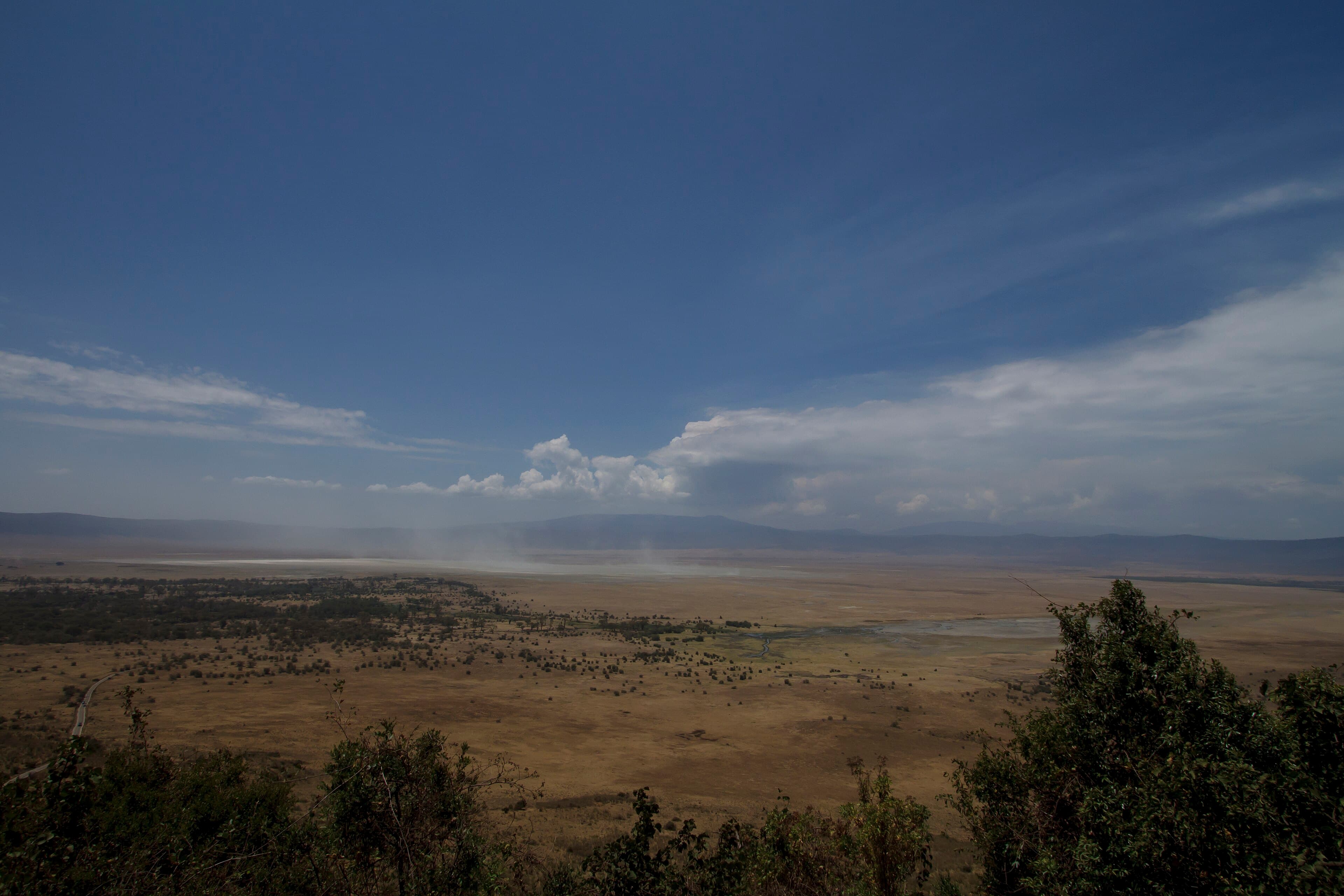
The Ngorongoro Crater is one of the planet's geological and ecological wonders. It's actually a caldera — the spectacular collapse of an ancient volcano that must have peaked at over 5,000 metres before its explosion around 2.5 million years ago. The result is a circular amphitheatre 19 kilometres in diameter, 600 metres deep, whose flat floor (260 km²) forms an almost closed ecosystem of biological richness unmatched in the world. It's the largest intact unflooded caldera on the planet and one of Africa's most iconic sites.
The Ngorongoro Conservation Area (NCA, 8,292 km² in total) encompassing the crater has been UNESCO World Heritage-listed since 1979 — a dual natural and cultural inscription, in recognition of both its biodiversity and the remarkable coexistence between wildlife and Maasai populations practising traditional pastoralism in the buffer zone around the crater. This particularity — human pastoralists living alongside a wildlife sanctuary — makes Ngorongoro a model of participatory conservation.
The animal density of the crater is among the highest in the world. The resident population on the 260 km² floor is estimated at around 25,000 large mammals — a concentration unmatched on the continent. The closed geological structure (the crater walls are almost impassable for most large species) explains this density: animals born in the crater remain there their whole lives. Near-guaranteed observations: lions (estimated 50-70 individuals, with notable inbreeding due to isolation), elephants (but essentially old solitary males, females finding the crater floor too poor in soft vegetation), buffalo (700-1,000 individuals), hippos (at Hippo Pool, one of the most impressive concentrations in Africa), spotted hyenas (300-400 individuals, one of the world's largest populations), Thomson's and Grant's gazelles, zebras, wildebeest (resident, not migratory), and — unique particularity — one of the last stable populations of black rhinos in East Africa (estimate: 25-35 individuals in 2024, slowly recovering thanks to conservation efforts).
Ngorongoro is thus one of the only places in the world where it's possible to observe the Big Five in a single day.
What we love
- ✅Highest megafauna density in the world: 25,000 large mammals on 260 km² in the caldera
- ✅Big Five in a single day: one of the only places in the world guaranteeing the five great mammals in one drive
- ✅UNESCO site since 1979 (natural and cultural): biodiversity and coexistence with the Maasai
- ✅Unique geological spectacle: 19 km diameter, 600 m deep — the world's largest unflooded caldera
- ✅Accessible year-round — the crater remains workable even in rainy season
What to know
- ❌Very high affluence: 600,000+ visitors/year, sometimes 50-80 vehicles at the crater floor in high season
- ❌Very high cost: 70.80 USD/day entry + 295 USD crater fee per vehicle + 18% VAT
- ❌Strict timing: 8h maximum per vehicle in the crater, opening 6:30 am, closing 6 pm
- ❌Rim lodges among the most expensive in the Northern Circuit (500-2,500 USD/night/person)
- ❌Cool rim temperatures (10-22 °C), fleece and windbreaker essential
Situation
Où se situe Ngorongoro ?
Ouvrir la carte en grand sur OpenStreetMap →Frequently asked questions
How long to spend at Ngorongoro?+
How to avoid the crowd in the crater?+
How much does a crater descent cost?+
Do you really see the Big Five in the crater?+
What are the best lodges on the rim?+
Is Ngorongoro suitable for children?+
Can you hike around Ngorongoro?+
Our verdict
The Ngorongoro Crater is one of Africa's most extraordinary natural sites and a must-stop on the Tanzanian Northern Circuit. Its globally unique animal density (25,000 mammals on 260 km²), the possibility of observing the Big Five in a single day, and its exceptional geological setting (19 km diameter caldera, 600 m deep) make it an unforgettable experience despite the crowds and cost. Our advice: imperatively spend 2 nights on the rim rather than just one (which allows a full day in the crater floor rather than a rushed morning), descend at opening (6:30 am) to avoid groups, and combine with the Serengeti and Tarangire for the complete Northern Circuit. Ngorongoro is also one of the only places where black rhino observation is near-guaranteed — another reason to make it a priority.
Nearby

"Janvier : conditions globalement sèches, cratère animé, lumière douce. Combinaison naturelle avec la saison des naissances dans le sud du Serengeti (Ndutu)."
Expert on Ngorongoro · 1 contributions
 Africa & Americas Desk — Mowando·Editor