ville
Colombo
A tropical capital in full transformation, where glass towers rise next to colonial bungalows and century-old Buddhist temples.
Colombo is not a city most travellers visit for its own sake: it's Sri Lanka's gateway, a near-mandatory first stop before heading inland to the cultural triangle, the tea hills or the south coast. But reducing it to an airport hotel and a transit night would be a mistake. The island's commercial capital — political power having long since moved out to Sri Jayawardenepura Kotte, its immediate suburb — packs into a handful of districts a fascinating cross-section of Sri Lankan history: sixteenth-century Portuguese forts, Dutch warehouses in Pettah, British civic buildings in Fort, and the contemporary towers of Port City reshaping the skyline since 2020.
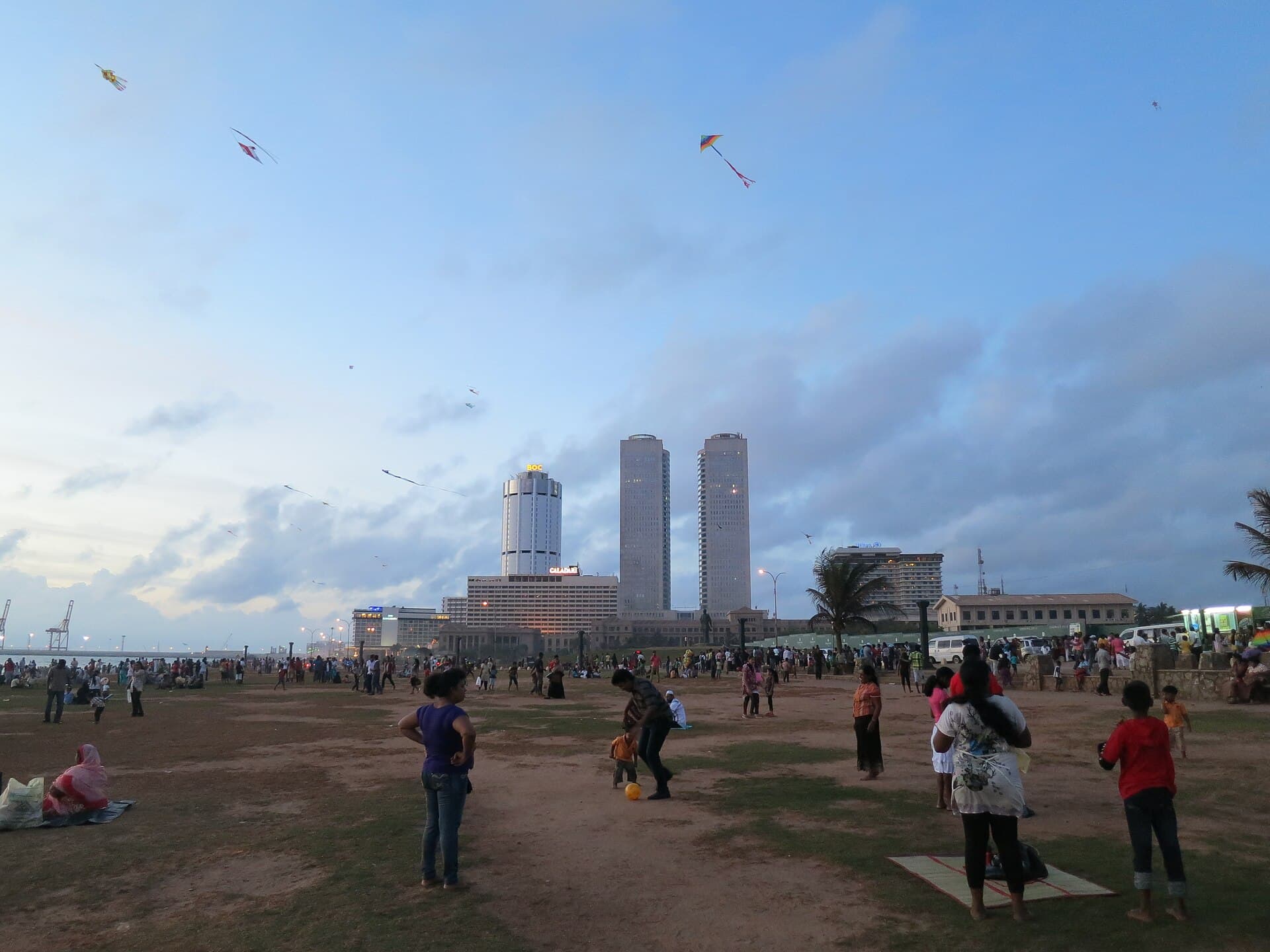
A well-orchestrated day in Colombo starts at Galle Face Green, the great seafront esplanade where Sinhalese families picnic at sunset, children fly kites in the trade winds, and street vendors hawk Sri Lanka's beloved kottu roti. It moves through the Pettah district — a labyrinthine market of specialised lanes (gold, electronics, textiles, fruit) — before pausing at the Gangaramaya Temple, an unlikely Buddhist jewel blending Thai, Indian and Chinese influences. Afternoons belong to the National Museum for context on the island's history, then a colonial afternoon tea on the veranda of the Galle Face Hotel (1864). Evenings unfold in Cinnamon Gardens and Colombo 7, where Sri Lanka's gastronomic revival is in full swing: contemporary Sinhalese restaurants, rooftop bars, and standout addresses like Ministry of Crab for the giant lagoon crabs that have become a national obsession. Two nights are plenty to take the measure of the city before heading into the country — but they make an excellent overture to Sri Lanka.
What we love
- ✅Natural gateway to Sri Lanka, with the international airport 35 km away
- ✅Concentrated colonial history: Portuguese Fort, Dutch Pettah, British Galle Face
- ✅Outstanding food scene: street food, refined Sinhalese cuisine, rooftop bars
- ✅Lively seafront (Galle Face Green) and spectacular Indian Ocean sunsets
- ✅Exceptional value on 4-5 star accommodation by Asian capital standards
What to know
- ❌Chaotic traffic and severe rush-hour congestion
- ❌High air and noise pollution in the centre
- ❌Few must-see sights: 1-2 days is plenty
- ❌Urban beaches unsuitable for swimming — head to Bentota or Mirissa
Situation
Où se situe Colombo ?
Ouvrir la carte en grand sur OpenStreetMap →Frequently asked questions
How many days should I plan in Colombo?+
How do I get from Bandaranaike airport (CMB) to central Colombo?+
Where should I stay in Colombo?+
When is the best time to visit Colombo?+
Is Colombo safe?+
Is the food scene worth the detour?+
How do I get around Colombo?+
Our verdict
Colombo isn't a destination in itself, it's a way-station — but one that deserves a day or two rather than just an airport hotel overnight. The capital offers a useful introduction to Sri Lankan history and cuisine, and its hotel value is among the best in Asia for travellers who like comfort. Our advice: one day on arrival to shake off jet lag, and one last day before the return flight to load up on souvenirs at Pettah market and a farewell dinner at Ministry of Crab.
Nearby

"Pic touristique haute saison, mer calme sud."
Expert on Colombo · 1 contributions
 South-East Asia Desk — Mowando·Editor