site naturel
Piton Fournaise
One of the world's most active volcanoes — an eruption every nine months on average — and a lunar landscape of the Plaine des Sables worthy of Mars, accessible by car up to Pas de Bellecombe at 2,311 m.
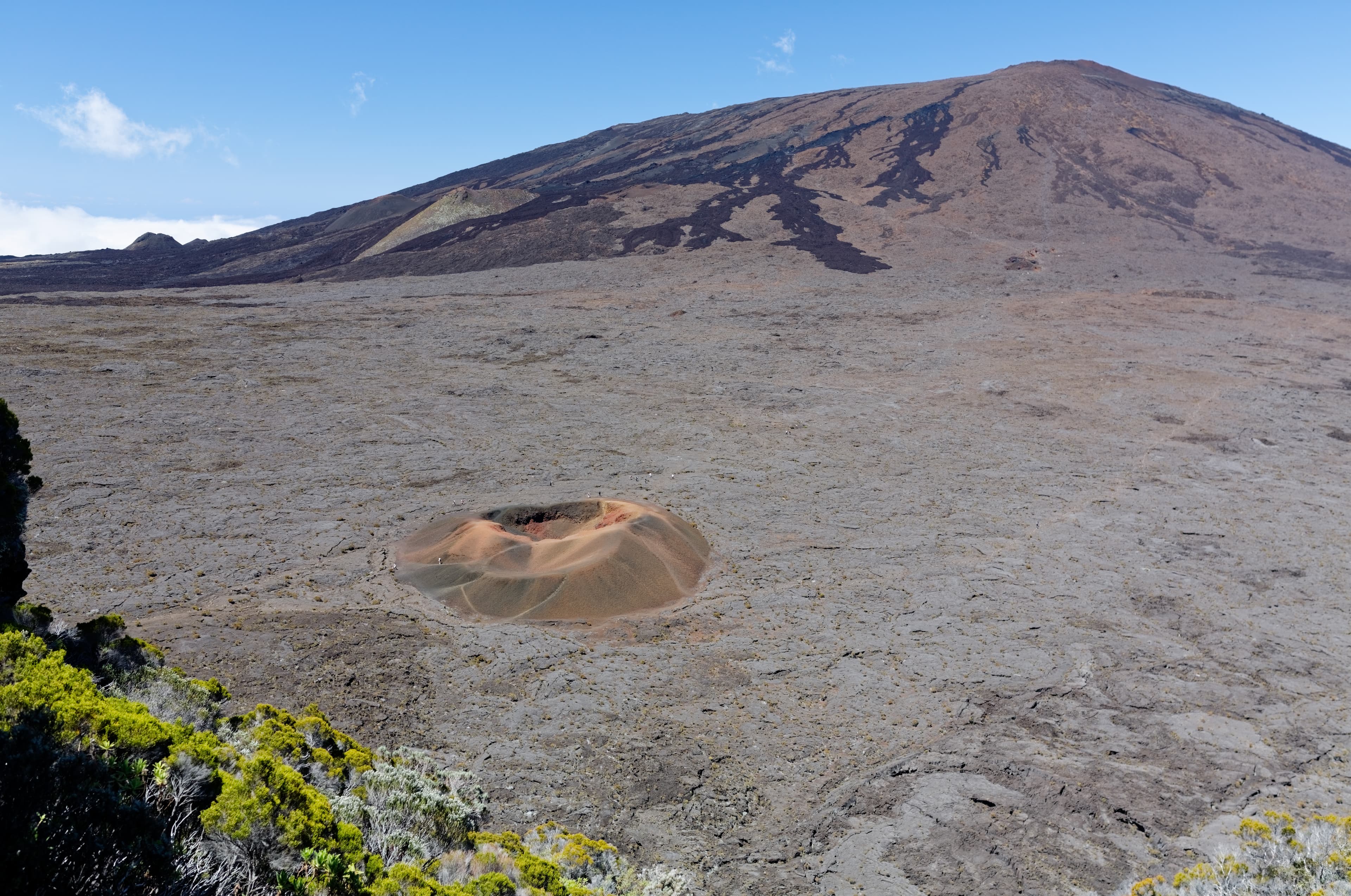
The Piton de la Fournaise (2,632 m) is one of the world's most active volcanoes — an eruption every nine months on average since 1640 (modern historical records). It is a Hawaiian-type shield volcano, fed by a deep hotspot identical to that which built Piton des Neiges (3,070 m, extinct) and which continues to shape Réunion. Its eruptions, generally effusive (fluid lava flows, little explosive), take place in the vast majority of cases inside the Enclos Fouqué — caldera of 8 km diameter open to the east, which effectively channels the flows to the sea without threatening inhabited areas.
Access is via the volcano forest road from Bourg-Murat (Plaine des Cafres, 1,600 m). The road climbs in 24 km to the Pas de Bellecombe (2,311 m), starting point of hikes to the crater. It crosses on the way the Plaine des Sables, vast desert of red and black scoria at 2,360 m altitude — a lunar landscape compared without exaggeration to Martian landscapes, where several science fiction film scenes have been shot.
The classic hike from Pas de Bellecombe is the Dolomieu crater loop: 5-6 hours round trip, 12 km, 600 metres descent then ascent. You descend by a steep switchback trail into the Enclos Fouqué, cross the black scoria field towards the Formica Leo (small volcanic cone shaped like an antlion, hence its name), then climb the Dolomieu crater to walk around it. The proper summit of Piton de la Fournaise consists of two twin craters: the Bory (the oldest) and the Dolomieu, which collapsed in April 2007 over 320 metres deep during a full eruption — a major geological event observed in real time by the Piton de la Fournaise Volcanological Observatory (OVPF).
In case of ongoing eruption, the crater approach trails are closed to the public for safety reasons, but observation belvederes are arranged around the Enclos. The Piton de Bert trail (from Nez de Bœuf, 1h30 round trip) often offers the best views over the Enclos during eruptions. The Maison du Volcan in Bourg-Murat (excellent interpretation museum, €9) is the obligatory stop to understand the geology of the island before the hike.
What we love
- ✅One of the world's most active volcanoes — an eruption every 9 months on average
- ✅Lunar landscape of the Plaine des Sables: desert of red and black scoria at 2,360 m
- ✅Hike to the Dolomieu crater: 5-6h in a volcanic landscape unique in the world
- ✅Car access to Pas de Bellecombe (2,311 m), starting point of the trails
- ✅Possibility to observe an ongoing eruption from dedicated belvederes
What to know
- ❌Trails regularly closed in cyclone season (January-March)
- ❌Almost systematic afternoon fog — very early departure imperative (5-6am)
- ❌Very large attendance in July-August: parking saturated from 7-8am
- ❌Cold wind at the summit, temperatures below 0°C before dawn in austral winter
- ❌Long forest road (1h from Bourg-Murat, 1h45 from Saint-Pierre)
Situation
Où se situe Piton Fournaise ?
Ouvrir la carte en grand sur OpenStreetMap →Frequently asked questions
How to get to Piton de la Fournaise?+
How long does the crater hike take?+
What to do if Piton de la Fournaise is erupting?+
How to know if the trails are open?+
What equipment for the hike?+
Can you fly over Piton de la Fournaise by helicopter?+
What is the best time for the volcano?+
Our verdict
The Piton de la Fournaise is Réunion's signature geological experience. It is one of the world's most active volcanoes, and it is an immense chance to be able to walk there on foot — on the hardened lava flows, through the black scoria field, to the edge of the Dolomieu crater. The landscape of the Plaine des Sables, at 2,360 metres altitude, is so Martian that science fiction film scenes have been shot there. Dedicate a full day to the excursion: very early departure from your accommodation (Plaine des Cafres or south coast), 1h of forest road to Pas de Bellecombe, 5-6h of hike to the Dolomieu crater, descent before fog sets in. Come imperatively between May and November, check the trail status on fournaise.info the day before, and equip yourself warmly.
Nearby


"Été austral chaud-humide, cyclones possibles."
Expert on Piton Fournaise · 1 contributions
 Africa & Americas Desk — Mowando·Editor