ville
Amman
A modern, safe and welcoming capital built on seven hills, where Roman temples, Umayyad palaces and contemporary rooftops sit a few streets apart.
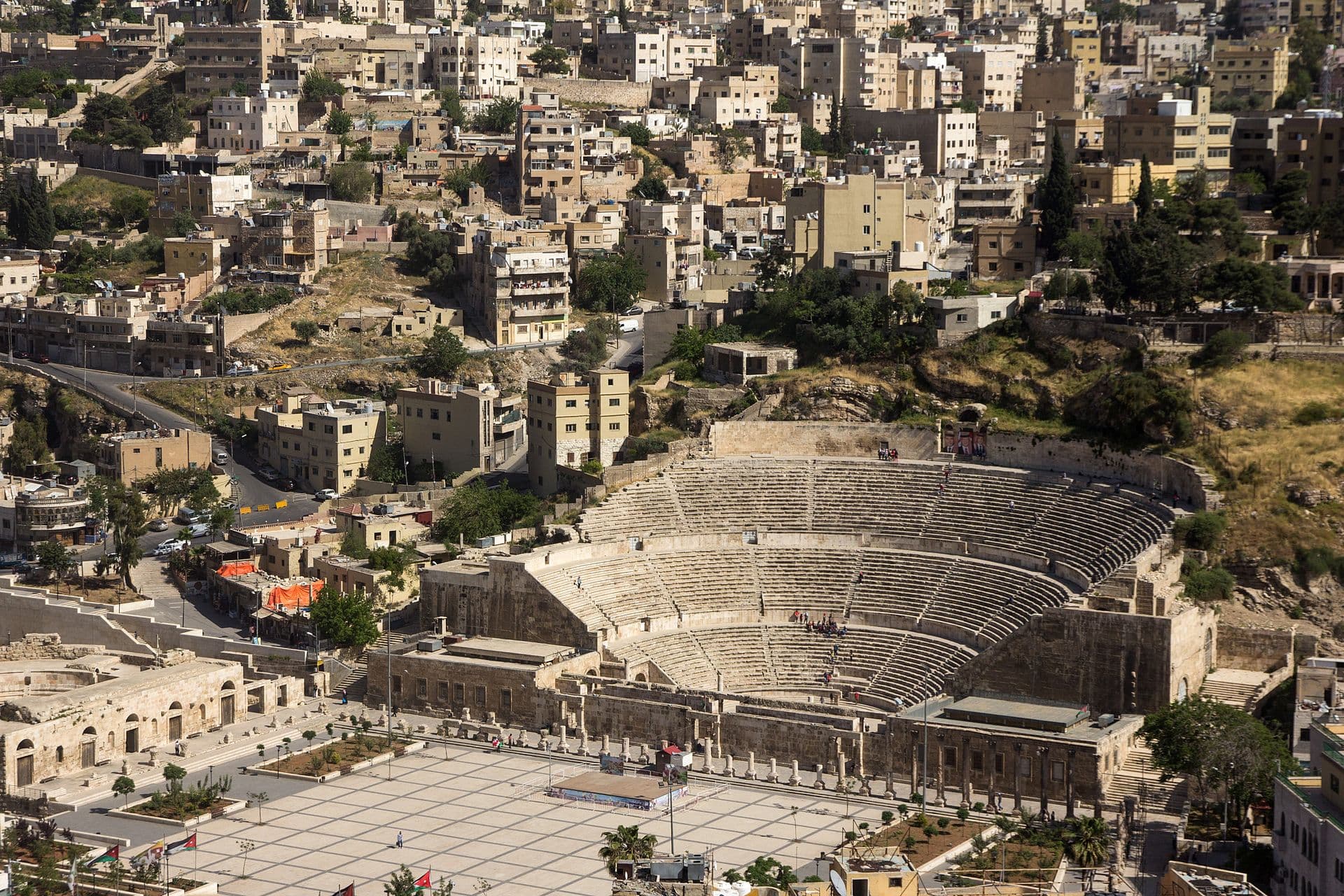
Amman is one of the most surprising capitals in the Middle East. Perched on seven hills like Rome, 1,000 metres above sea level on a desert plateau, it weaves together with rare fluency the legacy of the great civilisations that have ruled it — Ammonites, Romans, Byzantines, Umayyads, Mamluks, Ottomans — and the energy of a contemporary Arab capital that is open, safe and surprisingly cosmopolitan. In a single day's walk, an attentive traveller moves from the Temple of Hercules on the Citadel (Jabal al-Qal'a) to the Roman theatre carved into the downtown cliff face, then climbs to the pedestrian streets of Rainbow Street for a coffee in a 1930s stone house, before heading back down to the Al-Bukhariyya souk to buy spices by the gram.
But Amman is more than an open-air history book. It is also the Arab city where it is probably easiest for a Western traveller to settle for a few days: taxis are everywhere and cheap, English is spoken almost universally, international hotels meet Western standards, and the café and restaurant scene is in full bloom, carried by a creative, well-educated Jordanian youth. The neighbourhoods of Jabal Amman, Jabal Lweibdeh and Abdoun each offer a distinct atmosphere — bohemian and bourgeois for the first two, residential and upmarket for the latter — which contrasts with the popular downtown (Al-Balad) where the traditional souks still beat. Amman is almost always underestimated by travellers who pass through for two nights before Petra: that is a mistake. Four nights are needed to grasp what this capital has built over the past century, and why it remains, in a troubled region, one of the rare Arab cities where modernity speaks peacefully with its thousand-year past.
What we love
- ✅Safe and welcoming capital, English spoken everywhere, ideal for a first Middle East trip
- ✅Unique heritage density: Roman Citadel, ancient theatre, Umayyad palace, all within a few sq km
- ✅Outstanding Jordanian cuisine: mansaf, mezze, kunafa, downtown falafels
- ✅Lively, photogenic neighbourhoods (Rainbow Street, Jabal Lweibdeh) to explore on foot
- ✅Excellent logistical base for Jerash, Madaba, the Dead Sea and Karak as day trips
What to know
- ❌Very spread out and hilly city, walking quickly tiring between the hills
- ❌Limited public transport: taxi or Careem essential, chronic peak-hour traffic
- ❌Noise and air pollution in the centre (Al-Balad, 8th Circle)
- ❌Glaring lack of green spaces and pedestrian areas outside Rainbow Street
Situation
Où se situe Amman ?
Ouvrir la carte en grand sur OpenStreetMap →Frequently asked questions
How many days should I plan for Amman?+
Is Amman safe for travellers?+
Which neighbourhood should I stay in?+
How do I get around Amman?+
What must I taste in Amman?+
When is the best time to visit Amman?+
Do I need a visa to enter Jordan?+
What are the customary tips in Amman?+
Our verdict
Amman deserves far more than the one-night layover most Jordanian itineraries grant it. A layered, understated capital, it reveals its richness to those who take time to walk its hills, sit on the Rainbow Street terraces and wander the Al-Bukhariyya souk. Our advice: give it at least two full nights (three if you want to add Jerash, Madaba or the Dead Sea as a day trip), base yourself in Jabal Lweibdeh or Jabal Amman to feel the city like a local, and treat yourself to a mansaf in a good restaurant (Sufra, Hashem, Tawaheen Al Hawa) to understand why Jordan is one of the most underrated culinary terroirs in the Levant.
Nearby

"Frais (10°C), tarifs bas, Wadi Rum glacial."
Expert on Amman · 1 contributions
 Mediterranean Desk — Mowando·Editor