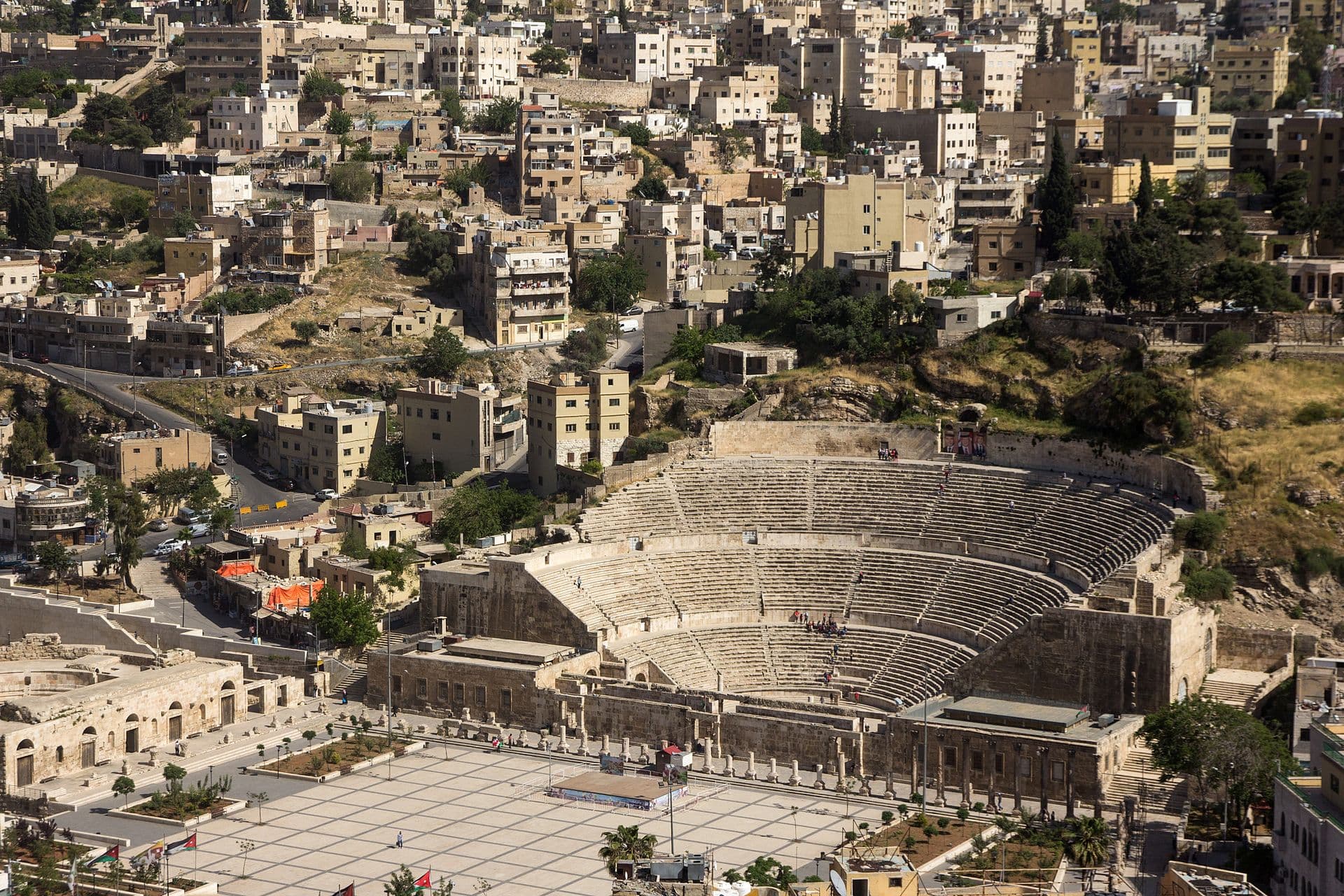
A visit to Amman organises around three main poles which complement each other perfectly across two full days.
The ancient pole is the absolute priority. Begin with the Citadel (Jabal al-Qal'a), perched on the highest of Amman's seven hills (850 m). The site brings together in a few hectares nine thousand years of human occupation: Bronze Age remains, the Roman Temple of Hercules (2nd century), restored Umayyad palace with its reconstructed dome, Byzantine cistern and the small Jordan Archaeological Museum (the Dead Sea Scrolls are kept here). The 360° panorama over the city and its Roman theatre from the southern promontory is one of the great moments of any Jordanian stay. Plan 2 to 3 hours. Then descend on foot (or by taxi to avoid the climb) to the Roman theatre carved into the cliff of al-Jabal al-Joufeh: 6,000 seats, 2nd century AD, still used for festivals. Next door, the small Museum of Popular Traditions and the Roman Odeon deserve another hour.
The downtown pole (Al-Balad) is the popular, commercial city. Follow King Faisal Street from the Roman theatre to reach the King Hussein Mosque (the oldest in the city, rebuilt in 1924), then plunge into the Al-Bukhariyya souks: spices by the gram, dried fruits, cardamom coffee roasted in front of you, oriental perfumes, traditional ironwork. Pause at Hashem (a century-old institution) for the best falafels and hummus in the Levant, eaten standing at the counter, and finish with a kunafa nabulsi at Habibah 100 metres away.
The modern pole is concentrated in the neighbourhoods of Jabal Amman and Jabal Lweibdeh. Rainbow Street (Jabal Amman 1st Circle) is the epicentre of Jordanian social life: 1920s-30s stone houses reconverted into cafés (Wild Jordan Center, Jafra, Books@Cafe), ethical craft shops (Jordan River Foundation), gastronomic restaurants (Sufra for an authentic mansaf). The Friday Souk Jara market (June-August, Saturdays) is a good chance to meet the local craft scene. Jabal Lweibdeh, neighbouring and more bohemian, hosts the National Gallery of Fine Arts and several independent galleries.
In addition, the Royal Automobile Museum (King Hussein's private collection, 70 historic vehicles) and the King Abdullah I Mosque (the only place of worship in the city open to non-Muslims, with a magnificent 35 m blue dome) round out a three-day programme without exhausting it.
Read also
- Jerash, the Pompeii of the Middle East — 50 km north of Amman: one of the best preserved Roman cities in the world.
- Madaba, the city of mosaics — 30 km south-west: the world's oldest surviving map of Jerusalem, in mosaic.
- Jordan — Complete country guide: entry rules, budget, when to visit, regions.
- Petra, 7th Wonder of the Modern World — 240 km south: the Nabataean city carved into the rose cliffs.