ville
Varanasi
One of the world's oldest continuously inhabited cities (5,000 years per Hindu tradition, 3,000 years archaeologically attested), Hinduism's most sacred city — 88 ghats, where every Hindu dreams of dying to reach moksha.
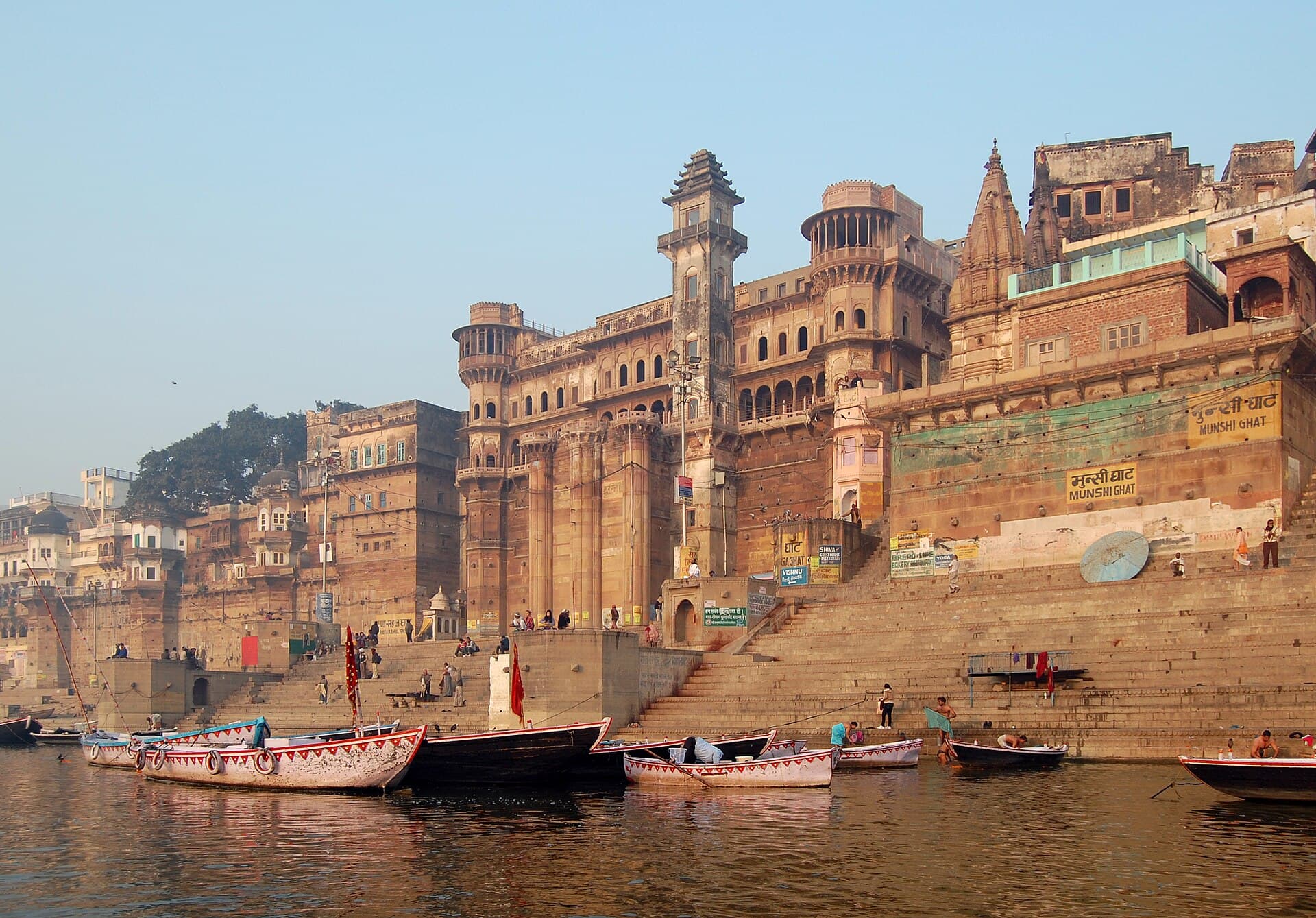
Varanasi (other names: Benares, Kashi, 1.5 million inhabitants) is Hinduism's most sacred city and one of the world's oldest continuously inhabited cities. According to Hindu tradition, it was founded by Shiva himself 5,000 years ago — archaeologically, continuous occupation since at least 3,000 years is attested. It is India's spiritual capital, where every Hindu dreams of dying and being cremated to reach moksha.
Geographically, Varanasi stretches 4 km along the concave western bank of the Ganges — Hinduism's most important sacred river (the convex eastern bank is traditionally considered sterile and cursed, without temples). This crescent configuration opens an exceptional panoramic perspective: the entire amphitheatre of 88 ghats extends 4 km, dominated by Maharaja palaces, temples, ashrams, havelis.
The sacred ghats. The 5 ghats every pious Hindu must visit in ritual order (panchatirthi): Assi Ghat (southern point, starting point of boat rides), Dashashwamedh Ghat (central, busiest, evening Aarti site), Manikarnika Ghat (main cremation ghat, pyres burn 24/7 for millennia — 200-300 cremations/day, 80,000/year), Panchganga Ghat, Adi Keshava Ghat.
Above the ghats, the old quarter Vishwanath Galli stretches in inextricable labyrinth of narrow alleys, more than 2,000 temples (including the sacred Kashi Vishwanath Temple).
The signature experiences: sunrise boat ride (5:30-7:30 am), evening Ganga Aarti ceremony at Dashashwamedh (6:30-7:30 pm) — 7 synchronised priests perform 45 min elaborate ceremony. Cremations at Manikarnika: imperative ethical approach.
Sarnath (10 km north, 30 min taxi) — one of the 4 great Buddhist sites worldwide, where Buddha gave his first sermon around 528 BCE.
What we love
- ✅Most intense Indian spiritual experience — Hindu sacred city where every Hindu dreams of dying, immersion in living Hinduism
- ✅88 ghats over 4 km of Ganges — spectacular evening Aarti ceremonies, photogenic sunrise ghats
- ✅Buddhist Sarnath 10 km away: one of the 4 great Buddhist sites worldwide, Buddha's first sermon 528 BCE, Ashoka Lion Capital
- ✅Over 2,000 temples concentrated in old quarter, 5,000-year heritage (Kashi Vishwanath, Nepalese Lalita Ghat temple, etc.)
- ✅Exceptional ghat-front hotels: Brijrama Palace, Suryauday Haveli, Guleria Kothi — converted palaces with Ganges view from each room
What to know
- ❌Extreme cultural shock: open-air cremations can deeply disturb, not for everyone
- ❌Ganges pollution: extremely polluted water (industrial waste, sewage, ashes, human remains), don't bathe or drink
- ❌Sophisticated tourist scams: fake saints/sadhus, fake Aarti guides, boat overcharges
- ❌Extreme human density in old quarter, permanent crowd in narrow alleys
- ❌No direct international airport: domestic flight from Delhi 1h25 (€60-150) required
Situation
Où se situe Varanasi ?
Ouvrir la carte en grand sur OpenStreetMap →Frequently asked questions
How many nights for Varanasi?+
How to reach Varanasi from Delhi?+
Should I attend cremations at Manikarnika Ghat?+
Is Varanasi safe for solo women?+
Is Sarnath really worth the detour?+
Our verdict
Varanasi is India's most intense and marking experience — the one you never forget. Our advice: never reduce Varanasi to 1 night. At least 2 nights, ideally 3-4 nights to absorb the city's intensity without being overwhelmed. Optimal itinerary: D1 midday arrival, ghats walk, evening Aarti at Dashashwamedh; D2 sunrise boat ride (5:30-7:30 am — the absolute experience), ghat-front breakfast, nap, afternoon Sarnath excursion, evening Aarti; D3 old quarter (alleys, temples, street food), sunset boat. Recommended ghat-front hotels: Brijrama Palace (Darbhanga Ghat, palace converted, exceptional Ganges view, €250-450/night, absolute experience), Suryauday Haveli (Shivala Ghat, charming boutique, €150-250/night), Guleria Kothi (Munshi Ghat, 1900 palace, €200-350/night). Upper city comfort hotel: Taj Ganges (5-star, €200-350/night, 3 km from ghats). Period: November-March (but avoid December-January misty mornings). Bring anti-diarrhoeal medicines, water exclusively in sealed bottles, mask for crowded alleys, mosquito repellent.
Nearby

"Janvier : haute saison, brume matinale fréquente, fraîcheur agréable l'après-midi."
Expert on Varanasi · 1 contributions
 South-East Asia Desk — Mowando·Editor