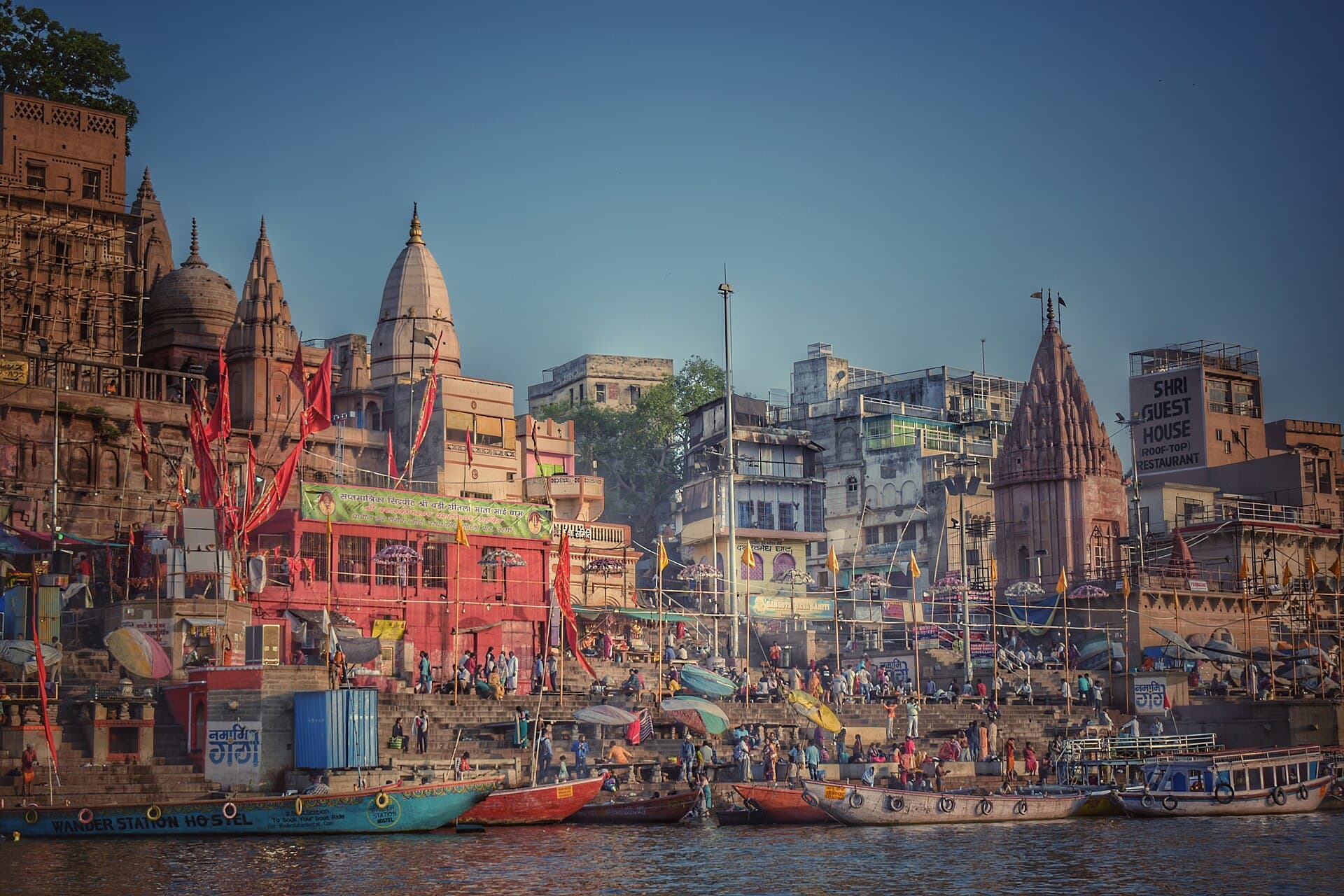
The Benares & Uttar Pradesh region covers eastern Uttar Pradesh (India's most populous state: 240 million inhabitants), crossed by the Ganges — Hinduism's most important sacred river. Here, on the banks of the Ganges, lies Varanasi — Hinduism's most sacred city, considered one of the world's oldest continuously inhabited cities (5,000 years according to Hindu tradition, 3,000 years archaeologically attested), India's spiritual capital, where every Hindu dreams of dying and being cremated to reach moksha (liberation from the reincarnation cycle).
Varanasi (1.5 million inhabitants) is not a tourist destination in the classic sense — it's an immersive dive into living Hinduism, the life-and-death cycle exposed in the open. The city stretches 4 km along the concave western bank of the Ganges (the sacred bank), with its 88 ghats (stairs descending to the river) forming a spectacular crescent succession. Above the ghats, the old quarter with labyrinthine alleys preserves over 2,000 temples.
10 km north of Varanasi, Sarnath adds the Buddhist dimension — here the Buddha gave his first sermon around 528 BCE, making Sarnath one of the 4 most sacred Buddhist sites worldwide.
Our editorial angle: Varanasi isn't for everyone — it's India's most intense experience, the one that can transform a traveller or definitively discourage them. For those emotionally ready, it's one of humanity's most marking places. For those who aren't, it's an ordeal.
Read also
- Varanasi (Benares) — the sacred city — Ganges ghats, Aarti ceremony, cremations at Manikarnika, India's most intense experience.
- India — complete country guide — Everything to know: mandatory e-Visa, currency, regions, best time to visit.
- Delhi & Rajasthan — Golden Triangle and Maharaja palaces: combine with Varanasi for a complete northern trip.
- Kerala & South — The gentle alternative: backwaters, plantations, beaches — perfect antithesis to Varanasi.