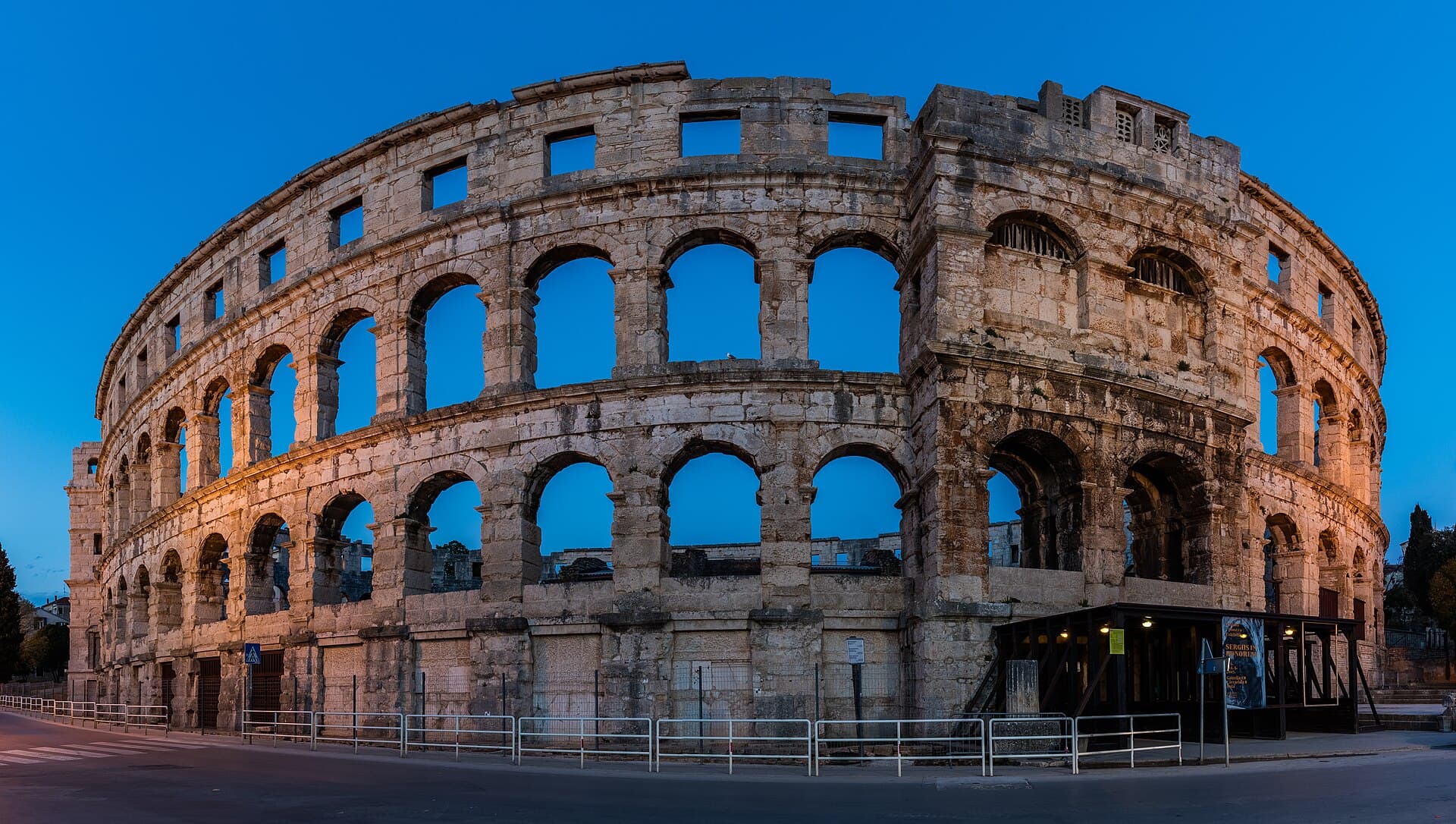
Pula reveals itself in three poles: Roman heritage (amphitheatre, Forum, monuments), Austro-Hungarian and naval heritage (Venetian fortress, military port), and the surroundings (Brijuni, Cape Kamenjak, beaches).
The Roman amphitheatre (Arena) is the headline attraction. Built between 27 BC and AD 68, 132 metres long, 105 wide, 32 high — capacity 23,000 spectators. Four corner towers (the internal staircases allowed for rapid evacuation). Interior visit: access to the perimeter, the preserved tiers (the best blocks were removed at various periods to build other buildings, including St Anthony of Padua), and the basements where amphorae and replicas of ancient objects are displayed. Allow 1-2 hours. Entry: €10/adult. For an unforgettable experience, attend a summer concert in the arena: Pula Film Festival in mid-July, musical programme June-September (Sting, Bocelli, Jamiroquai in recent years).
The Roman Forum and Temple of Augustus. The Forum is still Pula's main square, 2,000 years after its construction — a rare situation in Europe (only a handful of Roman cities preserve this continuity, like Lucca in Italy). At the centre, the Temple of Augustus (2 BC), a small Corinthian temple perfectly preserved. Turned into a church in the Middle Ages, then a grain store, then partially destroyed by an Allied bombing in 1944, it was rebuilt with the original stones in 1947 and restored as a Roman temple. It houses a small museum of Roman antiquities. Beside it, the Communal Palace (18th century, town hall) incorporates into its façade the vestiges of the twin temple of Augustus, dedicated to the goddess Diana.
The Arch of the Sergii. A family triumphal arch — meaning erected not by an emperor but by an aristocratic family to celebrate its own glories — built in 29 BC by the wealthy Sergii family to celebrate their part in the Battle of Actium alongside Octavian (future Augustus). One of the oldest triumphal arches preserved in the world. It marks the eastern entrance to the Roman city.
The urban gates. The Hercules Gate (Herkulova vrata, 1st century BC) is one of the city's oldest Roman monuments — a simple single-arched gate adorned with a representation of Hercules. The Twin Gate (Dvojna vrata, 2nd century AD) is a monumental double gate that marked the city's northern entrance. Both are freely accessible.
The cathedral and Venetian fortress. The Cathedral of the Assumption (Katedrala Uznesenja Blažene Djevice Marije) dates back to the 5th century but has been rebuilt several times. The Venetian fortress (Kaštel) — a 17th-century stone star — crowns Pula's central hill and houses the Istria History Museum (collections on the city's history from antiquity). From the terrace, an exceptional panoramic view over the amphitheatre, the port and the bay.
The Austro-Hungarian heritage. The Naval History Museum and the dry U-Boat U-9 submarine bear witness to the past as an imperial naval base. The Our Lady of the Sea Church (Russian Orthodox, 1888) attests to the multicultural presence of the imperial port.
The surroundings. Brijuni National Park (30 minutes by boat from Fažana, north of Pula): 14 islands, former summer residence of Tito, Roman remains, exotic zoo, Austrian golf course. Day trip: €35-45 per person. Cape Kamenjak (natural park 15 km south): 30 km of wild coastline with crystal coves, spectacular cliffs, ideal for snorkelling and kayaking. The medieval town of Vodnjan (15 km north): Italianate medieval centre, famous "living mummies" (Sant'Agneza, preserved without embalming since the 14th century), award-winning Chiavalon olive oil.
Read also
- Istria: Truffles, Vines and Hilltop Villages — Pula's amphitheatre, Venetian Rovinj and the truffle towns of Motovun and Grožnjan.
- Croatia — Complete country guide: entry rules, budget, when to visit, regions.
- Rovinj, the Venetian pearl — 35 minutes north of Pula: Old Town on a peninsula, St Euphemia's basilica, Italian-Croatian atmosphere.
- Zagreb, Austro-Hungarian capital — 3h30 east: cathedral, Dolac market, Europe's award-winning Christmas market.