ville
Rovinj
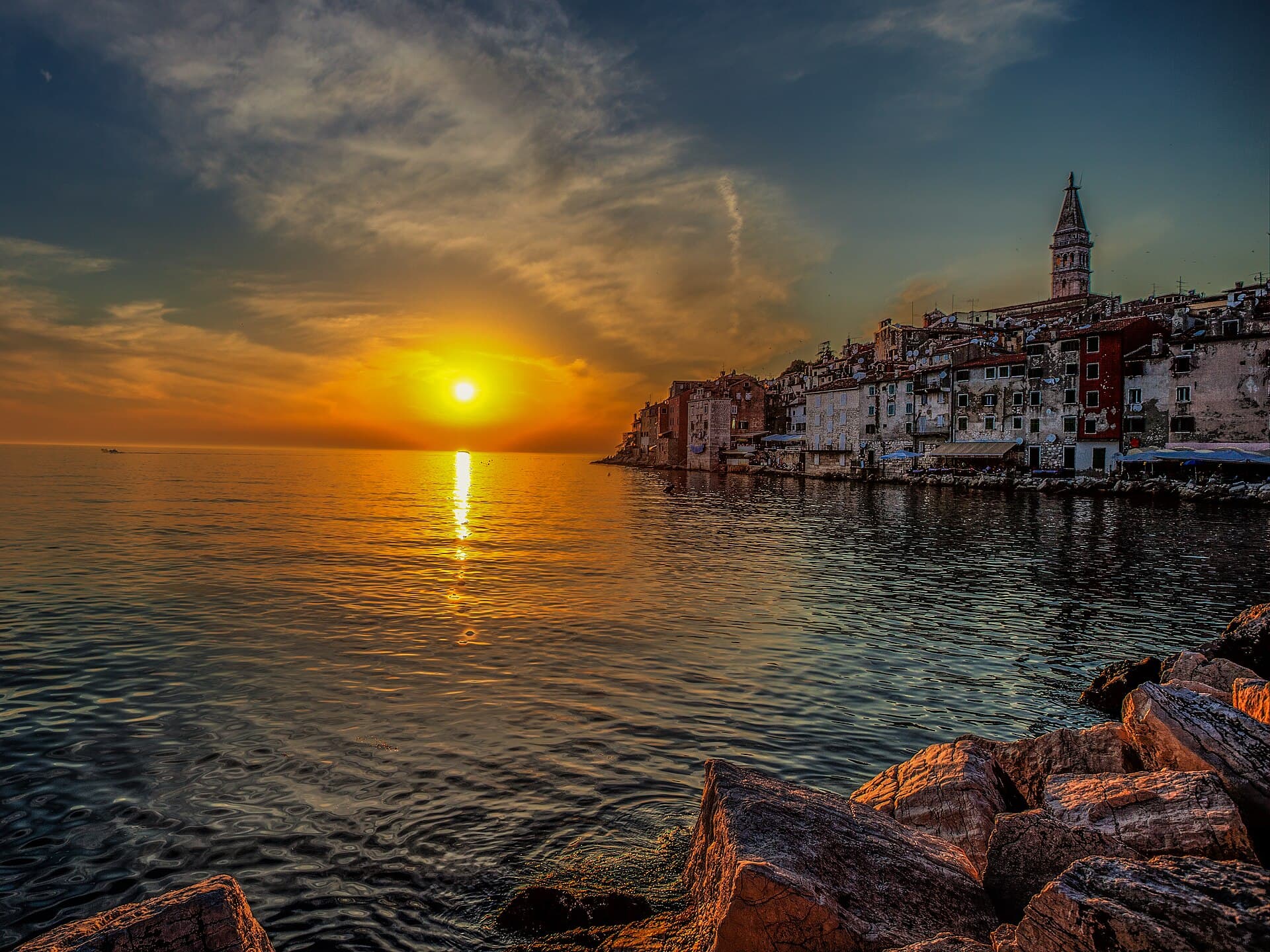
A former island town joined to the mainland in 1763, crowned by a 57-metre Venetian campanile — Rovinj is one of the loveliest Old Towns on the Adriatic.
Rovinj (Rovigno in Italian — one of the few officially bilingual Croatian towns) is the pearl of Istria and one of the most beautiful Old Towns on the entire Adriatic. On the west coast of the Istrian peninsula, just 90 km south of Trieste (Italy) and 220 km from Venice, it long belonged to the Republic of Venice (1283-1797) — a heritage still perfectly legible in its architecture, food, culture and even its language (the rovignese dialect, a mix of Venetian and Croatian, is endangered but still spoken by a few elders).
The Old Town sits on a former island joined to the mainland in 1763 by filling in the channel — a compact, harmonious silhouette perched on a limestone promontory, crowned by the bell tower of St Euphemia's Basilica (Sveta Eufemija), 57 metres high, topped by a copper weathervane depicting the patron saint — a smaller copy of St Mark's campanile in Venice. The cobbled alleys spiral up to the Baroque basilica (18th century) that houses the sarcophagus of St Euphemia, which miraculously arrived at Rovinj in AD 800 from Constantinople (according to legend, the stone sarcophagus floated all the way to Rovinj). From the top, the panoramic view of the Adriatic Sea and the Rovinj archipelago (Crveni Otok, Sveta Katarina) is one of Croatia's most iconic.
Around Rovinj, the Istrian hinterland holds some of Europe's most charming landscapes — rolling hills planted with olive trees and vineyards, hilltop villages in pale stone (Motovun, Grožnjan, Hum — "the smallest town in the world" with 30 inhabitants), home of the Istrian white truffle (October-December, equivalent quality to Alba in Italy but at half the price). The Lim Fjord (Limski kanal), an 11 km marine canal to the north, is a remarkable natural site (oyster and mussel farming, historic shellfish industry). Five kilometres south, the Punta Corrente forest reserve (Zlatni Rt park) offers 90 hectares of pine forest, hiking trails and swimming in coves.
What we love
- ✅Vieille ville vénitienne d'une beauté exceptionnelle, perchée sur une ancienne île au promontoire calcaire
- ✅Atmosphère bilingue italo-croate unique en Croatie — ambiance et cuisine très italianisantes
- ✅Gastronomie d'exception : truffes blanches d'Istrie, huile d'olive primée, vins de malvasia et teran
- ✅Couchers de soleil mythiques depuis le port et le bar Mediterraneo
- ✅Excellente base pour l'Istrie : Pula (35 min), Motovun, Grožnjan, fjord de Lim
What to know
- ❌Très fréquentée en juillet-août — petite vieille ville (1,5 km²) qui sature rapidement
- ❌Pas d'aéroport propre — accès via Pula (35 min) ou Trieste/Venise pour les vols italiens
- ❌Plages de galets et rochers — peu de sable, surtout dans la réserve Punta Corrente
- ❌Prix en hausse rapide : Rovinj est devenue l'une des destinations les plus chères d'Istrie
Situation
Où se situe Rovinj ?
Ouvrir la carte en grand sur OpenStreetMap →Frequently asked questions
How many days do I need in Rovinj?+
When can I find Istrian white truffles?+
How do I get to Rovinj from London or Zagreb?+
Where to stay in Rovinj?+
Which Istrian villages should I visit from Rovinj?+
Is the Lim Fjord worth the trip?+
Our verdict
Rovinj is arguably Istria's most beautiful Old Town and one of Croatia's most romantic destinations. Its preserved Venetian architecture, its unique bilingual Italian-Croatian atmosphere, its outstanding gastronomy (Istrian white truffles, malvasia wines, PDO olive oil) and the beauty of its hinterland (Motovun, Grožnjan, Lim Fjord) make it an ideal alternative to Dalmatia for those seeking Mediterranean charm without Dubrovnik's crush. Visit in May-June or September, sleep inside the peninsula (apartman €100-150/night) or in a seafront boutique hotel, and give yourself at least one full day for the hilltop villages inland — the complete Istrian experience that separates a touristic visit from real discovery.
Nearby

"Très calme, hôtels fermés sur les îles."
Expert on Rovinj · 1 contributions
 Mediterranean Desk — Mowando·Editor