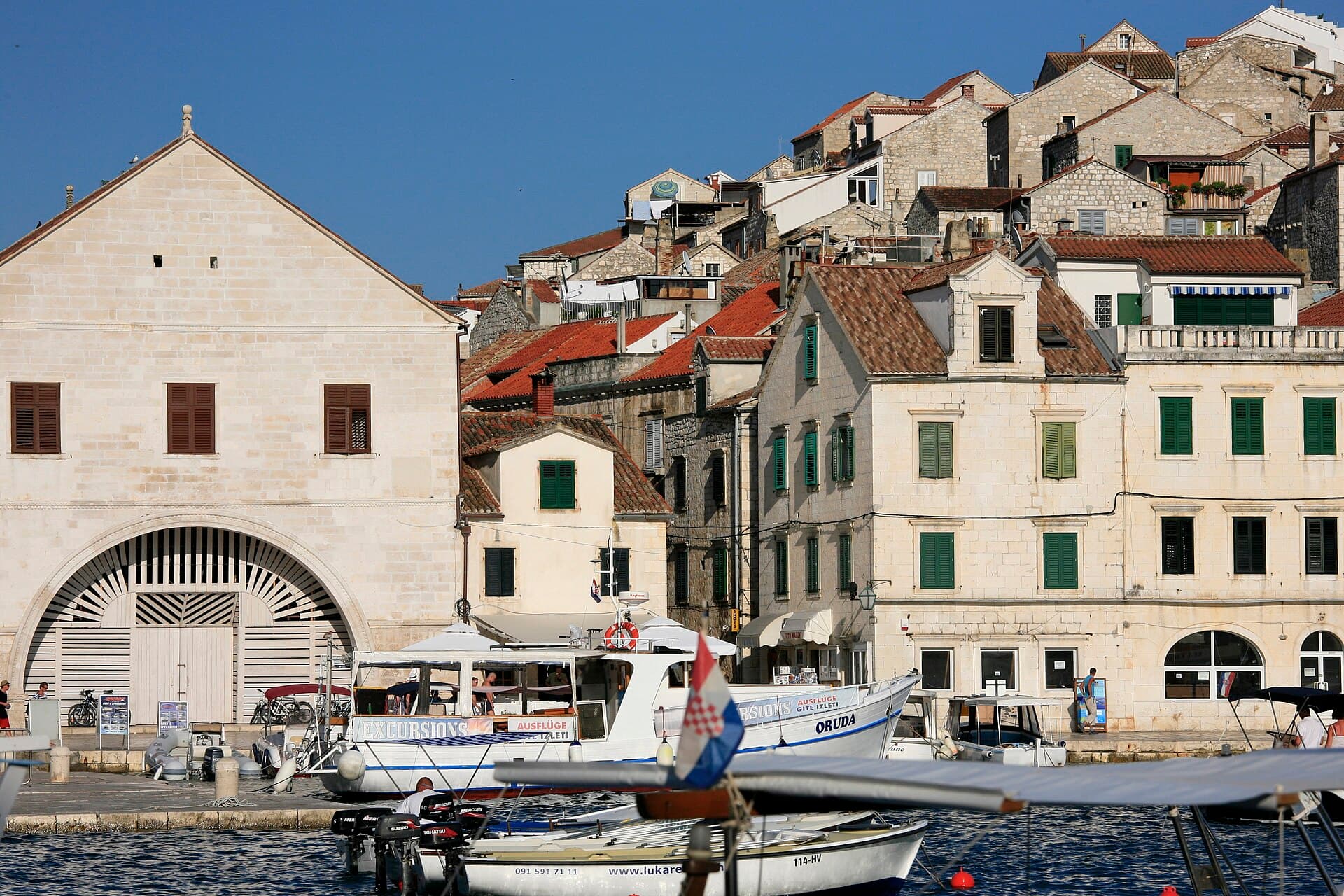
île
Hvar
2,800 hours of sunshine a year, more than any other European island — Hvar packs lavender, ancient vineyards, hidden coves and party nights into 297 km².
Hvar is one of Croatia's most famous islands and one of Europe's sunniest: 2,800 hours of sunshine a year (against 2,700 in Split and 2,500 in Saint-Tropez), a climate so remarkable that some hotels historically offered guests free stays on days without sun. The island, 68 km long but just 4 to 11 km wide, unfolds its limestone cliffs, lavender fields and vineyards between the Dalmatian coast and the open Adriatic. Its popularity exploded in the 2010s, propelling Hvar Town to the rank of Croatia's nightlife epicentre — Yacht Week, electronic festivals, beach clubs — to the point that the municipality had to impose in 2017 fines for public drunkenness, vomiting and nudity in town.
But Hvar is not just its party reputation. Stari Grad Plain, an ancient Greek agricultural parcelling still cultivated, has been UNESCO-listed since 2008 — one of the best-preserved cultural landscapes in the Mediterranean, with dry-stone walls that have outlined identical plots for 2,400 years since they were traced by Greek colonists from Pharos in 384 BC. Stari Grad ("old town") is itself a charming fishing village with Venetian alleys, a peaceful alternative to Hvar Town for travellers seeking calm. To the east, Jelsa is another lovely fishing village.
The island produces some of Croatia's best wines — plavac mali (a red grape, cousin of California zinfandel) on the steep southern slopes (Sveta Nedjelja, Ivan Dolac), white pošip on the plateaux, prošek (traditional sweet wine). The lavender fields are discovered in June (spectacular bloom) — production was once the island's leading economic activity. A hundred metres offshore from Hvar Town, the Pakleni Islands ("islands of hell" — debated etymology, possibly from "pakal", the resin used to waterproof boats) form an archipelago of 21 islets with secret beaches (Palmižana, Stipanska, Jerolim), reached by 15-minute water taxi.
What we love
- ✅Île la plus ensoleillée d'Europe : 2 800 h/an, climat exceptionnellement clément même hors été
- ✅Diversité de paysages : champs de lavande, vignobles, Pakleni Islands, falaises calcaires
- ✅Plaine UNESCO de Stari Grad : parcelles agricoles grecques antiques encore cultivées (depuis 2 400 ans)
- ✅Cuisine de qualité : poisson grillé, vins plavac mali et pošip, huile d'olive primée
- ✅Nightlife énergique pour les amateurs (Carpe Diem, Hula Hula, Pink Champagne, Falko Bar)
What to know
- ❌Très chère en haute saison : prix +50-70 % vs Split, +30 % vs Dubrovnik à équipement équivalent
- ❌Hvar Town saturée et bruyante en juillet-août (Yacht Week mi-juillet, clubs jusqu'à 4h)
- ❌Logistique ferries à organiser à l'avance — voitures réservées plusieurs semaines à l'avance
- ❌Peu de plages de sable — surtout galets et rochers (les Pakleni offrent les plus belles criques)
Situation
Où se situe Hvar ?
Ouvrir la carte en grand sur OpenStreetMap →Frequently asked questions
How many days do I need on Hvar?+
Where to stay on Hvar: Hvar Town, Stari Grad or Jelsa?+
How do I get to Hvar from Split?+
When are the lavender fields in bloom on Hvar?+
Are the Pakleni Islands worth the trip?+
Is Hvar really expensive?+
Our verdict
Hvar is one of the Mediterranean's most beautiful islands — exceptional climate, varied landscapes (lavender, vineyards, limestone), UNESCO heritage (Stari Grad Plain), refined gastronomy. But it's also one of the most polarising: Hvar Town in July-August has become an avowed nightlife epicentre that will either seduce or repel you depending on your profile. Our advice: sleep in Stari Grad or Jelsa (peaceful, authentic, 30-45 minutes from Hvar Town by bus) rather than in Hvar Town. Plan a half-day trip to the Pakleni Islands, a full day in the southern vineyards (Sveta Nedjelja, Ivan Dolac, panoramic road), and use Hvar Town for sunset from the Španjola Fortress. Visit late May-June (lavender bloom) or September (harvest) — and absolutely avoid the 4-day Ultra Yacht Week in mid-July.
Nearby

"Très calme, hôtels fermés sur les îles."
Expert on Hvar · 1 contributions
 Mediterranean Desk — Mowando·Editor