ville
Carcassonne
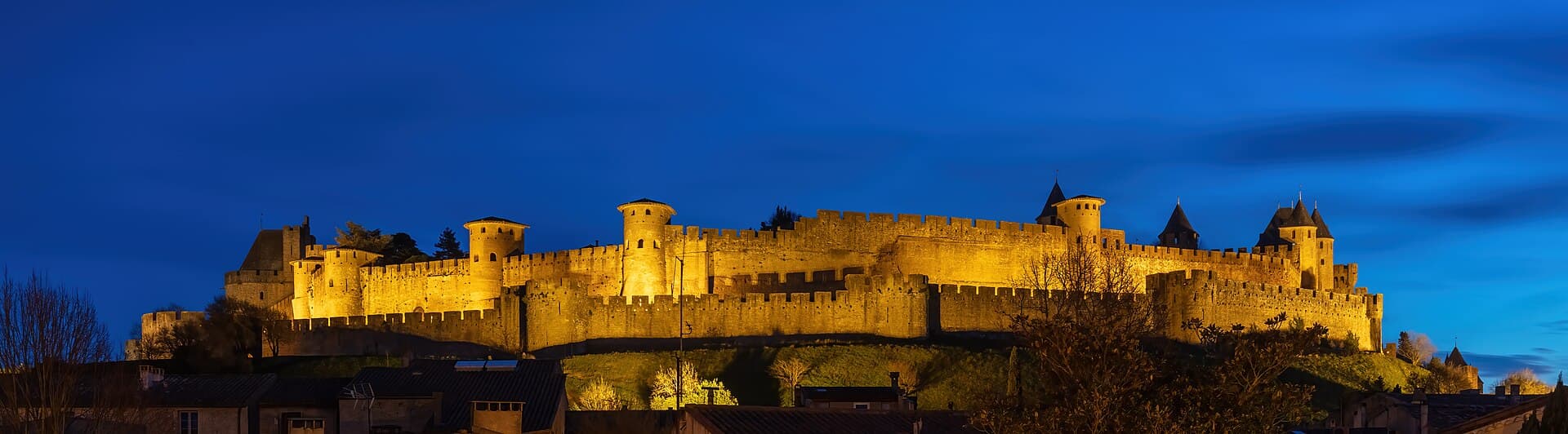
France's 5th tourist site (4 million visitors/year): Carcassonne is the restored medieval dream, the absolute archetype of fortified city.
Carcassonne is one of France's most emblematic cities — Europe's largest fortified medieval city, UNESCO-listed since 1997. With its 3 km of ramparts, 52 towers, double concentric wall (two parallel walls with lices between them), and central Comtal Château, the Cité welcomes 4 million visitors per year — it's France's 5th tourist site.
The Cité's origins go back to Antiquity (Gallic oppidum then Roman city), but it took its current face in the Middle Ages. Cathar fortress in the 13th century, captured by crusaders (Albigensian Crusade), then frontier of the Kingdom of France against Aragon, it lost its strategic importance in the 17th century (Treaty of the Pyrenees) and fell into ruins. It was Eugène Viollet-le-Duc who restored it in the 19th century, sometimes with historical inaccuracies (pointed slate roofs that did not exist in the medieval South) but with a spectacular result that made it an icon.
The Cité comprises two concentric walls separated by the Lices (space between the walls, free access, ideal for panoramic walks). At the centre, the Comtal Château (12th century, paid visit €9.50, 1h30 route with audioguide). The Saint-Nazaire Basilica (11th-14th centuries) offers exceptional Gothic stained-glass. The medieval lanes are commercial but retain their preserved charm. The Bastide Saint-Louis (lower town, created in the 13th century after the Cité's capture) is often forgotten by visitors but deserves a stroll: Place Carnot, markets, gastronomy.
Nearby: Lagrasse Abbey (40 km, one of France's Most Beautiful Villages), Cathar castles (Peyrepertuse, Quéribus, Aguilar, Termes — spectacular vestiges of the Albigensian Crusade), Minervois and Corbières vineyards, UNESCO Canal du Midi (Toulouse-Sète, 240 km, accessible by bike from Carcassonne).
What we love
- ✅Europe's largest fortified medieval city: 3 km of ramparts, 52 towers, double wall
- ✅UNESCO-listed since 1997, France's 5th tourist site
- ✅Architecture restored by Viollet-le-Duc: unique visual spectacle
- ✅Festival de Carcassonne in July (concerts in the antique theatre), exceptional 14 July fireworks
- ✅Accessible: TGV Paris-Carcassonne 6h, or flight Carcassonne-Salvaza (Ryanair from London, Manchester)
What to know
- ❌Heavy crowds in summer (up to 30,000 visitors/day)
- ❌Very touristy commercial lanes (identical souvenir shops)
- ❌Expensive and basic on-site catering on the Grande Rue
- ❌Intense heat in the plain (35-38 °C in July-August)
Situation
Où se situe Carcassonne ?
Ouvrir la carte en grand sur OpenStreetMap →Frequently asked questions
How do I get to Carcassonne?+
How much does the visit cost?+
Should I sleep in the Cité?+
How many days?+
Which Cathar castles to see?+
What to taste in Carcassonne?+
Is the Cité a tourist trap?+
Our verdict
Carcassonne is a spectacular site that broadly justifies its reputation — 3 km of ramparts, 52 towers, unique medieval atmosphere in Europe. Allow a full day to fully enjoy: free visit of the Lices (45 min), Comtal Château and inner ramparts (€9.50, 1h30), Saint-Nazaire Basilica, lanes. Combine with the Bastide Saint-Louis (lower town, often ignored), Lagrasse Abbey (40 km), Cathar castles (Peyrepertuse, Quéribus 1h-1h30) for 3-4 days. Visit in May-June or September-October to avoid heat and crowds. If possible, sleep in the Cité to enjoy the site once the gates close (in the evening, the empty Cité is magical).
Nearby

"Hiver doux Côte d'Azur, ski Alpes."
Expert on Carcassonne · 1 contributions
 France Desk — Mowando·Editor