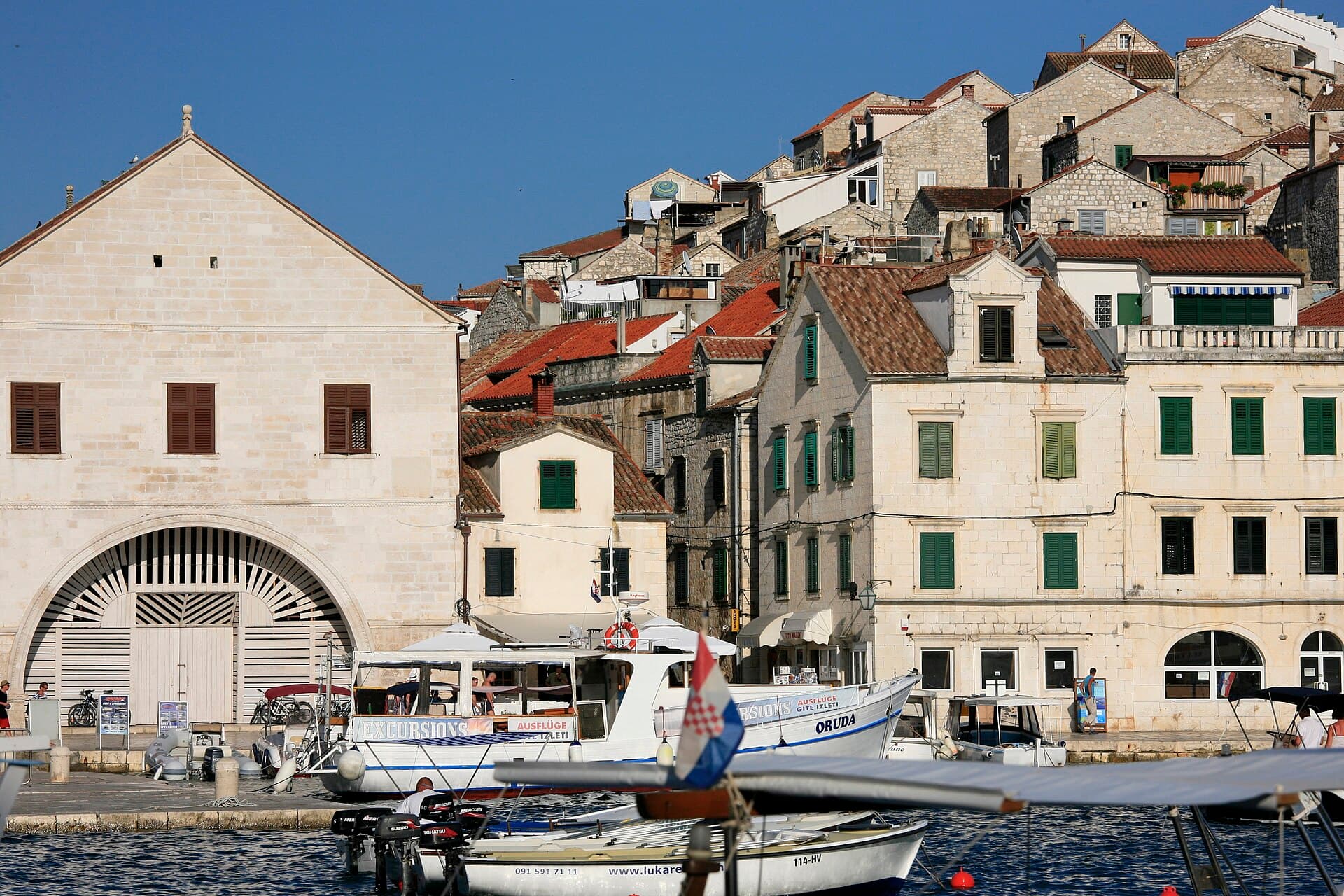
Hvar reveals itself in four poles: Hvar Town, Stari Grad and the UNESCO plain, the southern vineyards, and the Pakleni Islands.
Hvar Town is the main historic city (4,000 inhabitants inside the old walls). Architectural heart around St Stephen's Square (the largest square in Dalmatia), St Stephen's Cathedral (17th century), Hektorović Palace, the Venetian Arsenal (15th century, housing one of Europe's oldest public theatres — 1612), the Rector's Palace. The Španjola Fortress (Fortica) dominates the city from 100 m up — 20-minute climb on foot, exceptional panoramic view over the port, the Pakleni and the sea. Allow half a day for the visit + 1 hour at sunset from the fortress.
Stari Grad ("old town") is Hvar's original settlement — founded by Greeks from Pharos in 384 BC, one of Europe's oldest cities still inhabited. The fishing town wraps around a long deep-water harbour, with Venetian alleys, the Tvrdalj Palace (Renaissance residence of poet Petar Hektorović, 1520, with its famous fish pond), St Stephen's Church, the Dominican monastery. Far more authentic atmosphere than Hvar Town.
The Stari Grad Plain stretches just east of the town — 14 km² of agricultural parcels traced by Greek colonists in 384 BC and unchanged for 2,400 years. Dry-stone walls, ancient olive trees, old vines. UNESCO-listed in 2008 as an exceptionally preserved cultural landscape. Explore by bike (rental in town, €10-15/day) or on foot via marked trails (2-3 hour loop).
The southern vineyards (panoramic road from Sveta Nedjelja to Ivan Dolac, 20 km), clinging to Europe's steepest limestone slopes (40-45° gradients), are a unique wine experience. Plavac mali — a red grape, cousin of California zinfandel — produces Croatia's finest results here. Wineries to visit: Zlatan Otok (Sveta Nedjelja, the most famous, accessible by boat or road), Tomić (Bastijana, road between Jelsa and the south), Hora Hvar (Stari Grad). Plan €60-100 per person for a guided tasting with a snack.
The Pakleni Islands are the absolute nature experience. 21 islets 100 metres offshore from Hvar Town, reached by water taxi from the port (€5-15 per person, departures every 15-30 minutes). Palmižana is the main one (sandy beach, restaurants, marina). Stipanska and Jerolim (the latter nudist) have wilder beaches. Crystal-clear water (30 m+ visibility), exceptional snorkelling. For more freedom, hire a boat (with or without skipper, €100-300/day) or a kayak (€15-25/day).
Longer day trips: Vis (the neighbouring island, more authentic, the Biševo blue cave, accessible by ferry or day boat tour), Bol on Brač (iconic Zlatni Rat beach, 35 minutes by catamaran).
Activities: sea kayaking along the southern coast, scuba diving (Second World War wrecks in the Hvar channel), cycling in the UNESCO plain, hiking up Sveti Nikola (628 m, the island's highest point, 360° view), sunset cocktail at Hula Hula Bar.
Read also
- Central Dalmatia: Split, Hvar, Korčula — Diocletian's Palace, Hvar's lavender fields and Marco Polo's birthplace.
- Croatia — Complete country guide: entry rules, budget, when to visit, regions.
- Split, Diocletian's Palace — An hour by catamaran from Hvar: UNESCO Roman city and Dalmatian ferry hub.
- Dubrovnik, Pearl of the Adriatic — Four hours by catamaran from Hvar: UNESCO walls and Renaissance palaces.