station balneaire
Mirissa
One of the world's three best spots for blue whale watching — 90%+ success rate between December and March on early-morning trips.
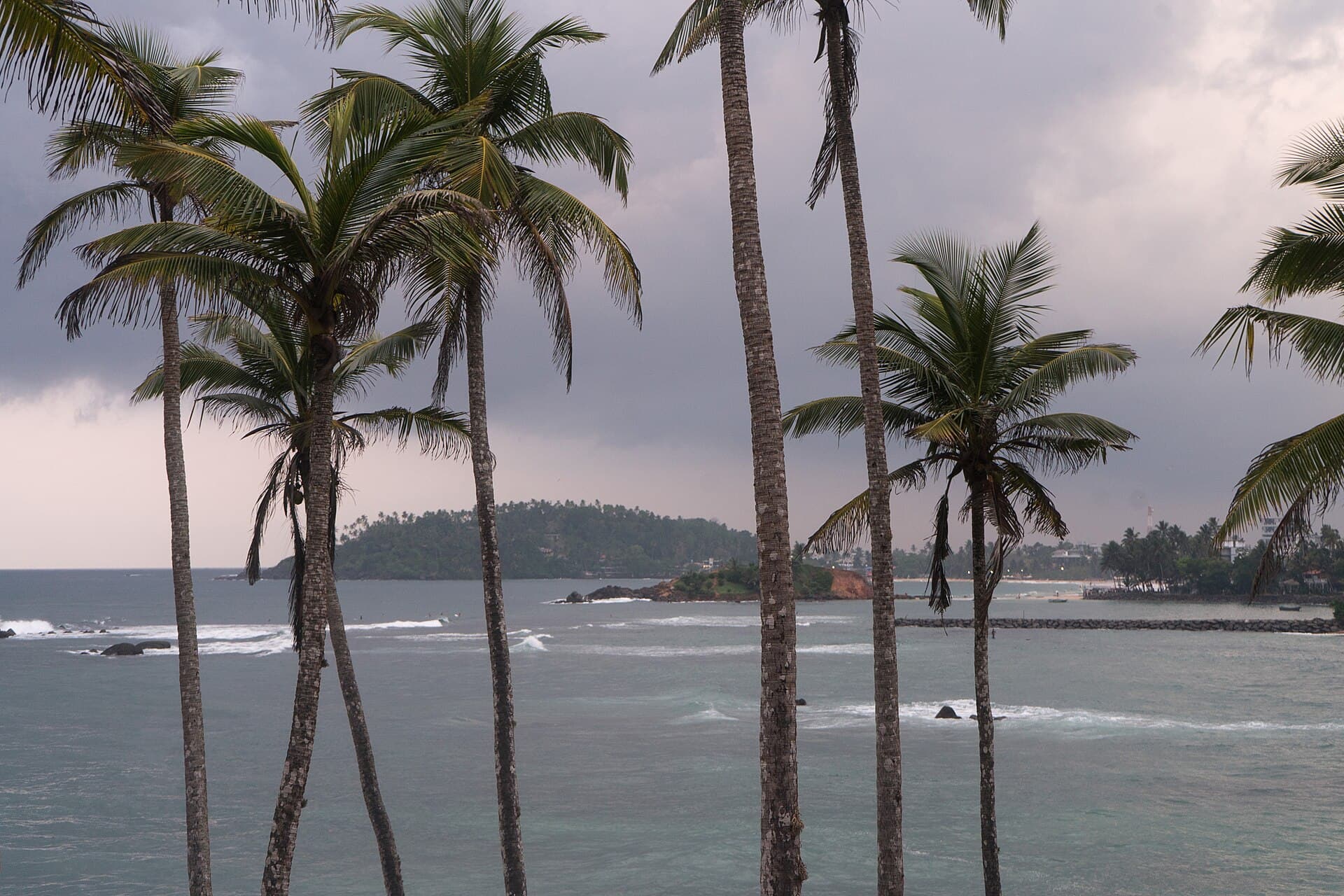
Mirissa has become in a decade one of Sri Lanka's flagship beach resorts, and the essential spot for blue whale watching. The village, set on a golden-sand crescent bay lined with coconut palms, had nothing particularly remarkable until the 2000s — a few fishermen, deserted beaches, a modest local economy. Everything changed in 2008 when marine biologists confirmed what old Sinhalese fishermen had long said: the deep waters off Mirissa, just 10 km from the coast, are one of the world's three best spots for observing blue whales — the largest animal ever to appear on Earth (up to 30 metres long, 180 tonnes). A major migratory route passes here between December and April, and the success rate on morning boat trips reaches 90% and above during high season.
Whale watching has become Mirissa's main attraction. Around twenty operators offer trips at dawn (departure 6 am, return 11 am-12 pm, 5,000-8,000 LKR / £13-22 per person depending on the boat). Morning trips are essential: whales are more active at dawn, the sea is calmer, and winds often pick up around 10-11 am making the journey less comfortable. On a good trip, you can see 3 to 6 blue whales, sometimes accompanied by Bryde's whales, dolphins (often in their hundreds), sea turtles, and more rarely sperm whales. The success rate drops considerably after mid-April (whales depart for the east coast) and picks up timidly in November.
Beyond the whales, Mirissa offers a picture-postcard beach setting. The main beach (Mirissa Beach) stretches 1.5 km of golden sand lined with coconut palms, with dozens of beach-shack restaurants on the sand where you dine feet in the sand at sunset. Coconut Tree Hill, a small point above the sea covered in iconic palms, has become one of the most-shared Instagram photo spots. Secret Beach and Hiriketiya Beach (15 km east) offer quieter alternatives. Surf for beginners at Weligama (5 km west) is one of the best learning spots in the world, with gentle, consistent waves. Finally, the café-restaurant scene has developed substantially: cool cafés, yoga studios, beachside seafood restaurants. A full-blown beach stop in its own right, more relaxed than Unawatuna but less luxurious than Galle.
What we love
- ✅Blue whale watching: one of the world's three best spots, 90% success rate in high season
- ✅Mirissa Beach: golden sand, coconut palms, beach-shack restaurants, the classic tropical image
- ✅Beginner surf at Weligama (5 km): one of the world's best learning spots, gentle constant waves
- ✅Coconut Tree Hill: iconic photo spot at sunset
- ✅Perfect combination with Galle (35 km west) to mix culture and beach
What to know
- ❌Very touristy beach in high season, less authentic atmosphere than pre-2015
- ❌Whale trips sometimes problematic: some operators approach too close, stressing the animals
- ❌Whale watching impossible May to November (monsoon)
- ❌Dangerous sea during monsoon, swimming not recommended
Situation
Où se situe Mirissa ?
Ouvrir la carte en grand sur OpenStreetMap →Frequently asked questions
When can I see blue whales at Mirissa?+
How much does a whale watching trip cost?+
When is the best time to visit Mirissa?+
Where should I stay in Mirissa?+
Do I need to worry about seasickness on whale trips?+
What else is there to do in Mirissa apart from whale watching?+
How do I get to Mirissa from Galle or Colombo?+
Our verdict
Mirissa is a non-negotiable stop on Sri Lanka's south coast, particularly between December and April for blue whale watching. The combo of beach + whales + Coconut Tree Hill + seafront restaurants makes it one of the most complete beach destinations in the country. Our advice: plan 3 nights — day 1 arrival and relaxation, day 2 whale watching at dawn (depart 6 am, return 11 am) + afternoon rest + sunset at Coconut Tree Hill, day 3 surf at Weligama or excursion to Hiriketiya Beach. Choose a responsible whale operator (Raja and the Whales, Mirissa Water Sports — avoid the cheapest ones that approach too close). Absolutely avoid monsoon (May-November): whales absent, sea dangerous, many restaurants closed.
Nearby

"Pic touristique haute saison, mer calme sud."
Expert on Mirissa · 1 contributions
 South-East Asia Desk — Mowando·Editor