ville
Galle
The largest European fort ever built in South Asia, with 36 hectares of colonial streets preserved within 17th-century Dutch ramparts.
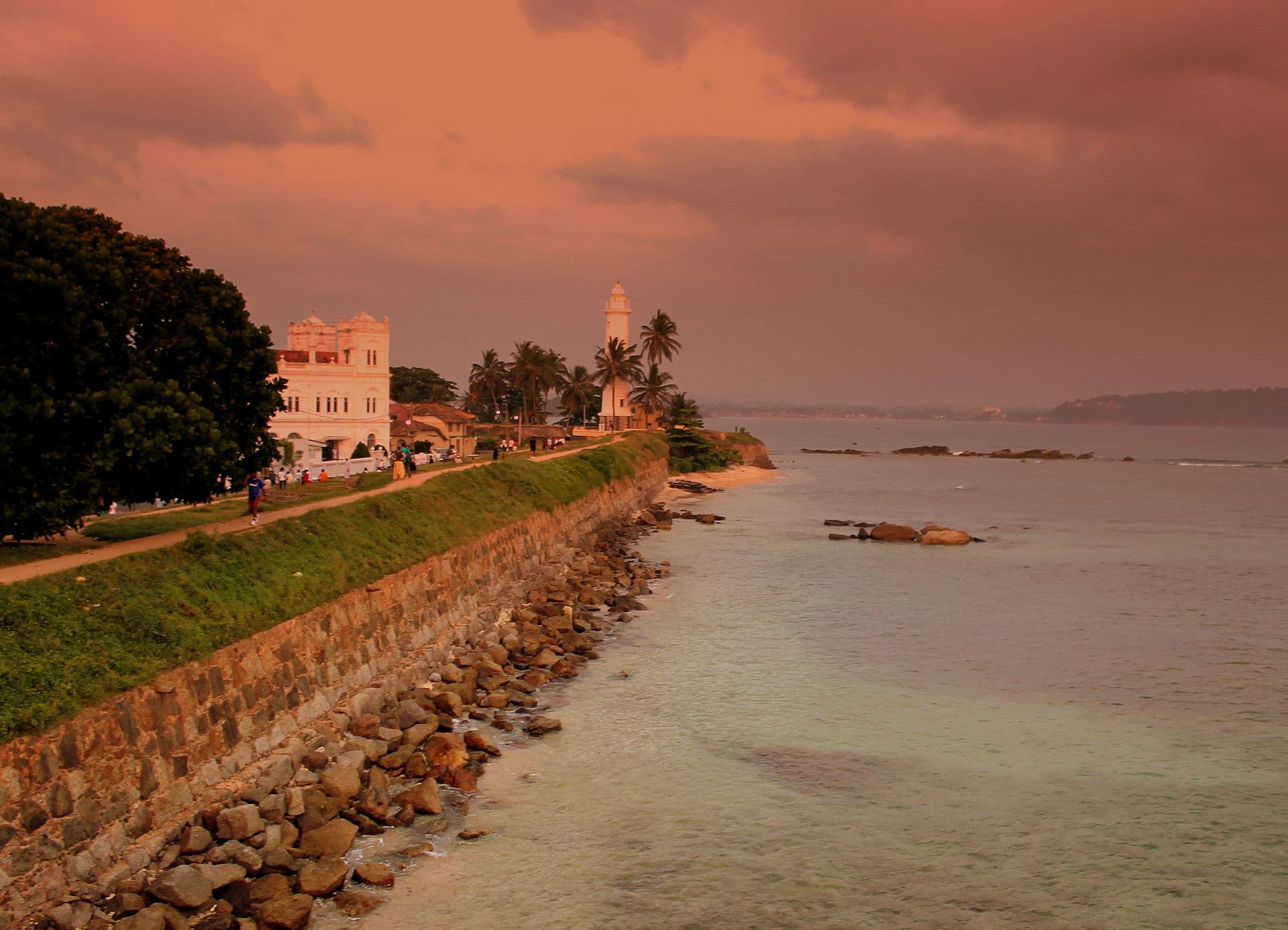
Galle is the jewel of Sri Lanka's south coast, and one of Asia's finest colonial towns. The Galle Fort — 36 hectares of cobbled streets enclosed by 17th-century Dutch ramparts — has been UNESCO-listed since 1988 as one of the best-preserved European fortifications in the entire Indian Ocean. Built by the Portuguese in 1588, considerably extended by the Dutch after they took the port in 1640, then held by the British from 1796 to 1948, Galle Fort is a unique architectural palimpsest where three centuries of European colonisation overlap in a few hectares.
Inside the ramparts, you discover a living museum-town. The old Dutch merchant houses with their deep verandas, red-tiled roofs and courtyard patios have been converted since the 2004 tsunami into exceptional boutique hotels (the famous Galle Fort Hotel, Amangalla, Fort Bazaar, The Bartizan), refined restaurants and contemporary art galleries. The Dutch Reformed Church (1755) and the Maritime Museum bear witness to the maritime past. The all-white lighthouse on the southern point, built in 1939, has become one of Sri Lanka's most iconic images. And the sunset walk around the ramparts — 2.5 km above the Indian Ocean — remains one of the most memorable urban strolls in Asia.
But Galle isn't only a fort. The modern town, north and east of the ramparts, houses 100,000 inhabitants, the large commercial port and a lively market. Above all, Galle is the ideal gateway to the tourist south coast: Unawatuna (5 km east, golden sand beach, beginner surf, snorkelling), Mirissa (35 km, blue whale watching, quieter beaches), Hikkaduwa (20 km north, intermediate surf and coral reef), and the wild south (Tangalle, Hiriketiya — beaches still preserved from mass tourism). With its elegant boutique hotels, its flourishing café-restaurant scene and its neighbouring beaches, Galle has become the gastronomic and romantic stop of Sri Lanka — a striking contrast with backpacker Ella or spiritual Kandy.
What we love
- ✅UNESCO Galle Fort: 36 hectares of perfectly preserved 17th-century colonial streets
- ✅Outstanding boutique hotel and restaurant scene: Galle Fort Hotel, Amangalla, The Bartizan
- ✅Ideal position between culture (Fort) and beaches (Unawatuna, Mirissa at 5-35 km)
- ✅Sunset over the ramparts: 2.5 km walk above the Indian Ocean
- ✅Climate tempered by sea breeze, more pleasant than the tropical interior
What to know
- ❌Galle Fort very touristy in high season, heavy crowds in the afternoon
- ❌Boutique hotel prices high (€150-400/night) — Galle is no longer a backpacker destination
- ❌Sea often rough April to November: dangerous swimming, compromised surf
- ❌Noise pollution and chaotic traffic in the modern city outside the Fort
Situation
Où se situe Galle ?
Ouvrir la carte en grand sur OpenStreetMap →Frequently asked questions
How do I get to Galle from Colombo?+
How many days should I plan in Galle?+
Where should I stay in Galle?+
When is the best time to visit Galle?+
Which beaches are near Galle?+
What is there to see in Galle Fort?+
Is the food in Galle worth the detour?+
Our verdict
Galle is a non-negotiable stop on any Sri Lanka trip, especially for couples and travellers sensitive to architecture and gastronomy. The UNESCO Fort, walked at sunset and then dined in one of the refined restaurants of the old Dutch houses, delivers one of the country's most memorable experiences. Our advice: sleep 2 nights in a Fort boutique hotel (book 2 months ahead in high season), spend your days between the ramparts in the morning, Unawatuna beaches in the afternoon, and Fort restaurants in the evening. For a longer stay, add 2 nights at Mirissa (35 km east) for blue whale watching and quieter beaches.
Nearby

"Pic touristique haute saison, mer calme sud."
Expert on Galle · 1 contributions
 South-East Asia Desk — Mowando·Editor