site archeologique
Ephesus
One of the world's best-preserved ancient sites — the Library of Celsus, the 25,000-seat Great Theatre where the Apostle Paul preached, the Temple of Hadrian and exceptional Roman terrace houses with mosaics.
Ephesus (Efes in Turkish, 3 km from Selçuk village) is one of the world's most extraordinary archaeological sites — a Greco-Roman city so well preserved that it allows concrete imagination of Roman urban life 2,000 years ago. Capital of the Roman province of Asia in the 1st-3rd centuries, it had 250,000 inhabitants — one of the five largest cities of the Roman Empire after Rome, Alexandria and Antioch. UNESCO listed in 2015, Ephesus attracts 1.9 million visitors every year.
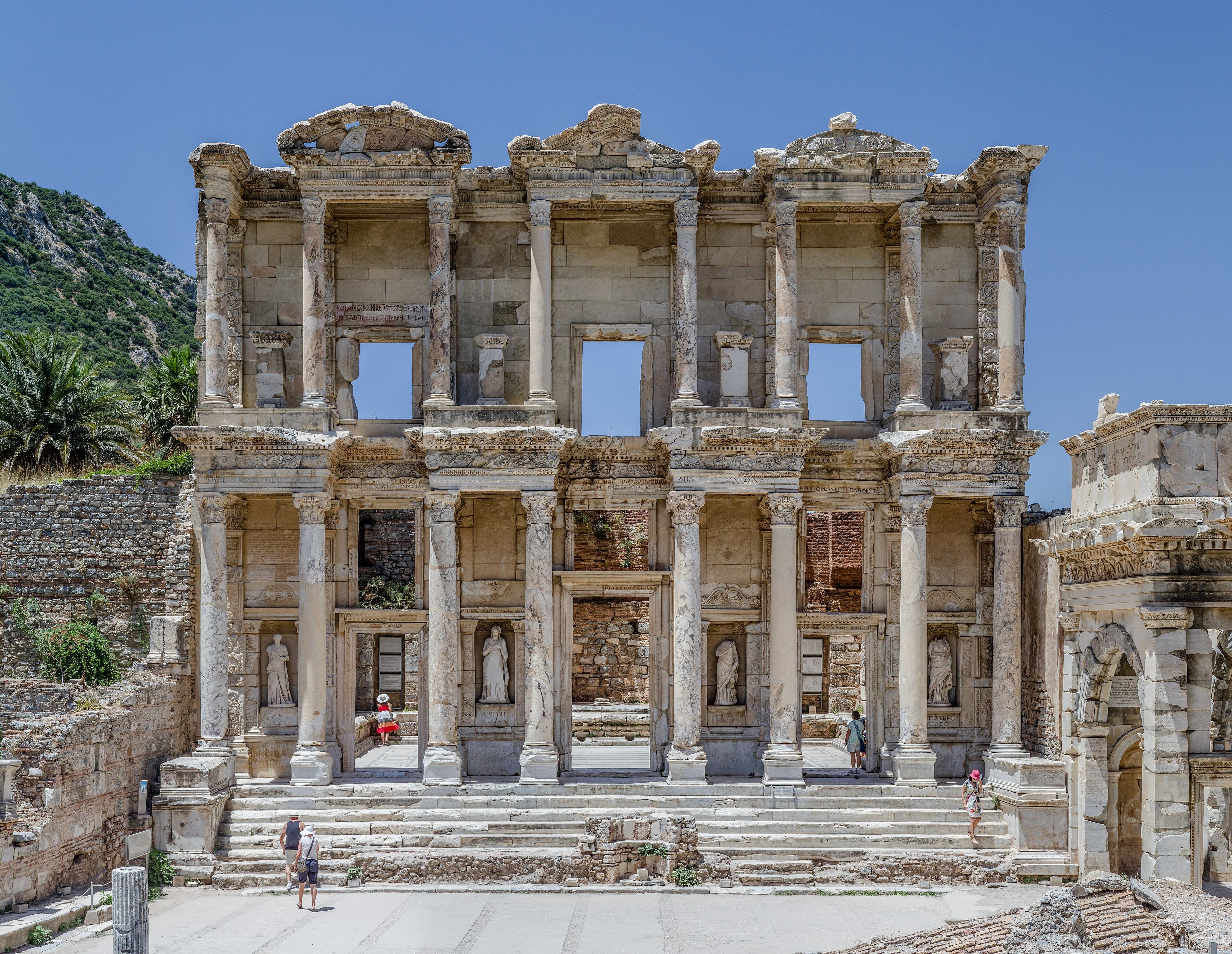
The Library of Celsus (135 AD, two-storey façade restored in the 1970s) is the iconic image of the site — one of the most beautiful preserved ancient façades in the world, comparable to Petra's Treasury or Hatshepsut's temple. Built in white marble with four allegorical statues (Wisdom, Knowledge, Intelligence, Virtue) in niches, it originally housed 12,000 papyrus scrolls — the third largest library in the ancient world after Alexandria and Pergamum. Destroyed by an earthquake in the 3rd century, its façade was carefully reassembled by Austrian archaeologists between 1970 and 1978.
The Great Theatre (25,000 seats, built under Lysimachus in 300 BC and enlarged by the Romans) is the other signature monument — one of the largest ancient theatres in the world, still occasionally used for concerts and operas in summer. It is here that, according to the Acts of the Apostles (chapter 19), the Apostle Paul preached during his stay in Ephesus around 53-56 AD, triggering the riot of Artemis silversmiths who saw their statuette trade threatened by nascent Christianity. The theatre is still visitable and one can sit on the marble tiers to feel the exceptional acoustics that characterise Roman construction.
The rest of the site displays a succession of remarkable monuments: the Temple of Hadrian (2nd century, sculpted frieze representing the mythical foundation of Ephesus), the Terrace Houses (Yamaç Evler, luxurious Roman dwellings with exceptional frescoes and mosaics, supplementary ticket but absolutely worth seeing), the Hercules Gate, the Trajan Fountain, the Odeon (small 1,500-seat theatre for concerts), the commercial agora, the marble public latrines (mythical for the photo), the Curetes colonnaded street. 3 km from the site, the village of Selçuk houses the Temple of Artemis (one of the 7 wonders of the ancient world, now reduced to a single standing column), the Basilica of St John (tomb of the apostle John the Evangelist who is said to have ended his life in Ephesus), the Isa Bey Mosque and the Byzantine citadel. 7 km away, the House of the Virgin Mary (Meryem Ana Evi, where according to tradition Mary lived her last years under John's protection) attracts both Christian and Muslim pilgrims.
What we love
- ✅Best-preserved ancient site in the entire eastern Mediterranean — iconic Library of Celsus
- ✅25,000-seat Great Theatre still used for concerts and operas in summer
- ✅Exceptional monumental density: Library, theatre, Temple of Hadrian, terrace houses, latrines, agora — all within 2 km
- ✅UNESCO site since 2015 — one of the major must-sees of a Mediterranean trip
- ✅Immediate accessibility from Selçuk (charming village 3 km away, charming accommodation) and Kuşadası (cruise port 20 km away)
What to know
- ❌Extreme crowds in high season (July-August) — 1-2 hour queues, cruise tourists invading the site at 10am
- ❌Crushing heat in summer (35-42°C) — no shade, gruelling visit
- ❌High entry fee for Turkey: 1500 TRY (€45) + 700 TRY for terrace houses
- ❌Annex sites (Temple of Artemis, Basilica of St John) sometimes disappointing — especially Temple of Artemis reduced to a column
Situation
Où se situe Ephesus ?
Ouvrir la carte en grand sur OpenStreetMap →Frequently asked questions
How long do you need to visit Ephesus?+
How to avoid crowds at Ephesus?+
Should you pay the supplement for the terrace houses (Yamaç Evler)?+
How to get to Ephesus from Istanbul?+
Where to stay to visit Ephesus?+
Our verdict
Ephesus is one of the great must-sees of a Turkey trip — an ancient site of exceptional conservation quality and monumental density. Go ideally in April-June or September-October to avoid crushing summer heat. Visit early (opening 8am) to avoid tourist buses arriving at 10am. Imperatively pay the 700 TRY supplement for terrace houses (Yamaç Evler) — the Roman mosaics and frescoes there are among the best preserved in the world. Stay in Selçuk (3 km from the site, charming accommodation at €50-150/night) rather than Kuşadası (touristy and beachy). Plan half a day to a full day for the visit, and combine with the House of the Virgin Mary (7 km), Basilica of St John (Selçuk), Temple of Artemis (Selçuk) and ideally Pamukkale (200 km, 3h drive) for a complete 3-4 day cultural stay on the Aegean Coast.
Nearby

"Frais Istanbul, neige Cappadoce."
Expert on Ephesus · 1 contributions
 Mediterranean Desk — Mowando·Editor