Mowando

montagne

Mount Kilimanjaro

Africa's rooftop at 5,895 metres, the continent's highest peak and the world's tallest free-standing mountain — climbable without mountaineering technique.

4.90Kilimandjaro

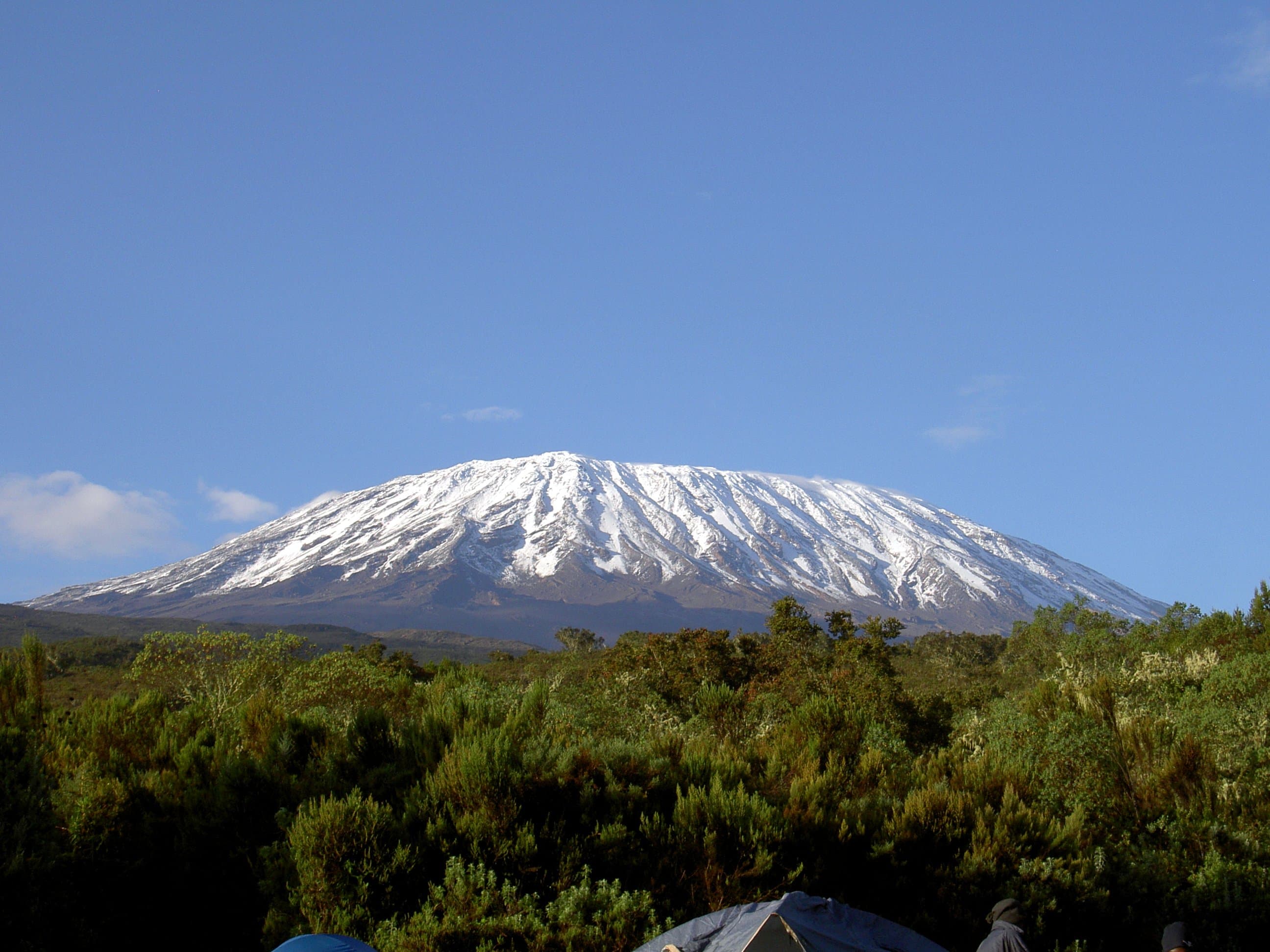
Mount Kilimanjaro is one of the planet's most iconic summits and the adventure goal of thousands of trekkers each year. Peaking at 5,895 metres at a point called Uhuru Peak ('Freedom Peak' in Swahili, so named after Tanzanian independence in 1961), it is both Africa's highest peak and the world's tallest free-standing mountain — meaning not part of a chain. This geological singularity gives it unmatched visual majesty: the massif emerges alone from the Maasai plain at 1,000 metres altitude, offering a total visual elevation gain of nearly 4,900 metres between base and summit, and its snow-capped silhouette stands out on the horizon of Tanzanian plains from over 250 km away on clear days.

Kilimanjaro is in fact a dormant stratovolcano composed of three main cones. Kibo (5,895 m) is the main summit and the only one accessible by normal routes — what is commonly called 'Kilimanjaro'. Mawenzi (5,149 m), to the north-east, is a technical peak with steep walls, accessible only to experienced mountaineers via climbing routes. Shira (3,962 m), to the north-west, is eroded into a plateau and constitutes an important stage of the Lemosho and Machame routes. The volcano is considered dormant (last major eruption dated 360,000 years ago), but remains geologically active — some persistent fumaroles near the summit attest to residual activity.

The Kilimanjaro climb is one of the great expeditions accessible to ordinary trekkers in good physical condition. More than 30,000 people attempt the summit each year, with a global success rate of around 65%. This rate varies enormously by chosen route: 85% on Lemosho 8 days (long acclimatisation, maximum rate), 65-70% on Machame 7 days, but only 55% on Marangu 5 days (acclimatisation too fast). The limiting factor is not technical difficulty — no rope, no ice axe, no crampons are required on the normal routes — but altitude and acute mountain sickness (AMS), which affects 50% of trekkers to varying degrees above 4,000 metres.

What we love

  • Africa's highest summit and the world's tallest free-standing mountain — a legendary peak on every adventurer's list
  • Accessible to non-mountaineers: no climbing technique required, just cardio and acclimatisation
  • 6 complementary routes allowing adaptation of duration, difficulty and crowding
  • Mature professional supervision: certified guides (Mweka school), KPAP porters, high-altitude cooks
  • Five ecosystems crossed in a single ascent: rainforest, moorland, high-altitude desert, arctic zone

What to know

  • High cost: 2,000 to 4,000 USD/person for a 7-8 day climb, park fees included (140 USD/day)
  • Highly variable success rate: 85% Lemosho 8d vs 55% Marangu 5d
  • Acute mountain sickness: 50% of trekkers affected to varying degrees above 4,000 m
  • Physically demanding experience: 6-9 days of walking, summit at -15/-20 °C at night
  • No easy turnback during the climb — helicopter emergency evacuation expensive

Situation

Où se situe Mount Kilimanjaro ?

Ouvrir la carte en grand sur OpenStreetMap →

Frequently asked questions

Which route to choose for the Kilimanjaro climb?+
The __Lemosho 7-8 day route__ is largely the best for first-time climbers: __maximum success rate (85%)__, most varied landscapes (western start, crossing the Shira plateau), moderate traffic, ideal acclimatisation profile with progressive climb and 'climb high, sleep low'. The __Machame 7 day route__ ('Whiskey route') is the second option, popular and beautiful (65-70% success rate). The __Marangu 5-6 day route__ ('Coca-Cola route') is the only one with huts, but its fast profile gives a low success rate (55%) — avoid for a first summit, except for budget/time constraint. The __Northern Circuit 8-9 days__ is the long-duration option for purists (rate > 90%).
How much does a complete climb cost?+
Count on __2,000 to 4,000 USD/person__ for a 7-8 day all-inclusive climb (certified guide, porters, cook, food, tents, transfers from Moshi, park fees). __Park fees__ represent a huge share: 70 USD/day entry + 50 USD/day camping + 20 USD rescue fee + 18% VAT = around __700 USD for 7 days__. Low-cost operators at 1,500 USD exist but often sacrifice safety and porter conditions — avoid. For a serious KPAP-referenced operator: Tusker Trail (2,800-3,500 USD), Altezza Travel (2,200-2,800 USD), Climbing Kilimanjaro (2,400-3,000 USD), Kandoo Adventures (2,500-3,200 USD), Zara Tours (1,800-2,400 USD, serious budget option).
What is the risk of altitude sickness?+
__Acute Mountain Sickness__ (AMS) affects 50% of trekkers on Kilimanjaro to varying degrees, starting at 4,000 metres. Symptoms: persistent headaches, nausea, loss of appetite, sleep disturbances, breathlessness at rest. Serious forms (high-altitude pulmonary or cerebral edema) are rare but potentially fatal — immediate descent is then imperative. __Prevention__: choose a long route (Lemosho 7-8 days rather than Marangu 5 days), climb slowly ('pole pole' in Swahili), drink 3-4 litres of water per day, take Diamox (acetazolamide) on medical prescription 1-2 days before the summit, follow the 'climb high, sleep low' rule. The guide is trained to recognise symptoms — always listen if they recommend descent.
What equipment is needed?+
Clothing must cover temperatures from +25 °C at the base to -20 °C at the summit. __Essentials__: high waterproof hiking boots already broken in, warm down jacket (700+ down or synthetic), fleece, windproof and waterproof hardshell jacket, thermal underwear (merino), warm gloves + waterproof overgloves, hat, glacier glasses (category 4), -10 °C comfort sleeping bag, 25-35 L daypack for the day, 80 L duffel bag (carried by porters, 15 kg limit), telescopic trekking poles, headlamp + spare batteries, water bottles/bladder (3 L), first aid kit. Most operators rent missing gear in Moshi (sleeping bag, down jacket, poles) for 5-10 USD/day.
How much physical preparation time is needed?+
__Minimum 3 months__ for a regular hiker, __6 months__ for an unfit traveller. The ideal programme combines: __cardio__ (running 3-4 times/week, cycling, swimming for endurance) with a long weekend outing (2-4 hours of mountain walking or stairs elevation), __leg strengthening__ (squats, lunges, weighted stair climbs), and __high-altitude hikes__ if possible (ideally 1-2 outings above 3,000 m before departure). Walking with a 8-10 kg loaded pack is essential to accustom joints and back. Altitude itself cannot be prepared — only on-site acclimatisation counts. Schedule your departure with a safety margin: don't book a return flight the day after descent.
Can the climb be done in rainy season?+
Technically yes, but it's __strongly discouraged__. From mid-March to May (long rains), the forest zone (1,800-3,000 m) receives up to 250 mm of precipitation per month, trails become muddy and slippery, summit visibility is often reduced by clouds, and the success rate drops drastically. Several serious operators don't organise ascents during this period. From November to mid-December (short rains), conditions are less disabling — brief afternoon showers, generally workable trails, success rate close to high season. It's an interesting window for tight budgets (rates down 20-30%) and travellers seeking tranquillity.
Can Kilimanjaro and safari be combined?+
Yes, it's even the most common combination. The usual logic: arrival at Kilimanjaro Airport (JRO), 1 night in Moshi, Kilimanjaro climb (7-8 days via Lemosho or Machame), 1-2 recovery nights in Moshi or Arusha, then Northern Circuit safari (6-8 days). Count on __17-20 days on the ground total__. Some operators offer complete packages integrating climb + safari. Don't reverse the order: a safari before the summit is comfortable, but after a 7-day ascent you'll be tired and wildlife observation quality will suffer. Ideally add 4-5 nights in Zanzibar at the end for complete beach recovery.

Our verdict

Mount Kilimanjaro is one of the most accessible major summits on the planet, and one of the most emblematic personal challenges one can take on during a trip to Africa. The climb demands physical commitment, serious preparation (3-6 months of cardio) and substantial budget (2,000-4,000 USD/person), but the summit at 5,895 metres at sunrise, with tropical glaciers glittering and the shadow of the massif cast over the Maasai plains, is one of those experiences no description does justice. Imperatively choose the Lemosho 7-8 day route to maximise your summit chances (85% vs 55% on Marangu), select a serious KPAP-referenced operator, and ideally combine with a Northern Circuit safari (before or after) and 4-5 nights in Zanzibar for recovery.

Nearby
The Editors
The Editorsauteur principal✓ Verified

"Janvier (Moshi base) : petite saison sèche, conditions excellentes pour l'ascension. Au sommet (-15 à -20 °C la nuit)."

Expert on Mount Kilimanjaro · 1 contributions

Mowando Letter

Once a month: the right destinations for the right season + the best booking windows.

No spam. One-click unsubscribe. Your data is never shared.