region touristique
Cinque Terre
Manarola, Vernazza, Riomaggiore — five villages that seem to defy gravity on the Ligurian Riviera cliffs, a UNESCO World Heritage Site since 1997.
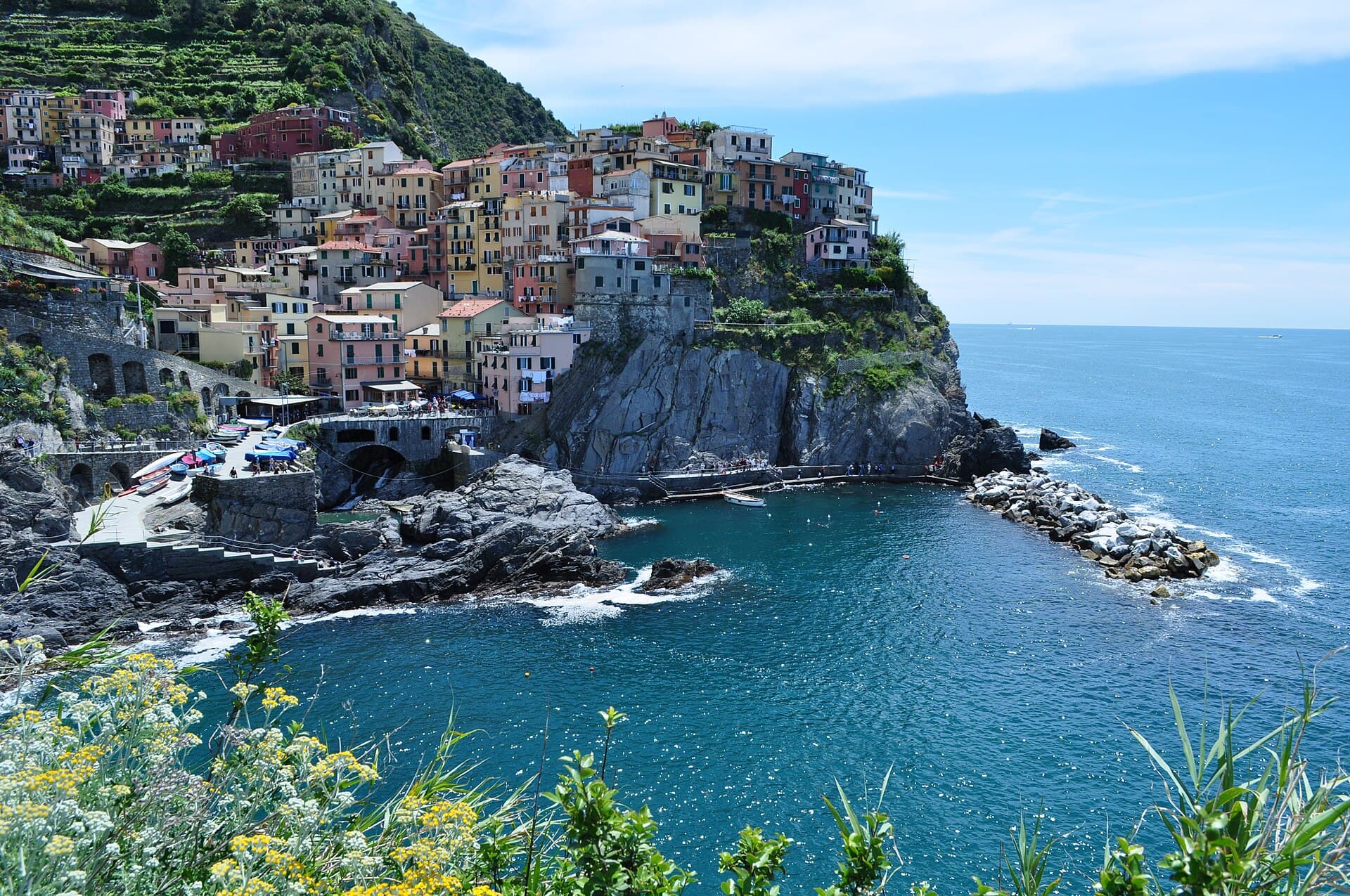
The Cinque Terre ('Five Lands') are five fishing villages clinging to the steep cliffs of the Ligurian Riviera, strung between Punta Mesco to the north and Punta di Montenero to the south: Monterosso al Mare, Vernazza, Corniglia, Manarola and Riomaggiore. A designated national park and a UNESCO World Heritage Site since 1997, this stretch of coastline owes its beauty to a particular combination — painted terraced houses (pink, ochre, yellow, green), vines cultivated by hand on dry-stone walls maintained for a thousand years, and a deep blue Mediterranean Sea that the midday sun turns to turquoise.
The headline activity in the Cinque Terre is hiking on the network of trails that link the five villages. The Sentiero Azzurro (Blue Trail, partially reopened after the rockslides of 2011-2012) is the most famous, but the high ridge trails (Alta Via delle Cinque Terre) deliver even more spectacular panoramas across the coast and the islands of the Riviera. The other way to take in the region is from the sea, on a boat excursion from Monterosso or La Spezia — the angle that best reveals the dizzying verticality of the cliffs and the painted-doll houses stacked above the water.
Beyond the headline pictures, the Cinque Terre also reward unhurried eating and drinking. Genoese pesto on hand-rolled trofie, focaccia warm from the morning bakery, anchovies pulled out of the Gulf of Poets at dawn, the sweet amber Sciacchetrà sipped after dinner on a terrace overlooking the lights of the village across the bay — this is a destination that genuinely understands the slow part of slow travel.
What we love
- ✅Coastal landscapes among the most beautiful in Europe: painted villages, cliffs, turquoise sea
- ✅Walking trails in the Parco Nazionale delle Cinque Terre with constant sea views
- ✅Swimming in the Ligurian Sea from rocks and tiny coves, with cristal-clear water
- ✅Ligurian cuisine: pesto alla genovese, trofie al pesto, fritto misto, focaccia, Sciacchetrà
- ✅Easy rail access from Genoa, Milan and Florence — no car needed or wanted
What to know
- ❌Overcrowding in July-August, with saturated alleys and trails
- ❌Trails periodically closed after heavy rain or landslides
- ❌Limited and expensive accommodation — reservations essential
- ❌No proper sandy beach (rocks and tiny coves only, except at Monterosso)
Situation
Où se situe Cinque Terre ?
Ouvrir la carte en grand sur OpenStreetMap →Frequently asked questions
How many days should I plan for the Cinque Terre?+
Which Cinque Terre village should I stay in?+
How do I reach the Cinque Terre without a car?+
Is the Sentiero Azzurro fully open?+
Can I swim in the Cinque Terre?+
What is Sciacchetrà?+
What should I eat in the Cinque Terre?+
Can I day-trip the Cinque Terre from Florence or Milan?+
Our verdict
The Cinque Terre deserve their global reputation — but only if you visit them on the right dates. In May or September, the villages recover their fishing-port soul, the trails are walkable and the sea is still beautiful. In July and August, the experience is genuinely degraded by the crowds, and you spend more time queueing for trains than walking on the trails. The essential ingredient is the landscape itself, which remains breathtakingly singular, and which is best appreciated from the sea or from the high ridge paths rather than from the bottleneck of the Via dell'Amore.
A realistic plan: book accommodation months ahead (the village inventory is genuinely tiny), stay overnight inside one of the five rather than as a day-tripper from La Spezia, walk before 9 in the morning and after 5 in the afternoon, eat in the working trattorie a couple of streets away from the harbour, and finish each evening with a glass of Sciacchetrà on a terrace looking at the lights of the village across the bay. Approached on those terms, the Cinque Terre quietly become one of the most rewarding short coastal trips in Europe; approached as a hurried bucket-list day trip, they can feel like a slightly disappointing greatest-hits compilation.
Réserver votre séjour
Liens partenaires — une commission peut nous être reversée, sans surcoût pour vous.
 HébergementAnnulation gratuite
Hôtels & séjours en Italie
Du B&B de charme au palazzo historique, à Rome, Florence, Venise et dans toute la péninsule italienne.
ActivitéCoup de cœurVisites & billets coupe-file en Italie
Colisée, galerie des Offices, basilique Saint-Marc, balade en gondole : évitez les files avec des billets réservés.
VolComparateurVols vers l'Italie
Rome, Venise, Milan, Naples : des vols directs de 1 h 30 à 2 h 30 depuis la France, comparés en un coup d'œil.
Nearby

"Janvier aux Cinque Terre est presque désert — certains restaurants et hébergements ferment. Mais les falaises baignées d'une lumière hivernale basse et l'absence totale de touristes offrent une expérience rare et authentique."
Expert on Cinque Terre · 1 contributions