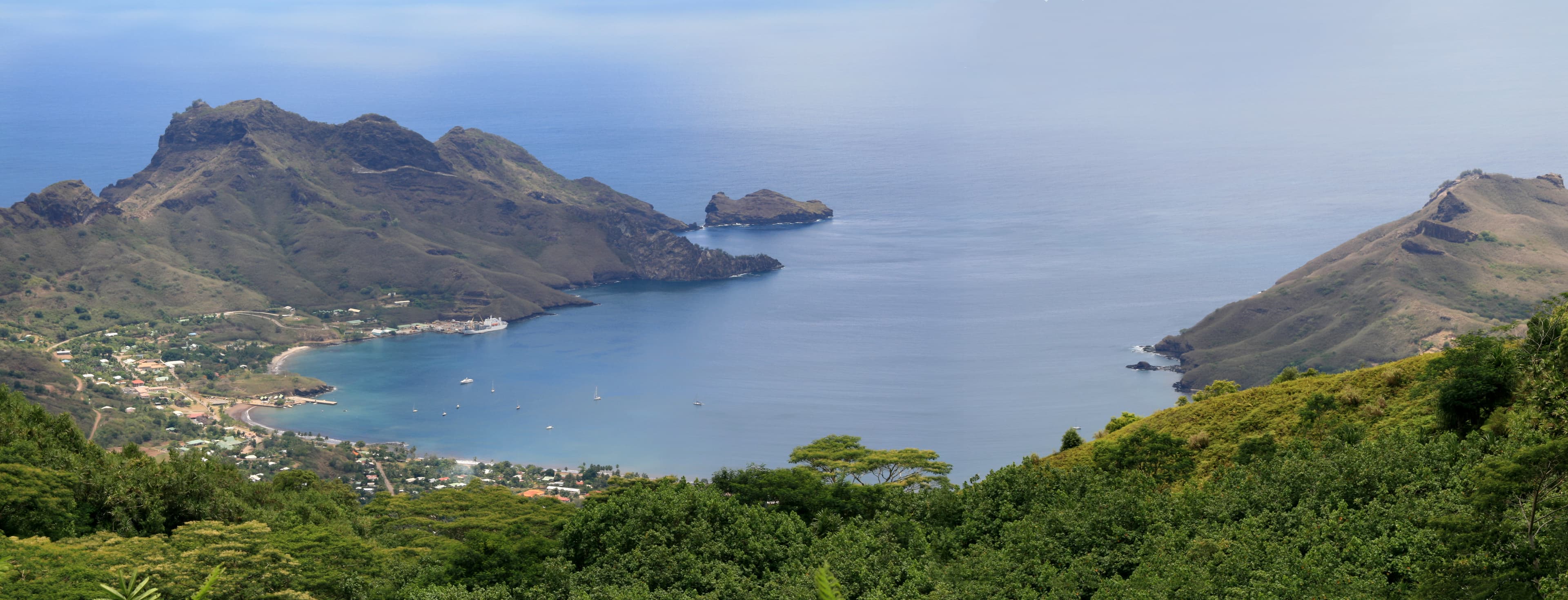
The Marquesas have a tropical equatorial climate drier and more stable than the rest of French Polynesia, thanks to their latitude (9° south) and exposure to trade winds. Temperatures are stable year-round (24-30 °C) with low seasonal variation.
The dry season (May to October) is the best period to discover the Marquesas. Hiking trails are passable, valleys are accessible, the sky is generously blue and rain is rare and brief. It is also the most favourable period for the Aranui 5 cruise — the sea is calmer, landings easier. The Heiva i Hiva Oa festival (in July, at Atuona) offers competitions of songs, dances and traditional sports — a beautiful cultural moment.
The wet season (November to April) brings more frequent rain and lush vegetation, but also muddy and slippery trails that make hiking difficult. Altitude fogs can hide the summits. The sea is rougher and landings sometimes difficult. Cyclone risk is however lower than in the Tuamotus — the Marquesas are above the main cyclone zone of the South Pacific.
A major cultural event falls every 4 years in December: the Marquesas Arts Festival (Matava'a o te Henua Enana), the biggest Marquesan cultural festival — dances, songs, traditional sports, sculpture, tattooing. The six inhabited islands participate by rotation (rotating host). The next edition will be held in December 2027 — an event to absolutely mark in your calendar if you plan a trip to the Marquesas that year.
Our recommendation: May-June or September-October for a classic trip, or December 2027 if you want to experience the arts festival that gathers all Marquesan artists.
Read also
- Hiva Oa, the island of Gauguin and Brel — Atuona, graves of Gauguin and Brel, monumental tikis of Puamau, sacred valleys.
- Society Islands — Tahiti, Moorea and Bora Bora: the main tourist archipelago to combine with the Marquesas.
- Tuamotus: the diving atolls — Rangiroa and Fakarava (UNESCO): the world's best diving spots.
- French Polynesia — Complete territory guide: 5 archipelagos, formalities, budget, best time.