Mowando

Region

Marquesas

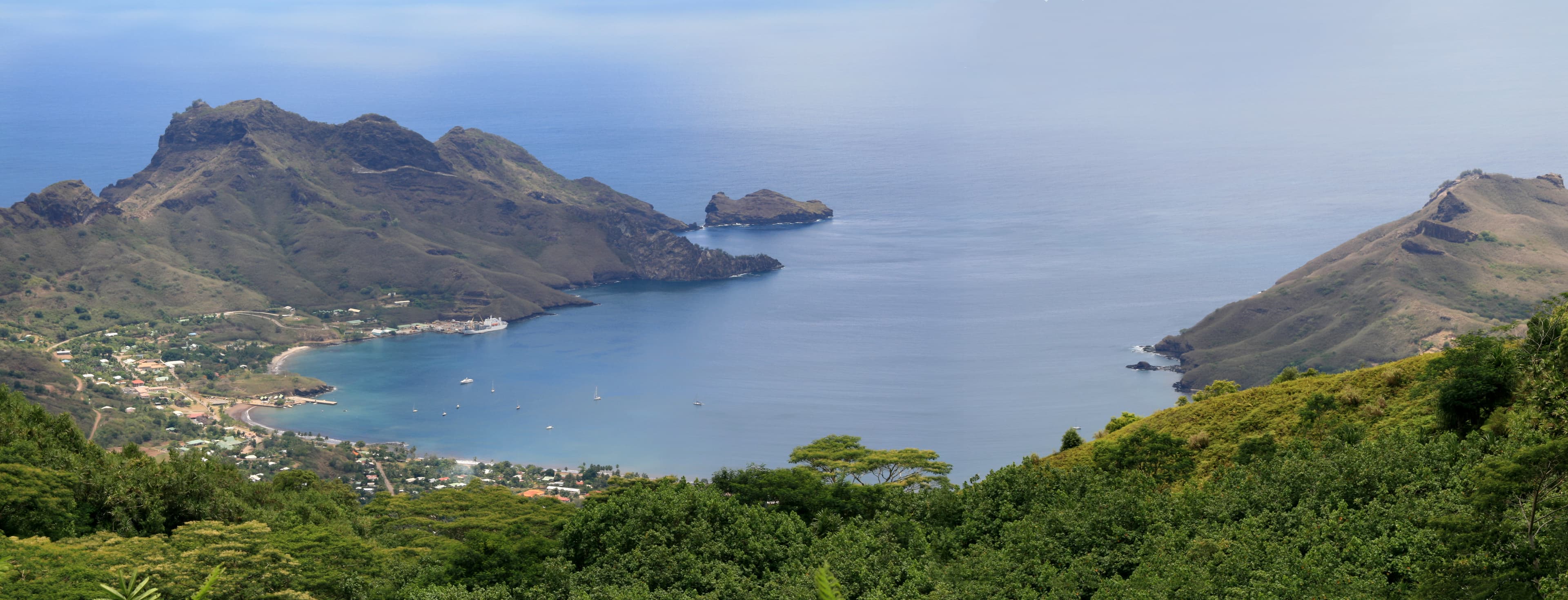
The Marquesas are the most remote, the wildest and the most culturally rich archipelago of French Polynesia. Travellers come here following the footsteps of Gauguin and Brel, and for the raw beauty of the volcanic cliffs.

4.80

The Marquesas archipelago (Te Henua Enana in Marquesan — 'the land of men') is the northernmost and most remote of French Polynesia, located 1,500 km north-east of Tahiti. Comprising 12 volcanic islands (6 inhabited), it forms a world apart: no turquoise lagoons or coral barrier as in the other archipelagos — here, black volcanic cliffs plunge directly into the Pacific, deep valleys are covered with lush tropical vegetation, and eroded summits dominate an open ocean of raw and wild beauty.

The two main islands are Hiva Oa (in the south, administrative capital of the archipelago) and Nuku Hiva (in the north, the largest, 339 km²). Four other inhabited islands complete the picture: Ua Pou and Ua Huka in the northern group, Tahuata and Fatu Hiva in the southern group. The total population does not exceed 9,200 — it is the least populated archipelago of French Polynesia.

The Marquesas are deeply marked by two Western figures who ended their lives there: Paul Gauguin, French painter, lived his last years at Atuona (Hiva Oa) and has rested there since 1903 in the Calvaire seaside cemetery. Jacques Brel, Belgian singer, spent his last years at Atuona and has rested there since 1978, in the same cemetery, a few metres from Gauguin. The Gauguin-Brel museum at Atuona retraces their Marquesan lives — a moving and unmissable stop.

But the Marquesas are far more than a cemetery of celebrities: this is the Polynesian archipelago that has best preserved its ancestral ma'ohi culture. The monumental tikis (anthropomorphic stone statues) of Puamau (Hiva Oa) — including the tiki Takaii, the largest tiki in the Marquesas (2.67 m) — and the me'ae (sacred temples) in the valleys of Taipivai (Nuku Hiva, the valley immortalised by Herman Melville in 'Typee') and Hatihu (Nuku Hiva) are among the most impressive pre-colonial vestiges of the South Pacific. Marquesan tattooing (the most complex and most respected in Polynesia) has survived without interruption from the origins.

The Marquesas are discovered by plane (daily Air Tahiti flights from Papeete, 3 h 30 flight) or by the legendary mixed cargo Aranui 5 — a cargo-passenger ship supplying the six inhabited islands in 12 days, blending tourist cruise and vital logistics for the inhabitants. It is one of the most authentic travel experiences in the world.

Explore Marquesas

Spots in the region
Situation

Où se situe Marquesas ?

Ouvrir la carte en grand sur OpenStreetMap →

Frequently asked questions

How do you get to the Marquesas from Tahiti?+
Two options. By plane via Air Tahiti from Papeete (PPT): Tahiti-Atuona (Hiva Oa) in 3 h 30 (with stop at Nuku Hiva or Ua Huka, 5-7 rotations/week, €400-550 return), Tahiti-Nuku Hiva in 3 h 30 (possible stop at Rangiroa, 6-8 rotations/week, €400-550 return). The Air Tahiti Marquesas passes allow Marquesan inter-island flights (Hiva Oa-Nuku Hiva-Ua Pou) for multi-island combinations. By mixed cargo Aranui 5: 12-day cruise from Papeete, stops in the 6 inhabited islands, unique cultural experience in the world — €3,500-7,000/person depending on cabin. One of the most beautiful Pacific cruises.
How many days do I need to visit the Marquesas?+
Minimum 7 to 10 days for a discovery by plane (given the transit time to and between the islands). Typical itinerary: 3-4 days on Hiva Oa (Atuona, Gauguin and Brel graves, museum, Puamau tikis, Hanapaaoa valley), 3-4 days on Nuku Hiva (Taipivai and Hatihu valleys, archaeological sites, Mont Tekao hike, Vaipo waterfalls). Add 2-3 days to visit Ua Pou (island of 12 volcanic pillars) or Fatu Hiva (the wildest, Bay of Virgins). For the Aranui 5 cruise formula, plan 12 fixed days (departure and return Papeete) with stops in the 6 inhabited islands — the most complete and immersive option.
Who are Paul Gauguin and Jacques Brel in the Marquesas?+
Paul Gauguin (1848-1903), French post-impressionist painter, spent the last years of his life at Atuona (Hiva Oa), where he settled in 1901 in his 'House of Pleasure'. He painted some of his last canvases there and died in May 1903, buried in the Calvaire seaside cemetery above the village. Jacques Brel (1929-1978), Belgian singer, settled at Atuona in 1975 after his singing career, lived in a house facing Tahauku Bay, piloted his Jojo plane (a Beechcraft Twin Bonanza) to supply neighbouring islands, and died in Brussels in October 1978 of lung cancer. According to his wish, he was buried in the Calvaire cemetery, a few metres from Gauguin. The Paul Gauguin Museum and the Jacques Brel Space (with his restored Jojo plane) at Atuona retrace their Marquesan lives.
What is the Aranui 5 cruise?+
The Aranui 5 is a mixed cargo passenger ship of 254 passengers that has been operating since 1984 (different generations of the ship) the Papeete-Marquesas connection with stops in the 6 inhabited islands (Nuku Hiva, Ua Pou, Ua Huka, Hiva Oa, Tahuata, Fatu Hiva). It is a real cargo that supplies the islands with goods (construction materials, fuel, food) and loads Marquesan products to Tahiti (copra, fruits, sculptures). Voyages last 12 days (departure and return Papeete), with stops of half a day to 2 days on each island. Passengers participate in unloading operations, visit villages, hike valleys, meet local artists and sculptors. Prices: €3,500-7,000/person depending on cabin (standard interior to upper suite with balcony). One of the most authentic cruises in the world.
What is the climate and best season in the Marquesas?+
The Marquesas have a tropical equatorial climate drier than the rest of French Polynesia thanks to their latitude (9° south) and exposure to trade winds. Stable temperatures year-round (24-30 °C). The dry season runs from May to October: passable hiking trails, accessible valleys, optimal conditions for cruises. The wet season (November to April) brings more frequent rain and lush vegetation, but also muddy and slippery trails. Low cyclone risk (the Marquesas are above the main cyclone zone). May-June and September-October offer the best weather/price compromise. The Marquesas Arts Festival (Matava'a o te Henua Enana) is held every 4 years in December — next edition in 2027 — the most important Polynesian cultural event.
What are the main archaeological sites in the Marquesas?+
The Marquesas shelter the most impressive pre-colonial vestiges of French Polynesia. At Hiva Oa: the Puamau site (valley east of the island) with its me'ae Iipona — ceremonial platform adorned with monumental tikis, including the tiki Takaii (2.67 m, the largest tiki in the Marquesas), the tiki Maki Taua Pepe (female figure giving birth). At Nuku Hiva: the Kamuihei site in the Hatihu valley, with its huge pae pae (ceremonial terraces), tikis and petroglyphs; the Taipivai valley, immortalised by Herman Melville in his novel 'Typee' (1846, based on his 4-week stay as a deserter in 1842); the white stone tiki of Hikokua. At Ua Huka: the Vaikivi archaeological site with its petroglyphs. At Fatu Hiva: the Bay of Virgins (Hanavave) — one of the most beautiful bays of the South Pacific.
What are 'nono' in the Marquesas and how to protect against them?+
Nono are tiny biting midges (genus Simulium or Culicoides depending on species) particularly present in the Marquesas, notably on coasts and in humid valleys. Their bites cause strong itching for several days and can leave marks. To protect yourself: strong repellent based on DEET (35-50%) applied generously and regularly on exposed skin, long lightweight clothing in cotton or linen, monoi oil (effective as supplement), avoid humid and wooded areas at dusk. Hotels and pensions generally provide mosquito nets. Bring your repellent from home — it is expensive and less effective on site. Nono are less present at altitude (summits) and on open sea.

Our verdict

The Marquesas are the most demanding but probably the most memorable archipelago of French Polynesia. Far from Bora Bora's postcard images, you come here for the living ma'ohi culture (monumental tikis, sacred valleys, traditional tattooing), for the pilgrimage to Atuona in the footsteps of Gauguin and Brel, and for the spectacular volcanic landscapes of the cliffs and valleys of Hiva Oa and Nuku Hiva. It is a niche destination, for seasoned travellers, requiring you to give up paradise beaches for a cultural and natural experience of rare intensity. Plan a minimum of 7-10 days on the ground to visit Hiva Oa and Nuku Hiva. The dry season (May to October) is strongly preferable. For a signature experience, choose the Aranui 5 cruise (12 days in the 6 inhabited islands) — one of the most beautiful voyages in the world.

Mowando Letter

Once a month: the right destinations for the right season + the best booking windows.

No spam. One-click unsubscribe. Your data is never shared.