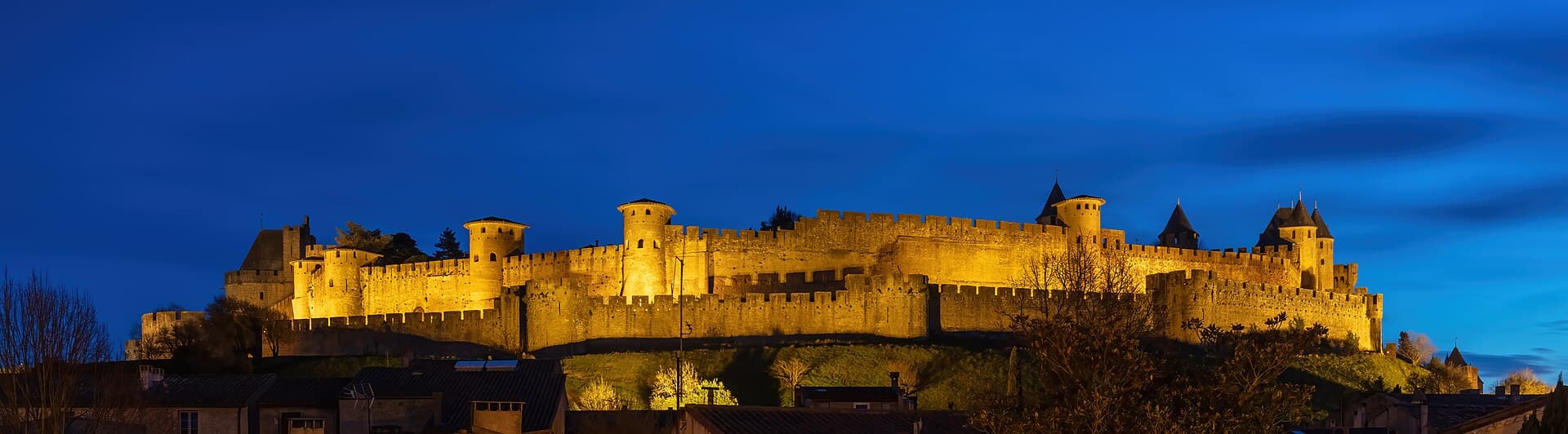
Carcassonne is the headline site. The Medieval City (UNESCO since 1997) is Europe's largest fortified city: 3 km of ramparts, 52 towers, two concentric walls. Restored by Viollet-le-Duc in the 19th century (with some historical inaccuracies but a spectacular result). Visit of the outer ramparts (Lices) is free; the Comtal Château and inner ramparts are paid (€9.50). Visit recommended early morning (9 am) or late afternoon to avoid groups. The Festival de Carcassonne (July) hosts concerts in the antique theatre. Don't miss the Saint-Nazaire Basilica and the often-forgotten lower town (Bastide Saint-Louis).
The Pont du Gard (UNESCO since 1985), Roman aqueduct built around 50 AD to supply Nîmes with water, is one of Europe's most impressive Roman Empire remains (50 m high, 275 m long, 3 storeys of arches). Paid site (€9.50) including bridge access (lower deck crossing allowed), the Pont du Gard Museum (3 floors on the aqueduct and water in Antiquity), and a discovery trail in the garrigue. Canoe possibility on the Gardon in season. Magnificent at sunset. To combine with Nîmes (Roman arenas, Maison Carrée, 25 min) and Uzès (1st duchy of France, 15 min).
Toulouse, nicknamed "La Ville Rose" for its brick foraine constructions (red-orange terracotta), is France's 4th city. Must-sees: Saint-Sernin basilica (Europe's largest Romanesque church), Place du Capitole (18th-century city hall, Hall of the Illustrious), Jacobins convent (southern Gothic church, stone palm tree, Saint Thomas Aquinas's tomb), Pont Neuf (Toulouse's oldest bridge, 1632), Augustins Museum (painting, sculpture, in a former convent), Hôtel d'Assézat (Renaissance, houses the Bemberg Foundation). The Cité de l'Espace (CNES, 30 min by bus) and Aeroscopia (Airbus museum in Blagnac) are perfect for families. Gastronomy: Toulouse cassoulet (at Bibent or Au Bon Crémant), Toulouse sausage, Toulouse violets (sweets and liqueur).
Albi (1h from Toulouse) houses the Sainte-Cécile Cathedral (UNESCO since 2010, the world's largest brick cathedral) and the Toulouse-Lautrec Museum (the world's largest collection of the painter, in the Berbie palace). To visit as a complement: Cordes-sur-Ciel (classified Most Beautiful Village, perched medieval city).
The Cathar castles (Aude, Pyrenees-Orientales) are the tragic legacy of the Albigensian Crusade (13th century). Peyrepertuse, Quéribus, Aguilar, Termes, Puivert, Lastours: spectacular ruins perched on rocky spurs. The Cathar path (250 km from Port-la-Nouvelle to Foix) connects these châteaux.
The Cévennes (UNESCO since 2011 as a cultural landscape of Mediterranean agro-pastoralism) unfold their wild valleys: Mont Aigoual, Mont Lozère, Causse Méjean. Anduze, Saint-Jean-du-Gard, Florac are the gateways. The Corniche des Cévennes (D9) between Florac and Saint-Jean-du-Gard is one of France's most beautiful roads.
The Cirque de Gavarnie (UNESCO, Pyrenees) is one of Europe's most spectacular natural amphitheatres: 1,700 m drop, 422 m waterfall (France's highest), 3,000 m altitude at the summit. Access from Cauterets or Luz-Saint-Sauveur, 2h walk to reach the cirque. Sound and light show in summer. To combine with Lourdes (1h, pilgrimage sanctuary), Cauterets (Belle Époque thermal resort) and Pic du Midi de Bigorre (2,877 m, cable car from La Mongie, astronomical observatory).
The Mediterranean coast alternates modern family resorts (La Grande-Motte, Cap d'Agde, Le Grau-du-Roi), authentic maritime cities (Sète, nicknamed "the singular island", home of Brassens and Valéry), and the Catalan Côte Vermeille: Collioure (painted by Matisse and Derain, Fauvism), Port-Vendres, Banyuls-sur-Mer (terraced vineyards on the sea). Albi and Béziers inland deserve a detour.
The Camargue (partly in Occitanie, partly in PACA) unfolds its unique landscapes: marshes, black bulls, white horses, pink flamingos, salt marshes of Aigues-Mortes (Saint Louis's fortified city, on the Canal du Midi).
Read also
- Carcassonne, Europe's largest medieval city — 3 km of UNESCO ramparts, 52 towers, double wall: the medieval dream restored by Viollet-le-Duc.
- France — Complete country guide: entry rules, regions, budget, gastronomy.
- Provence-Alpes-Côte d'Azur — Provence, Marseille and Riviera just east of Occitanie.
- Nouvelle-Aquitaine — Bordeaux, Basque Country and Pyrenees-Atlantiques west of Occitanie.