site naturel
Étretat
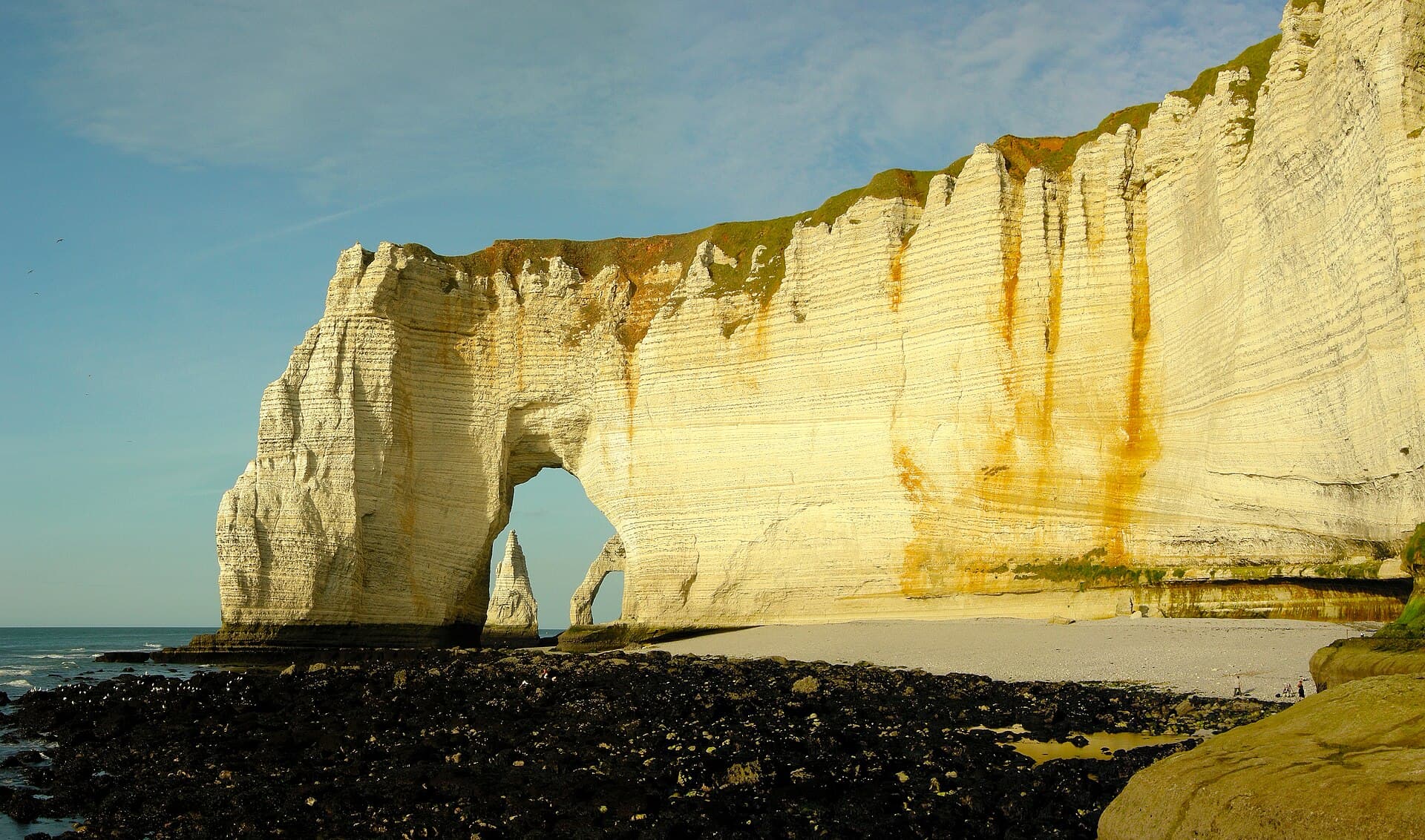
The most photographed natural arches in France, 80 m high, sculpted by erosion: Étretat is the jewel of the Norman Alabaster Coast.
Étretat is one of France's most emblematic coastal sites — a small village of 1,500 inhabitants in Seine-Maritime, dominated by white chalk cliffs 80 metres high sculpted by erosion into spectacular natural arches: the Porte d'Aval (the most iconic main arch), the Manneporte (the widest), the Porte d'Amont (to the north). These cliffs inspired the greatest 19th-century painters: Claude Monet painted more than 80 canvases there, Eugène Boudin, Gustave Courbet and Camille Corot followed.
The Customs Officers' path (GR21, coastal path) allows you to walk the cliffs — 1h30 to reach the Manneporte from the village, exceptional panoramas at every step. The walk to the Notre-Dame de la Garde chapel (at the top of the Amont cliff) offers the iconic view of the Porte d'Aval. At low tide, you can access the foot of the cliffs and pass under the Porte d'Aval arch — remarkable geological spectacle.
The village of Étretat itself retains its preserved charm: Notre-Dame church (12th-13th centuries), fish market hall (1926), Belle Époque villas recalling the time when Étretat was a prized seaside resort of the Parisian bourgeoisie. The Clos Lupin House (museum-house of Maurice Leblanc, creator of Arsène Lupin, writer who lived in Étretat) is highly original. The Étretat Gardens (contemporary creation by Alexandre Grivko, 2017) open at the top of the Amont cliff, mixing topiary art and contemporary sculptures with views over the Channel.
Nearby, the Alabaster Coast unfolds other remarkable sites: Yport (10 km, preserved fishing village), Fécamp (15 km, Bénédictine Palace, fishing port), Saint-Valery-en-Caux, Veules-les-Roses (Most Beautiful Villages, the shortest river in France, 1.2 km).
What we love
- ✅Iconic cliffs: Porte d'Aval, Manneporte, Porte d'Amont — 80 m high, unique landscape in France
- ✅Customs Officers' path (GR21): easy hike with exceptional panoramas
- ✅Artistic heritage: painted by Monet, Boudin, Courbet — the village remains a high place of painting
- ✅Étretat Gardens: spectacular contemporary creation atop the cliff
- ✅Temperate climate, pleasant refuge against summer heatwaves
What to know
- ❌Heavy crowds in high season (July-August), saturated parking
- ❌Limited accommodation in the village (3-4 hotels), book very early
- ❌Pebble beach not sand, uncomfortable
- ❌Unpredictable weather: rain and wind possible year-round
Situation
Où se situe Étretat ?
Ouvrir la carte en grand sur OpenStreetMap →Frequently asked questions
How do I get to Étretat?+
How long to plan on site?+
What's the best time for photos?+
Is the Customs Officers' path difficult?+
Which villages to see around Étretat?+
What to taste in Étretat?+
What are the Étretat Gardens?+
Our verdict
Étretat is one of France's most beautiful coastal sites — the chalk cliffs sculpted into natural arches offer a unique landscape in Europe. The Customs Officers' path (GR21) is an essential hike, 1h30 to the Manneporte to discover the 3 successive arches. Visit preferably in May-June or September for golden light and reduced crowds. Avoid July-August if you can (saturated parking). Combine with a night in Étretat or Fécamp (15 km) to enjoy the sunset on the cliffs — the light at this hour is exceptional, and the village emptied of its daytime tourists regains its preserved charm.
Nearby

"Hiver doux Côte d'Azur, ski Alpes."
Expert on Étretat · 1 contributions
 France Desk — Mowando·Editor