site archeologique
Abu Simbel
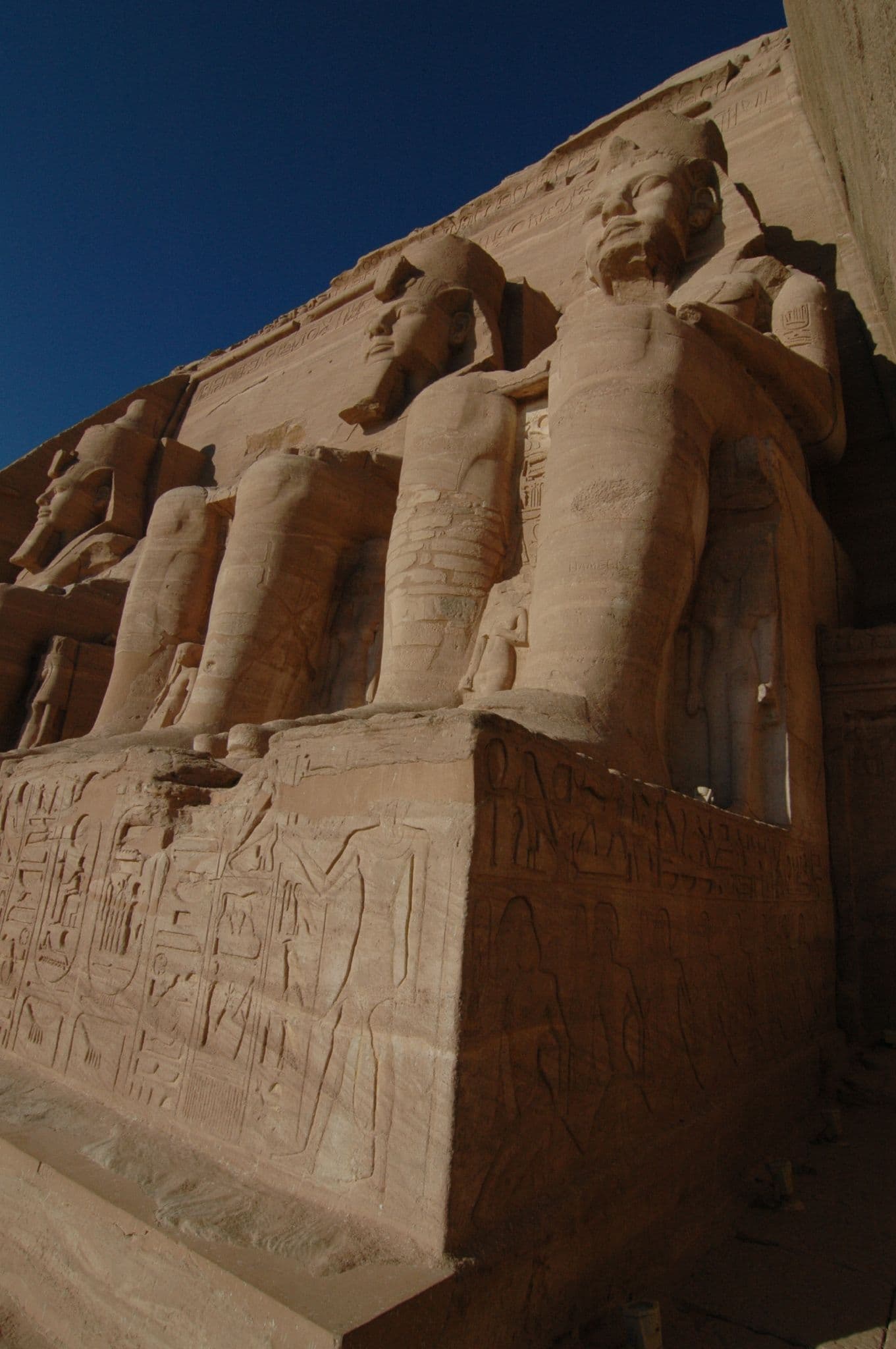
Four 20-metre colossi of Ramesses II carved directly into the cliff, and Nefertari's temple 100 m away — moved block by block in the 1960s to escape the rising Lake Nasser.
Abu Simbel is one of the most moving sites on the planet, on more than one count. It is first of all an absolute architectural masterpiece: commissioned by Ramesses II in the 13th century BC to celebrate his victory at Kadesh against the Hittites and mark Egypt's southern border, the Great Temple rises 33 metres high and displays four colossi of the pharaoh seated, 20 metres high, carved directly into the sandstone cliff. Inside, a sequence of hypostyle halls sinks 65 metres into the rock to the innermost sanctuary, where four seated gods are placed: Ramesses himself deified, Amun-Re, Re-Horakhty and Ptah. Twice a year — on 22 February and 22 October, dates probably chosen to celebrate the pharaoh's birthday and coronation — the first rays of the sun penetrate the corridor at dawn and illuminate three of the four statues, leaving Ptah (god of darkness) in shadow. 100 metres away, the Small Temple is dedicated to Nefertari, Ramesses II's favourite wife, and to the goddess Hathor — a political and amorous gesture of rare audacity for its time, as it is one of the very few Egyptian temples where the queen is depicted at the same scale as the pharaoh.
Abu Simbel is also a monument to international cooperation. With the construction of the Aswan High Dam between 1960 and 1970, Lake Nasser's waters were due to submerge the site under 65 metres of water. UNESCO then launched one of the largest archaeological rescue operations in history: between 1964 and 1968, the two temples were cut into 1,042 blocks of 20 to 30 tonnes each, raised 65 metres higher and 200 metres further away on a specifically built false hill, and reassembled with millimetric precision. The result is so perfect that nothing betrays the operation to the naked eye, and the astronomical orientation of the solar rays has been preserved to within a single day. Nearly 50 countries contributed to the funding (USD 36 million in 1968, equivalent to USD 250 million today). This rescue marked the beginning of the World Heritage Convention — Abu Simbel is, in more than one sense, the cradle of modern UNESCO.
What we love
- ✅One of the absolute architectural masterpieces of Egyptian antiquity
- ✅UNESCO rescue 1964-1968: one of the 20th century's greatest archaeological feats
- ✅Nefertari's Temple: rare temple where the queen appears at the pharaoh's scale
- ✅Solstice ceremonies (22 February and 22 October) at sunrise, unique atmosphere
- ✅Option to arrive by Lake Nasser cruise — magnificent approach at sunset
What to know
- ❌Demanding excursion: 280 km from Aswan, very early morning departure
- ❌Extreme heat from April to October, no shade on site
- ❌Short visit (1-2h) imposed by convoy logistics
- ❌Very limited on-site accommodation (only 3-4 hotels)
Situation
Où se situe Abu Simbel ?
Ouvrir la carte en grand sur OpenStreetMap →Frequently asked questions
How do I get to Abu Simbel?+
How long do I need on site?+
When is the solar solstice ceremony?+
Which season for Abu Simbel?+
Do I need a guide at Abu Simbel?+
Can I sleep at Abu Simbel?+
Is the sound and light show worth it?+
Our verdict
Abu Simbel is one of the three or four great moments of any Egyptian trip, on a par with Karnak, the Giza pyramids and the Valley of the Kings. The logistical effort to get there — 280 km of desert from Aswan, pre-dawn departure, mid-afternoon return — is part of the experience, and the reward is immense: standing before these four 20-metre colossi carved directly into the cliff 33 centuries ago, knowing they were dismantled and rebuilt stone by stone in the 1960s to escape the lake's waters, and imagining Nefertari accompanying her pharaoh-husband in the dim sanctuary next door, is one of those moments that lastingly marks a traveller. Come strictly between October and March, fly if your budget allows, and consider the solstice ceremonies (22 February or 22 October) if your dates align.
Nearby

"Saison sèche idéale, 22°C journée."
Expert on Abu Simbel · 1 contributions
 Africa & Americas Desk — Mowando·Editor