ville
Zagreb
An under-the-radar Mitteleuropean capital, split between the medieval Upper Town and the Austro-Hungarian Lower Town — voted Europe's best Christmas market three years running.
Zagreb is Croatia's capital (810,000 inhabitants, 1.2 million for the metropolitan area) — under-the-radar, too often overlooked by travellers heading straight down to the Adriatic coast. That's a mistake. Inland, at the foot of the Medvednica massif, Zagreb is a genuine Mitteleuropean capital — comparable to Ljubljana, Bratislava or Budapest in its atmosphere, architecture and café culture — that deserves at least 2 nights on any serious Croatian itinerary.
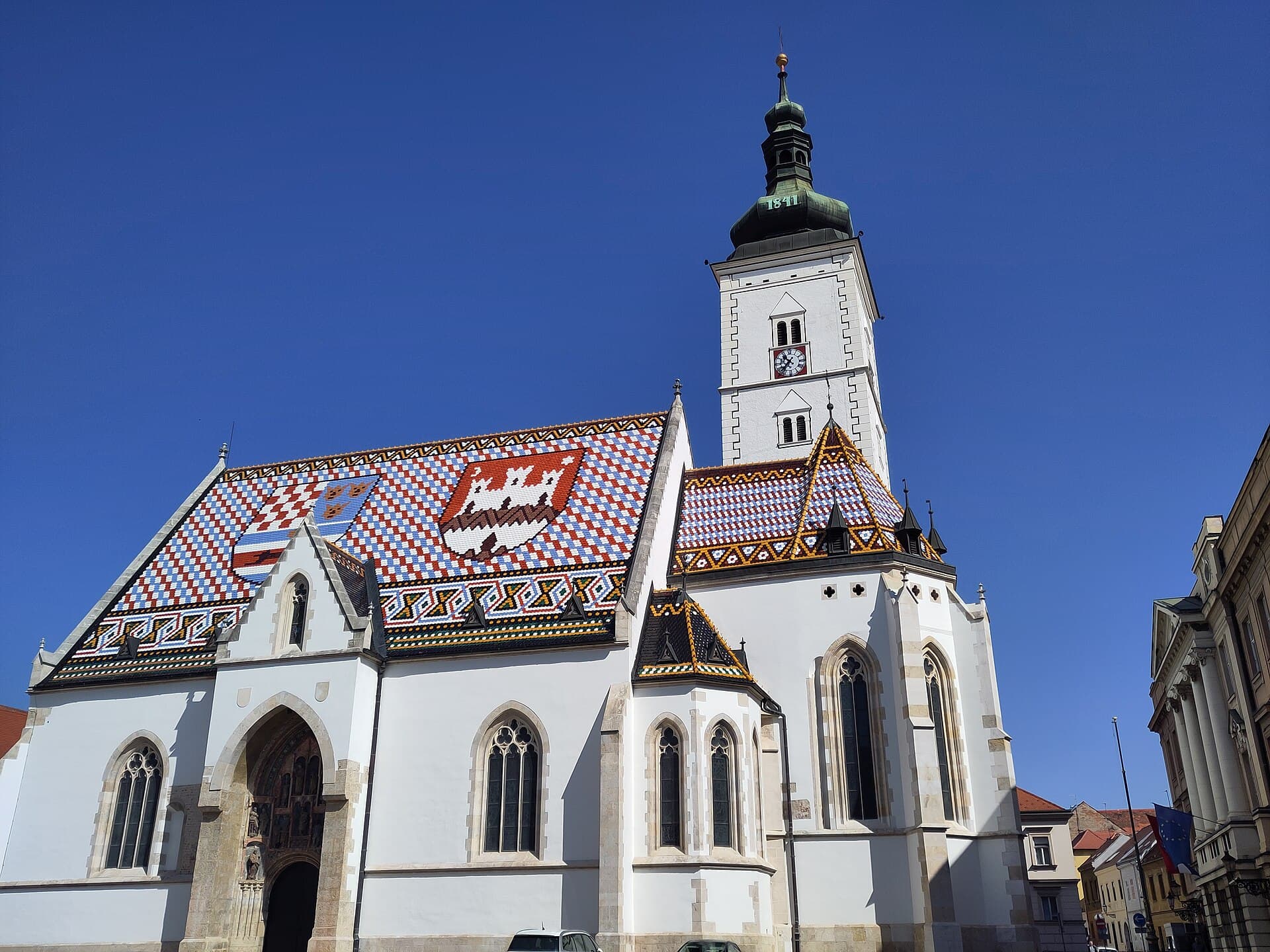
The city splits into two historic parts. The Upper Town (Gornji Grad), perched on two hills (Gradec and Kaptol), forms the medieval heart. Here you find St Stephen's Cathedral (13th century, twin neo-Gothic spires 108 metres tall — Croatia's tallest), the Dolac market (open-air food market, one of Europe's most colourful, open since 1930), St Mark's Church (its tiled roof forming the arms of Zagreb and of the Croatian-Slavonian-Dalmatian kingdom), the Palace of the Bans (seat of the Croatian government), the Stone Gate (Kamenita vrata, the only surviving medieval gate, housing a shrine to the Virgin), the Uspinjača funicular (1893, one of the world's shortest — 66 metres in 64 seconds) linking the lower and upper towns, and the Museum of Broken Relationships — an original concept created in 2010, now a global phenomenon, gathering objects from separated couples with their personal stories.
The Lower Town (Donji Grad) deploys its Austro-Hungarian urbanism from the late 19th century. It's the work of architect Milan Lenuci, who designed "Lenuci's Green Horseshoe" — a succession of eight squares and parks linking the central station to the city heart, lined with palaces, museums, the opera house and King Tomislav Square with its emblematic equestrian statue. Ban Jelačić Square (Trg bana Jelačića), at the foot of the Upper Town, is the central hub: transport, terraces, urban life. Nearby, the Croatian National Theatre (1895, neo-Baroque opera), the Mimara Museum (private collection donated to the city, from the Middle Ages to the 20th century), the Archaeological Museum, the Ethnographic Museum and the Strossmayer Gallery of old masters.
Since 2016, Zagreb has exploded onto the tourism scene thanks to its Christmas market (Advent in Zagreb), voted Europe's best Christmas market three years running (2016, 2017, 2018) by European Best Destinations. From late November to early January, the city centre transforms into a winter fairyland with wooden chalets, mulled wine (kuhano vino) on every corner, concerts, skating rinks, light installations and an atmosphere unlike anywhere else in Central Europe. Advent has become a major reason to visit Zagreb in December.
What we love
- ✅Capitale mitteleuropéenne authentique : architecture austro-hongroise, cafés viennois, vie urbaine vivante
- ✅Marché de Noël Advent : élu meilleur d'Europe 2016-2018, expérience hivernale unique
- ✅Concentration culturelle exceptionnelle : 50+ musées (Mimara, Relations Rompues, Art Naïf, Klovićevi Dvori)
- ✅Marché Dolac : l'un des plus colorés et authentiques d'Europe, à visiter le matin
- ✅Prix très accessibles pour une capitale européenne : repas 10-25 €, hôtel 3* 80-130 €
What to know
- ❌Pas de mer ni de plage — Zagreb est à 200 km de la côte adriatique
- ❌Climat continental rude en hiver (gel, neige, -5 à 5 °C en janvier-février)
- ❌Étés parfois étouffants (32-36 °C en juillet-août, peu de relief pour ventiler)
- ❌Vie nocturne plus calme que les capitales voisines (Ljubljana, Budapest, Belgrade)
Situation
Où se situe Zagreb ?
Ouvrir la carte en grand sur OpenStreetMap →Frequently asked questions
How many days do I need in Zagreb?+
When can I see the Christmas market (Advent) in Zagreb?+
How do I get to Zagreb from London or Paris?+
What are Zagreb's must-see museums?+
What to taste in Zagreb? Local specialities?+
How to combine Zagreb with the rest of Croatia?+
Our verdict
Zagreb is Europe's most under-the-radar Mitteleuropean capital — and that's partly its charm. Preserved Austro-Hungarian architecture, medieval Upper Town, colourful Dolac market, more than 50 museums (including the brilliant Museum of Broken Relationships), Viennese-style café terraces: everything is there for an absolutely successful 2-3 day getaway. Visit in May-June or September for the terraces, in December for Advent (Christmas market voted Europe's best 2016-2018, an absolute must), and combine with Plitvice (2 hours south) and the Adriatic coast. Very gentle prices, warm welcome, a true alternative to better-known European destinations — Zagreb is one of Central Europe's loveliest secrets.
Nearby

"Très calme, hôtels fermés sur les îles."
Expert on Zagreb · 1 contributions
 Mediterranean Desk — Mowando·Editor