Zagreb is mainly explored on foot — the historic centre is compact (around 3 km²). Two main poles: the Upper Town (Gornji Grad) and the Lower Town (Donji Grad).
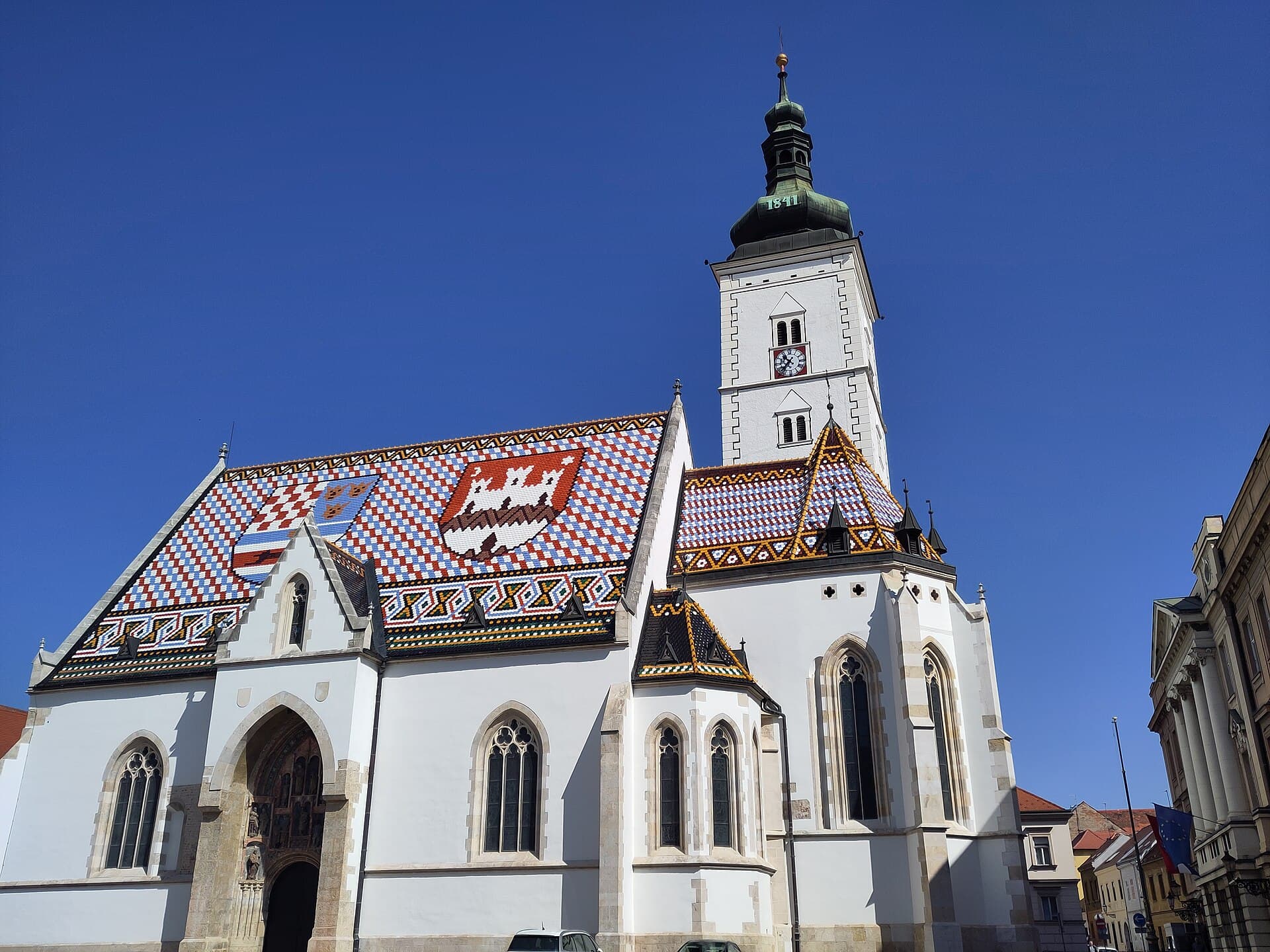
The Upper Town (Gornji Grad). Start with the Dolac market (mandatory in the morning, closed afternoons and Sundays) — open-air market under red parasols since 1930, one of Europe's most colourful. Fresh produce, flowers, cheeses, charcuterie. Then climb to St Stephen's Cathedral (Katedrala Marijina Uznesenja) — twin neo-Gothic spires 108 m tall, the highest in Croatia. Visit the interior (free), the treasury (€4). Cross Kaptol towards the Stone Gate (Kamenita vrata), the only surviving medieval gate of the Upper Town, which shelters a Marian shrine (miraculous image saved from a fire in 1731). Continue to St Mark's Square (Trg svetog Marka) — political heart of Croatia, lined by the Palace of the Bans (Croatian government), the Croatian Parliament (Sabor) and the Constitutional Court. At the centre, St Mark's Church (Crkva svetog Marka, 13th century) with its famous coloured-tile roof forming the arms of Zagreb and of the Croatian-Slavonian-Dalmatian kingdom (interior closed except for services). Visit the Museum of Broken Relationships (right next door) — one of the world's most original and moving museums, concept created in 2010, Kenneth Hudson Prize 2011. Descend by the Uspinjača funicular (1893, 66 metres in 64 seconds, one of the world's shortest, €1) or by the Lotrščak tower (13th century, noon cannon fired daily at 12 sharp).
The Lower Town (Donji Grad). At the foot of the funicular, you reach the pedestrian street Tkalčićeva — backbone of Zagreb social life, lined with cafés and restaurants. Continue to Ban Jelačić Square (Trg bana Jelačića), the city's central hub with the equestrian statue of Ban Jelačić. From there, descend towards Lenuci's Green Horseshoe — a succession of eight squares and parks linking the central station to Ilica street. The most beautiful: Zrinjevac (the most romantic, fountain, bandstand, century-old chestnut trees), Strossmayer Square (Strossmayer Gallery of old masters — Bellini, El Greco, Carpaccio), King Tomislav Square (equestrian statue, Art Pavilion, central station behind). Visit the Croatian National Theatre (HNK, 1895, neo-Baroque), the Mimara Museum (private collection of industrialist Ante Topić Mimara), the Museum of Arts and Crafts, the Archaeological Museum (Vučedol dove, 3000 BC).
Further out: Mount Medvednica (1,035 m, reached by the Sljeme cable car from tram n°14 + bus n°102, 30 minutes from the centre) — forest hikes, medieval castle of Medvedgrad (residence of Croatian bans), traditional restaurants (planinarski domovi). Women's slalom World Cup each January (Snow Queen Trophy). The Mirogoj cemetery (north, reached by bus n°106) — one of Europe's most beautiful garden cemeteries, neo-Renaissance arcades designed by Hermann Bollé (1879), tombs of great Croatians (Tito rests in Belgrade but his mother is here).
In December: Advent in Zagreb (Christmas market voted Europe's best 2016-2018) is the absolute experience. Five main zones: Ban Jelačić Square (giant tree, animations), Zrinjevac park (the most romantic, lights in the chestnut trees, gastronomic chalets), King Tomislav Square (skating rink, concerts), Strossmartre (Upper Town, bohemian vibe), Lenuci Esplanade (chalets and lights). Allow 2-3 full days.
Read also
- Zagreb and Continental Croatia — Austro-Hungarian capital, vivid markets and Europe's award-winning Christmas market.
- Croatia — Complete country guide: entry rules, budget, when to visit, regions.
- Plitvice, 16 UNESCO lakes — 2 hours south of Zagreb: Croatia's most beautiful national park, UNESCO-listed since 1979.
- Split, Diocletian's Palace — 4 hours southwest: UNESCO Roman palace and ferry hub for the Dalmatian islands.