Zadar reveals itself in three poles: the historic Old Town (peninsula), the contemporary works at the western tip, and day trips around the area.
The Old Town (peninsula). Enter through the Land Gate (Kopnena vrata, Venetian, 1543, UNESCO-listed in 2017) that marks the eastern end of the peninsula. Cross the main street Široka ulica — the Roman cardo equivalent — to the historic heart. At the centre, the Roman Forum (1st century AD) is one of the largest on the Adriatic: pillory column used until the 19th century, original Roman slabs, vestiges of the capitol. On the Forum, the pre-Romanesque Church of St Donatus (9th century) — a circular building 27 metres in diameter, one of Europe's most original — reuses Roman elements from the Forum in its construction. Beside it, the Cathedral of St Anastasia (12th-13th centuries, Romanesque) with its 56-metre bell tower (paid climb, €5, panoramic view of the Old Town and the sea). Also visit the Cedulin Palace (18th century), the Archaeological Museum (one of Croatia's oldest, 1832), the Museum of Gold and Silver of Zadar (sacred goldsmith collection from local monasteries, at St Mary's).
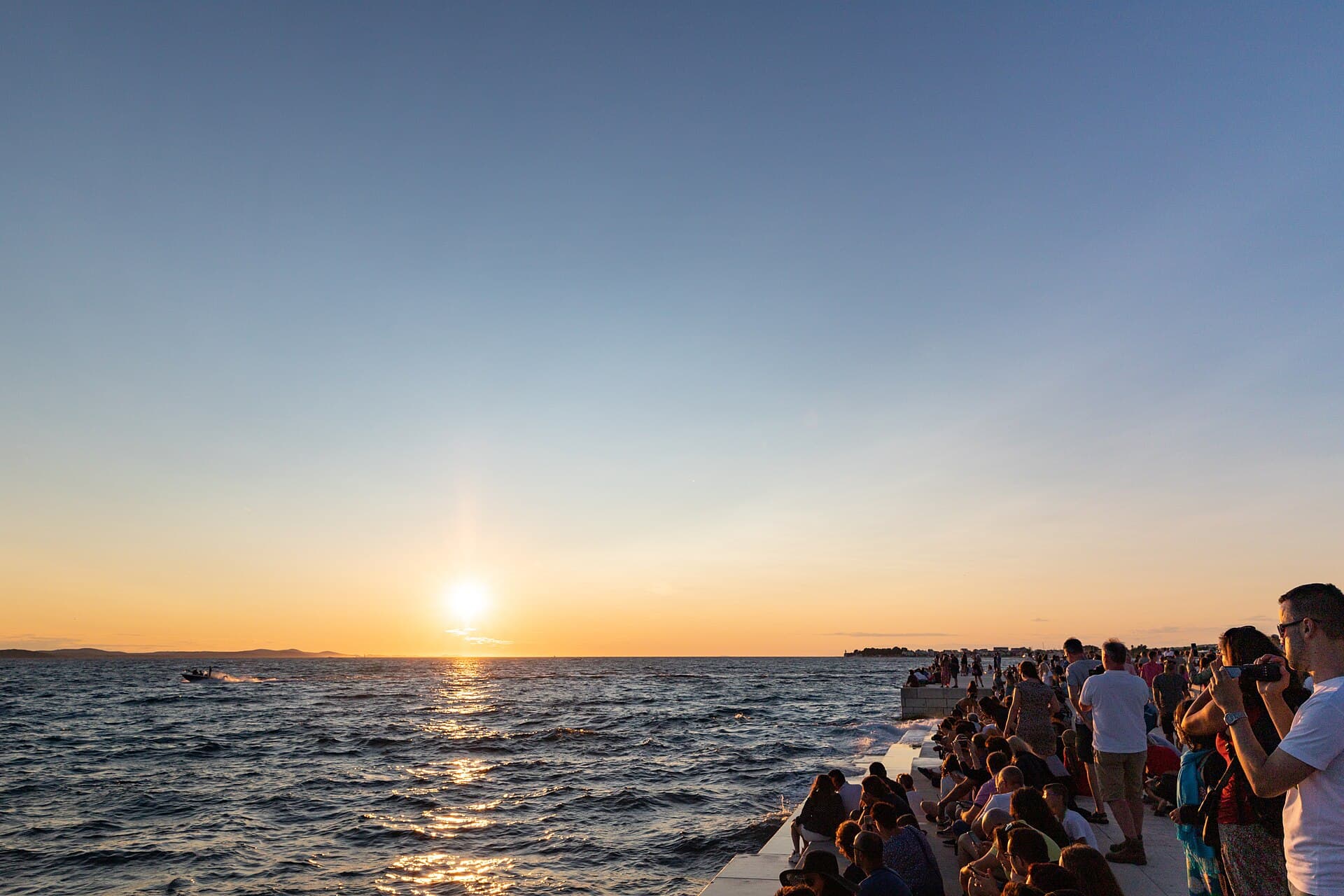
The contemporary works (western tip of the peninsula). The Sea Organ (Morske orgulje, 2005, architect Nikola Bašić): 70 metres of steps descending to the sea, beneath which 35 polyethylene tubes are activated by the waves and air pressure. The melody produced is unique, random, hypnotic. Stay at least 30 minutes on the steps to let it carry you. The Greeting to the Sun (Pozdrav Suncu, 2008, same architect): a 22-metre diameter disc made of 300 ground photovoltaic panels, charging all day and staging at nightfall an hour-long light show — colours dancing on the ground following an algorithm inspired by planetary motion. This is where the crowd gathers for the sunset (called by Hitchcock in 1964 "the most beautiful in the world").
Day trips. Krka National Park (1 hour by car south, or bus + boat): seven major travertine waterfalls (Skradinski Buk, Roški Slap), Orthodox monastery on an islet, swimming allowed below Skradinski Buk (though regulated since 2021). Plitvice National Park (1h30 by car east): 16 UNESCO terraced lakes. The Kornati Islands (national park 1 hour by boat offshore): a rocky, desert archipelago of 89 uninhabited islands, paradise for sailing and diving — day boat tours organised from Zadar (€60-90 per person, lunch included). Ugljan island (25 minutes by fast ferry from Zadar): green island with preserved villages, pebble beaches, Venetian St Michael's Fort. Pag island (1 hour by car via the bridge): lunar landscapes, Zrće beach (Croatia's summer party epicentre), PDO paški sir cheese, UNESCO lacework.
Read also
- Northern Dalmatia: Zadar and Plitvice — Zadar's Sea Organ, Plitvice National Park and the Kornati archipelago.
- Croatia — Complete country guide: entry rules, budget, when to visit, regions.
- Plitvice, 16 UNESCO lakes — 1h30 from Zadar: Croatia's most beautiful national park, UNESCO-listed since 1979.
- Split, Diocletian's Palace — 2h30 from Zadar: UNESCO Roman palace and ferry hub for the Dalmatian islands.