site naturel
Uluru
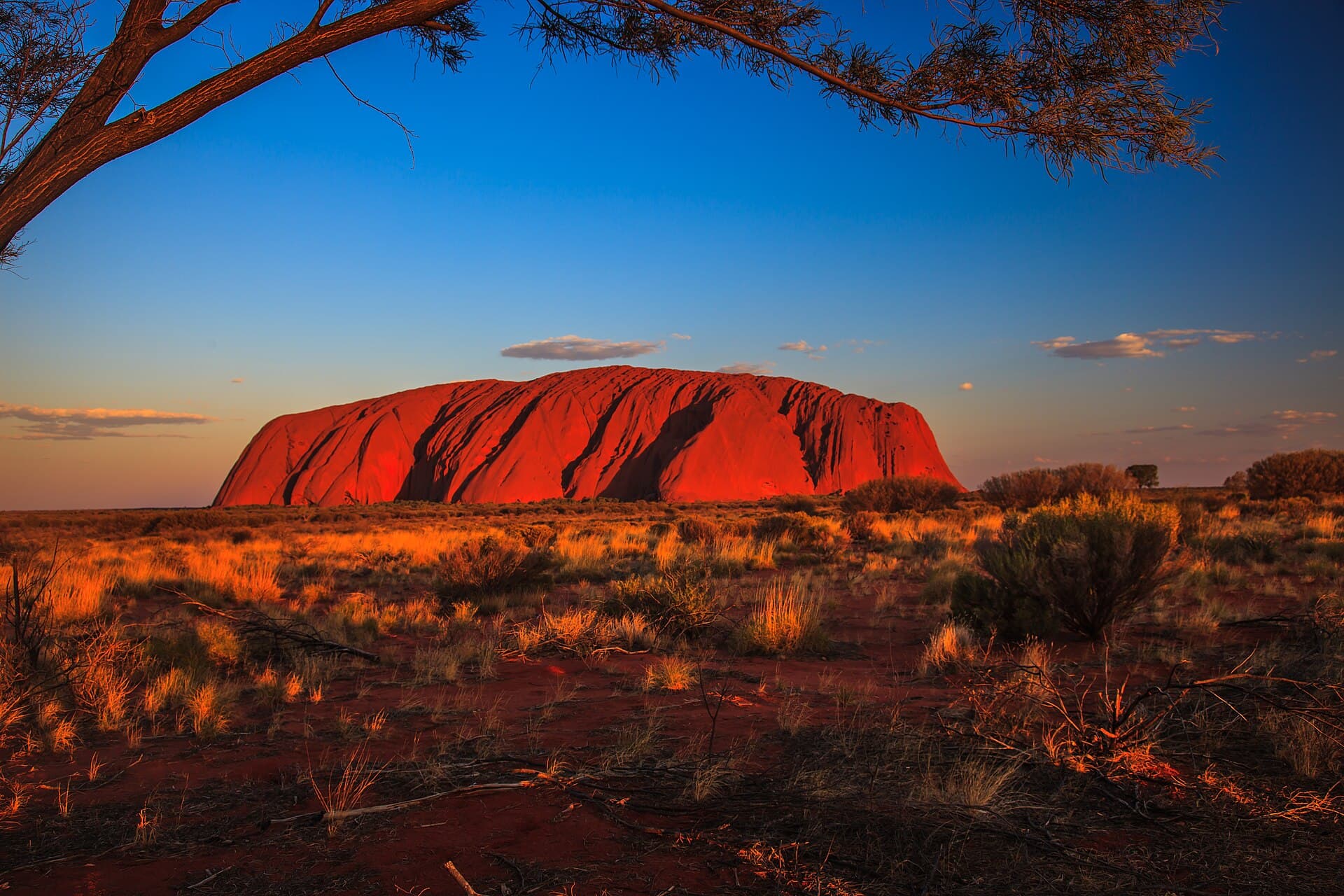
Uluru is the absolute icon of the Australian Outback — 348 m red sandstone monolith, sacred to the Aboriginal Anangu people for 30,000 years, spectacular sunrise and sunset (colour change from deep ochre to bright red), marking spiritual experience.
Uluru (officially Uluru / Ayers Rock, dual nomenclature since 1993 — Uluru being the traditional Anangu name, Ayers Rock the name given by explorer William Gosse in 1873) is the absolute icon of the Australian Outback and one of the world's most powerful natural sites. This arkosic sandstone monolith (reddish cemented sand containing 25% feldspar, which gives the intense red colour through iron oxidation) emerges isolated from an eroded desert plain — 348 m height above ground, 9.4 km circumference, 3.6 km long by 2 km wide. But above all, it sinks 6 km deep underground — Uluru is a true geological giant of 550 million years, originally a sedimentary deposit at the bottom of an inland sea, uplifted by tectonic movements.
Uluru is sacred to the Anangu people (Pitjantjatjara and Yankunytjatjara, the Aboriginals of the Red Centre) for at least 30,000 years according to archaeological dating — but the Anangu themselves consider their presence eternal, since the Tjukurpa (the Dreamtime, the Aboriginal cosmology where creation, ancestors, territory, laws and practices are linked in a unified system). The rock is associated with several sacred stories: the rainbow serpent, the Mala lizard-men, the Kuniya python-woman. Each relief, fault, cave and water hole of Uluru has a precise spiritual meaning for the Anangu, and some zones are so sacred they are photo-prohibited (clearly signed on the Base Walk).
The site was UNESCO World Heritage listed in 1987 for nature (unique desert landscape, endemic wildlife and flora), then added in 1994 for Aboriginal culture (Tjukurpa, rock art, sacred sites) — one of the rare mixed natural-cultural sites in the world. Uluru was officially returned to the Anangu on October 26, 1985 — one of the most symbolic acts of reconciliation between Australia and First Nations. Since then, the site is jointly managed by the Anangu (via Parks Australia and the Traditional Owners Council) under the name Uluru-Kata Tjuta National Park.
On October 26, 2019, exactly 34 years after the return, climbing Uluru was permanently prohibited by management council decision — a historic victory after decades of Anangu requests who considered climbing as sacred desecration. Previously, thousands of tourists climbed annually (10,000 to 20,000/year in the 1990s-2000s), causing 37 deaths since 1958 (falls, heart attacks, hyperthermia) and serious path erosion. Today, the experience is lived walking around the monolith via the Base Walk (10.6 km circular, 3-4h, easy but long — leave early to avoid heat), which offers extraordinary changing perspectives, allowing observation of Mutitjulu caves (ancient Aboriginal rock art), Mutitjulu water hole (precious refuge for desert wildlife), Kuniya reliefs (associated with Dreamtime).
The absolute signature experience is the sunrise and sunset over Uluru. In a few minutes, the monolith literally changes colour — passing from violet/grey shadow before dawn to deep ochre, then bright red, finally flamboyant orange for 20-30 minutes. One of the world's most powerful visual spectacles, and each Uluru day rhythms around these two moments. Official viewing areas: Talinguru Nyakunytjaku Sunrise Viewing Area (north-east, plan 30 min walk from parking, free access), Sunset Viewing Area (west, free access, parking and benches). Bring Australian wine and cheese, it's the cultural custom.
The Tjukurpa Cultural Centre (free, open year-round at park entrance) explains Anangu culture, Tjukurpa, return history, and offers activities guided by Anangu themselves: dot painting (traditional Aboriginal art style, AUD 50-90), boomerang making, bush tucker (traditional Aboriginal cuisine), Mala Walk guided hike (30 min, free with Anangu ranger some mornings).
What we love
- ✅Absolute Outback icon: the emblematic image of natural Australia
- ✅Spectacular sunrise and sunset: colour change ochre → red → orange
- ✅World's oldest Aboriginal culture (Anangu, 30,000+ years) respectfully accessible
- ✅Double UNESCO listing (1987 nature, 1994 culture) — rare
- ✅Exceptional starry sky (Dark Sky Place): Milky Way to naked eye spectacular
What to know
- ❌Climbing prohibited since 2019 (out of respect, some visitors disappointed)
- ❌Extreme heat in summer (38-45 °C November-March): impossible hikes
- ❌Limited and expensive lodging: Yulara/Ayers Rock Resort monopoly AUD 200-2,500/night
- ❌Annoying flies in summer (fly net recommended)
- ❌Flight from Sydney/Melbourne 3-3h30 (AUD 250-450 return)
Situation
Où se situe Uluru ?
Ouvrir la carte en grand sur OpenStreetMap →Frequently asked questions
Can you still climb Uluru?+
When is the best time to visit Uluru?+
How to get to Uluru?+
Where to stay at Uluru?+
What is the Sounds of Silence dinner?+
Our verdict
Uluru is Australia's signature nature and spiritual experience — the absolute Outback icon, sacred Aboriginal monolith, UNESCO double-listed site. Plan 2-3 nights minimum at Yulara/Ayers Rock Resort: Day 1 — arrival, sunset over Uluru from Sunset Viewing Area. Day 2 — sunrise from Talinguru Nyakunytjaku, Base Walk (10.6 km, 3-4h morning), Cultural Centre, sunset + Sounds of Silence dinner (AUD 220-250/person, under stars with astronomical observation). Day 3 — Kata Tjuta (Olgas) Valley of the Winds hike (7.4 km, 3-4h), return flight from AYQ. Imperatively prioritise austral winter (May to September) — perfect climate, no flies. Avoid November-March (extreme heat 38-45 °C, dangerous hikes). Do not forget the cultural dimension: respect prohibited photo zones (clearly signed), visit the Cultural Centre, ideally opt for Anangu-guided experience.
Nearby

"Été extrême, chaleur dangereuse 38-45 °C."
Expert on Uluru · 1 contributions
 South-East Asia Desk — Mowando·Editor