parc national
Grand Canyon
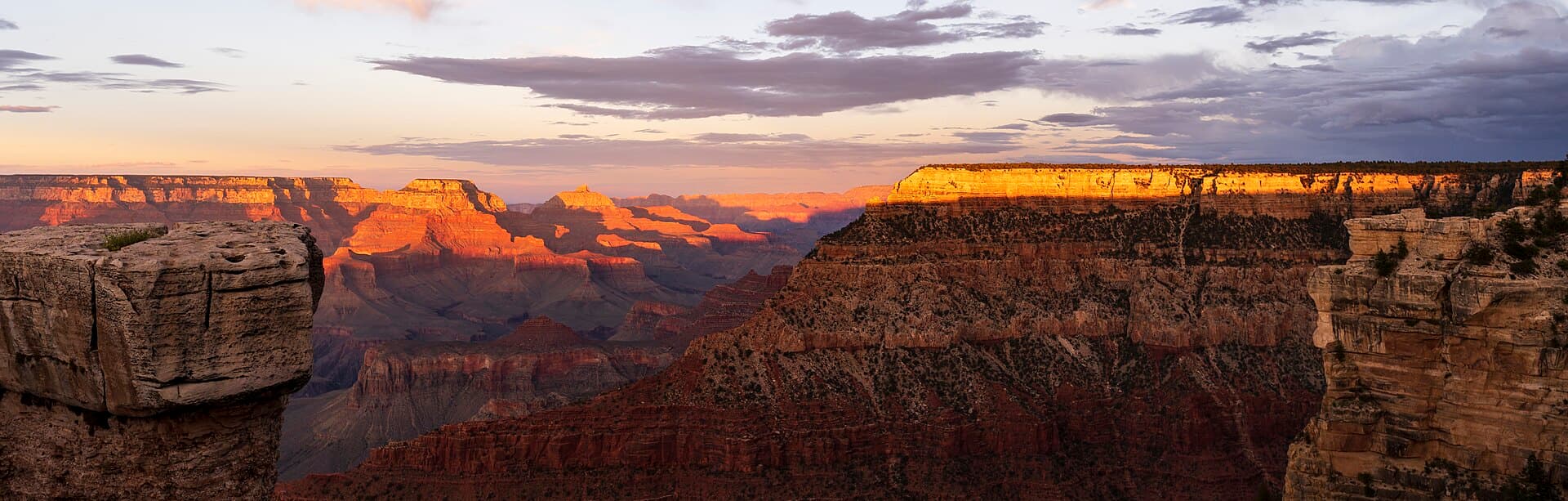
One of the world's most impressive natural landscapes — gorges carved by the Colorado River over 6 million years in the Colorado Plateau, 446 km long, 29 km wide, 1,829 m maximum depth, UNESCO-listed 1979, national park since 1919.
The Grand Canyon (Arizona, USA) is one of the world's most impressive natural landscapes — gorges carved by the Colorado River over 6 million years in the Colorado Plateau. Vertiginous dimensions: 446 km long (from Glen Canyon Dam to Lake Mead), 6 to 29 km wide, up to 1,829 m maximum depth. The national park covers 4,932 km² (larger than Luxembourg), UNESCO-listed 1979 for its exceptional geological value (stratigraphy exposes 2 billion years of Earth history, from Precambrian Vishnu Schist rocks to Permian Kaibab limestone). 6 million annual visitors (2nd most visited US national park after Great Smoky Mountains).
The park divides into 3 distinct zones: South Rim (2,100 m elevation, 90% of visitors, year-round open, complete services, most iconic views — Mather Point, Yavapai Point, Hopi Point, 1932 Mary Colter Desert View Watchtower), North Rim (2,500 m elevation, closed October to May by snow on Route 67, wilder, 10% of visitors, Bright Angel Point, Cape Royal, Point Imperial), and Bottom (Phantom Ranch lodge, canyon floor, accessible only on foot via Bright Angel Trail 12h descent or by mule 1 night, $600-900/person 6-month-ahead booking). The two rims are 16 km apart as the crow flies but 346 km by road (4h drive as no bridge between the two banks).
Native Americans have inhabited the canyon for 12,000 years (Ancestral Puebloans with cliff dwellings, Cohonina, Cerbat, Pai), 11 contemporary tribes have spiritual ties and adjacent lands (Hualapai on West Rim with Skywalk glass walkway, Havasupai in the canyon with Havasu Falls turquoise cascades accessible only by 16 km hike + very difficult permit). First European to see the canyon: García López de Cárdenas (Spanish Coronado expedition, 1540). Major American exploration: John Wesley Powell (1869, first Colorado descent by boat, Civil War amputee veteran who led 3-month expedition without cartography). The park became National Monument 1908 (Theodore Roosevelt — 'leave it as it is') then National Park 1919.
What we love
- ✅One of the world's most impressive landscapes — view that defies imagination (1,829 m deep, 29 km wide), UNESCO-listed
- ✅South Rim year-round accessible — magical snowy landscapes in winter (reduced crowds, red canyon + white powder contrast)
- ✅Exceptional hikes — easy Rim Trail (21 km flat edge), Bright Angel Trail progressive descent, spectacular South Kaibab Trail
- ✅Phantom Ranch at canyon floor (1922 historic Mary Colter lodge, unique experience, 6-month-ahead booking)
- ✅Accessible from Las Vegas (4h drive) or Phoenix (4h) — ideal base camp for Western parks road trip
What to know
- ❌Distances — South Rim 4h drive from Las Vegas or Phoenix, North Rim 4 additional hours from South Rim
- ❌Massive summer crowds (6M annual visitors concentrated May-September), saturated parking, mandatory shuttles
- ❌Extreme Bottom heat in summer (40-45°C) — dehydration risk, several reckless tourist deaths/year
- ❌North Rim closed mid-October to mid-May (Route 67 cut by snow)
- ❌Rare intra-park lodgings — El Tovar 78 rooms, Bright Angel Lodge 90 cabins, Phantom Ranch 11 cabins + dorms — 6-month-ahead booking
Situation
Où se situe Grand Canyon ?
Ouvrir la carte en grand sur OpenStreetMap →Frequently asked questions
How many days for Grand Canyon?+
South Rim or North Rim?+
Should you descend to canyon bottom?+
How to reach Grand Canyon?+
What budget for Grand Canyon?+
Our verdict
The Grand Canyon South Rim is an absolute must — one of the world's most impressive natural landscapes, year-round accessible. Our advice: minimum 2 nights to enjoy fully (1 night = you arrive and leave without really seeing sunset + sunrise, the magic moment). Stay intra-park at El Tovar Hotel (1905, most historic, $280-450/night, 6-month-ahead booking on grandcanyonlodges.com), Bright Angel Lodge (cabins $150-280, more affordable), Yavapai Lodge, Maswik Lodge. Outside park: Tusayan motels ($100-200/night, at entrance 3 km from Visitor Center) or Williams (1h south, historic Route 66 gateway $80-150). Favour April-June or September-October for optimal climate (18-25°C, moderate crowds). Classic 2-day programme: Day 1 East South Rim — Mather Point (sunrise 5:30am summer, 6:45am winter), Yavapai Point + Yavapai Geology Museum, Grand View Point, Moran Point, Lipan Point, 1932 Desert View Watchtower (east end with Painted Desert view). Rim Trail walk between points. Hopi Point or Hermits Rest sunset. Day 2 West South Rim + hike: Bright Angel Trail 4-6 km descent (1.5 Mile Resthouse or 3 Mile Resthouse, u-turn! Don't descend Bottom + return same day — several reckless tourist deaths/year), or South Kaibab Trail (more spectacular descent without water or shade, Ooh Aah Point 1.5 km good u-turn). Afternoon Hermits Rest Road (10 km, mandatory free shuttle March-November, Hopi-Mohave-Pima-Hermits Rest panoramic views). Evening ranger talk (free, variable schedule). $35/vehicle entry valid 7 days (or America the Beautiful Pass $80/year for all national parks). For Bottom (Phantom Ranch), 2 options: 1-night mule $600-900/person (6-month-ahead booking, 2 days total descent + return), or 2-3 day bivouac hike (mandatory BackCountry Permit Office 4 months ahead, demanding physical conditioning). Helicopter from Tusayan: $200-350/person flyover 30-50 min. Helicopter excursion from Las Vegas: $250-450/person half day with West Rim or South Rim landing.
Nearby

"Janvier : neige fréquente South Rim, North Rim fermé, magique mais glacial."
Expert on Grand Canyon · 1 contributions
 Africa & Americas Desk — Mowando·Editor