expérience
Great Ocean Road
The Great Ocean Road is one of the world's most beautiful coastal road trips — 243 km between limestone cliffs (iconic 12 Apostles), eucalyptus forests (Cape Otway, wild koalas), seaside villages (Apollo Bay) and legendary surf beaches (Bells Beach).
The Great Ocean Road (GOR) is one of the world's most beautiful coastal road trips — 243 km of panoramic road along the south coast of Victoria, between Torquay (1h30 from Melbourne, starting point) and Allansford (near Warrnambool, ending point). It is also a national memorial monument: built between 1919 and 1932 by Australian soldiers returned from World War I (the 'returned soldiers') as an employment programme and tribute to Great War victims — officially recognised as the world's largest memorial monument by its length.
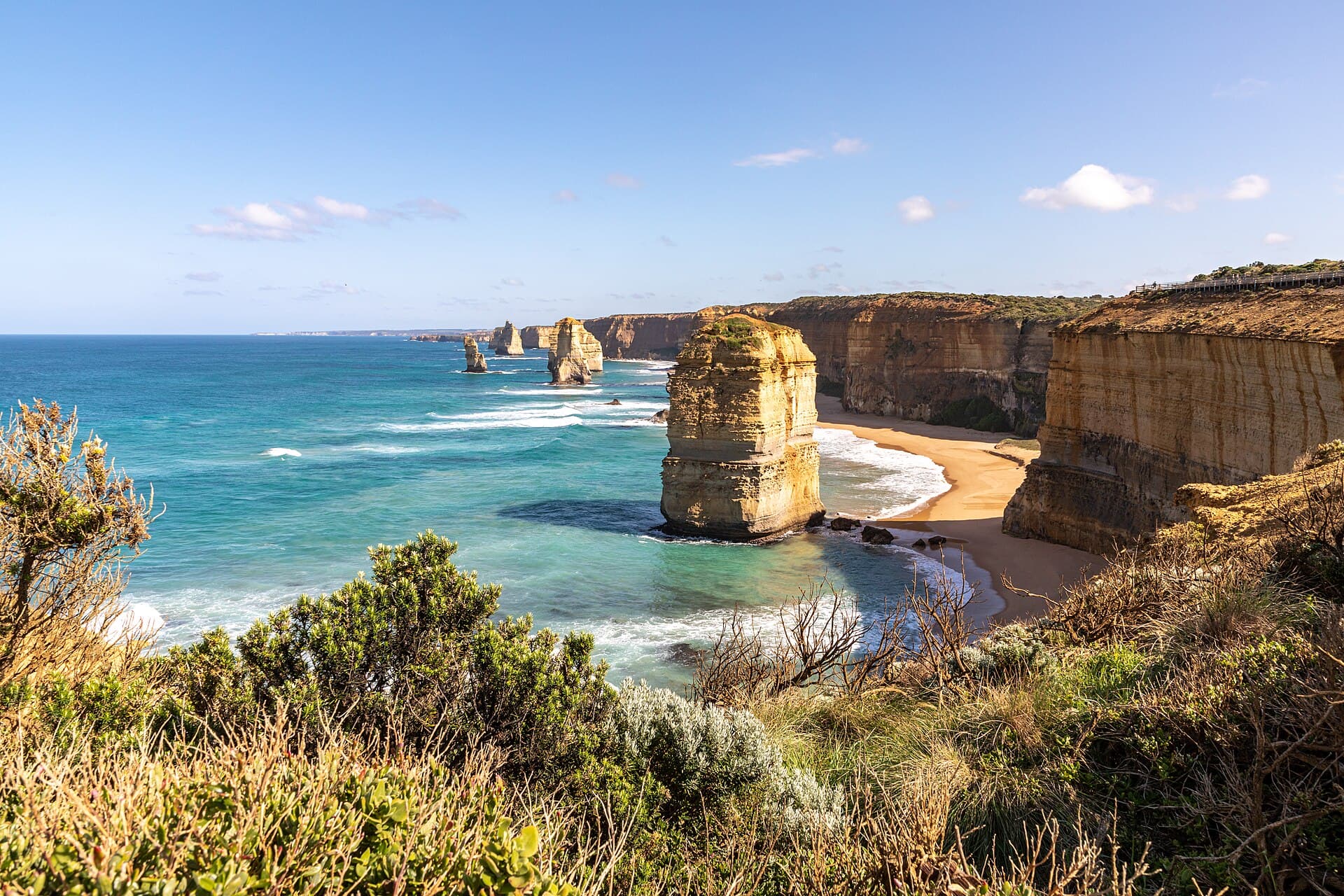
The road winds between spectacular limestone cliffs, pluvial eucalyptus forests and legendary surf beaches. The most iconic stretch is the Port Campbell National Park (4h from Melbourne, after Apollo Bay) where the famous rock formations are: 12 Apostles (actually 8 ochre-yellow limestone pillars remaining since one collapsed in July 2005 and another earlier — erosion continues, several will disappear in coming centuries), Loch Ard Gorge (marine gorge named after the clipper Loch Ard which ran aground there in 1878 with 54 victims out of 56 people on board), London Arch (formed by arch collapse in 1990 — two tourists were rescued by helicopter, stranded on the isolated islet), The Razorback, The Grotto, Bay of Islands.
The Great Otway National Park (midway, between Lorne and Port Campbell) is the other major attraction. Temperate rainforest of giant eucalyptus (Mountain Ash, Eucalyptus regnans, up to 80 m), tree ferns, lichens — one of Victoria's oldest ecosystems. Cape Otway is the refuge of wild koalas: Cape Otway Lighthouse Road (12 km from Great Ocean Road, eucalyptus-lined road) is famous for koala sightings in the trees — free, look up, dozens of individuals visible from roadside (among Australia's highest wild koala densities). The Otway Fly Treetop Adventures (AUD 25-30) offers a 600 m treetop walk at 30 m high in the canopy — signature experience with panoramic forest view.
The coastal villages punctuate the road. Torquay (at the start) is the world's surf capital — headquarters of Rip Curl and Quiksilver brands (founded here in the 1960s), the famous Bells Beach surf spot (world competition Rip Curl Pro every Easter), Surf World Museum. Lorne (1h from Torquay) is a charming seaside village with restaurants, cafés, family beach. Apollo Bay (1h30, after Great Otway National Park) is the recommended overnight stop — small coastal town with seafood restaurants, base for Cape Otway excursions. Port Campbell (3h, just before the 12 Apostles) is the other main stop — very simple village but ideal position to see the 12 Apostles at sunrise AND sunset without day-tripper crowds.
The signature experience is seeing the 12 Apostles at sunset (golden light on ochre limestone — Great Ocean Road's emblematic image) or at sunrise (pink-orange light from the east, minimal crowds). The Twelve Apostles Lookout (free, parking) is the main observation area, directly accessible from the road. For best photos, descend on Gibson Steps (staircase carved in the cliff, 86 steps, accessible 1 km east of 12 Apostles) — you arrive on the beach at the foot of cliffs, with 2 Apostles directly visible at your sides.
What we love
- ✅One of the world's most beautiful road trips: 243 km of spectacular coastal landscapes
- ✅12 Apostles: iconic ochre limestone rock formations, signature sunrise/sunset
- ✅Wild koalas visible at Cape Otway Lighthouse Road (free, from roadside)
- ✅Legendary surf: Bells Beach (Rip Curl Pro every Easter), world surf capital
- ✅Memorial: built by soldiers returned from World War I (1919-1932)
What to know
- ❌Long road trip: 243 km straight but 6-8h drive with stops, 2-3 days minimum recommended
- ❌Mid-day crowds at 12 Apostles (day excursions from Melbourne)
- ❌Cold sea (12-18 °C) — not really swimming despite beaches
- ❌Capricious Victorian weather (four seasons in one day)
- ❌12 Apostles in continuous erosion: 8 pillars remaining, some will disappear
Situation
Où se situe Great Ocean Road ?
Ouvrir la carte en grand sur OpenStreetMap →Frequently asked questions
How many days for the Great Ocean Road?+
Do you need a car for the Great Ocean Road?+
What must you see on the Great Ocean Road?+
Where to stay on the Great Ocean Road?+
Can you see wild koalas on the Great Ocean Road?+
Our verdict
The Great Ocean Road is one of the world's most beautiful road trips and the natural extension of a Melbourne stay. Plan 2-3 days minimum to fully enjoy: Day 1 — Melbourne → Torquay (Bells Beach surf) → Lorne (waterfront lunch) → Apollo Bay (overnight, seafood restaurants). Day 2 — Apollo Bay → Cape Otway (wild koalas from roadside — free) → Otway Fly Treetop Adventures (option) → Port Campbell (overnight) with sunset at 12 Apostles. Day 3 — Sunrise at 12 Apostles (no crowds) → Loch Ard Gorge → London Arch → Bay of Islands → return via interior (faster road via Colac, 3h to Melbourne). Mandatory car rental (AUD 50-80/day, left-hand driving). Prioritise austral spring (October-November), summer (December-February) or autumn (March-April). Signature experience: a sunrise or sunset at 12 Apostles from the lookout or Gibson Steps.
Nearby

"Été, pic touristique, vacances scolaires."
Expert on Great Ocean Road · 1 contributions
 South-East Asia Desk — Mowando·Editor