village
Vík
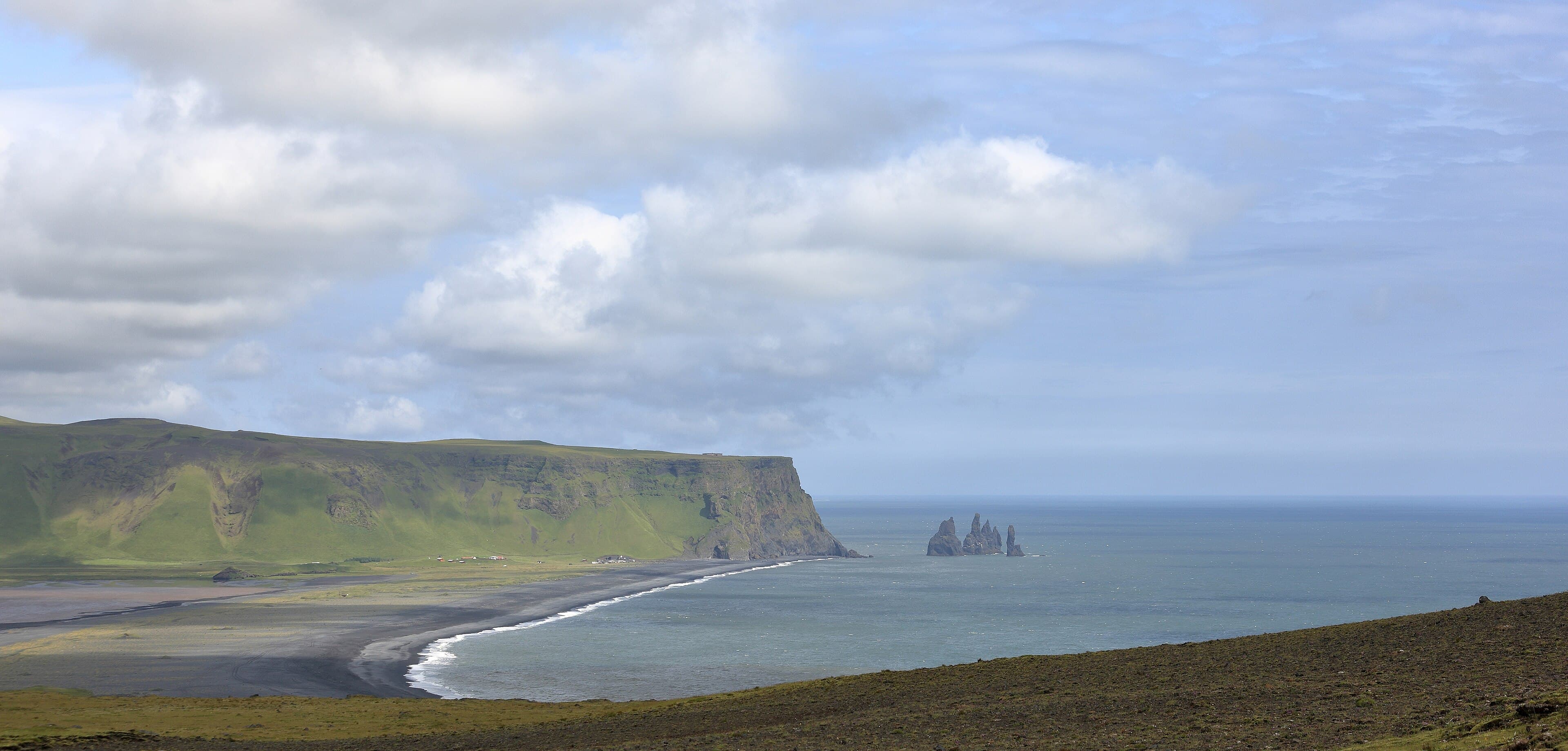
One of Iceland's most photogenic sites: black volcanic sand, hexagonal basalt columns, sea stacks rising from the ocean and a perfect basalt-columned cave — all at the foot of the country's southernmost village.
Vík (Vík í Mýrdal in full) is Iceland's southernmost village — 300 inhabitants at the foot of the Mýrdalsjökull glacier, set on the black Atlantic coast. Its red church perched on a hill is one of the country's iconic images: local legend says it is the only building that would survive a possible eruption of the Katla volcano under the glacier (lava and mud flows would reach the sea by skirting the hill). It is the main stopover on Route 1 between Reykjavik and Jökulsárlón, and the mandatory stop to visit the Reynisfjara black beach 5 km to the west.
Reynisfjara is probably Iceland's most famous beach. The black volcanic sand comes from the erosion of basalt rocks by the Atlantic Ocean. The Hálsanefshellir cave (on the right as you arrive on the beach) houses the country's most perfect basalt columns: hundreds of hexagonal columns of extraordinary geometric regularity, the result of slow and symmetric cooling of volcanic lava. Offshore, the Reynisdrangar stacks (rocks rising from the ocean 100-200 m from the beach) are remnants of an eroded ancient cliff. Icelandic legend says they are two trolls petrified by the first rays of sun as they tried to drag a ship ashore — they have remained frozen in the sea ever since.
WARNING: Reynisfjara beach is dangerous. It suffers from sneaker waves — unusually powerful waves that can appear without warning from the Atlantic and sweep careless visitors into the sea. Several tourist deaths have been recorded in recent years (at least 5 since 2007, including one in 2022 and one in 2024). The alert system installed includes orange/red lights at the beach entrance depending on the danger level. Strictly observe the warning signs, never turn your back to the ocean, stay more than 30 metres from the edge and never go down on the wet sand. Vigilance is particularly important on rough-sea days (check conditions on safetravel.is).
5 km west of Vík, the rocky peninsula of Dyrhólaey (accessible by Route 218) offers one of the best panoramas on Iceland's south coast: plunging view over Reynisfjara beach, the Dyrhóláey rock arch (which ancient navigators sailed through) and the Mýrdalsjökull glacier. It is also one of the best puffin observation sites in Iceland, between May and early August: birds nest in the cliffs and return to the nest in late afternoon (4pm-10pm). Free site, parking at the top (sometimes closed during nesting season to preserve the birds), marked path to the cliffs.
What we love
- ✅Emblematic black beach with basalt columns and Reynisdrangar stacks — Iceland's iconic site
- ✅Free access (beach, parking, trails, Dyrhólaey)
- ✅Puffins at Dyrhólaey between May and early August (5 km west)
- ✅Vík: only stopover village on 250 km between Hvolsvöllur and Höfn, restaurants and hotels available
- ✅Red church perched on the hill: iconic photo in all seasons
What to know
- ❌Reynisfjara beach dangerous (sneaker waves, several deaths) — permanent vigilance required
- ❌Heavy crowds in mid-day (10am-4pm) in high season
- ❌Vík accommodation to book 3-4 months ahead (limited capacity)
- ❌Often windy and changeable weather, powerful spray
Situation
Où se situe Vík ?
Ouvrir la carte en grand sur OpenStreetMap →Frequently asked questions
Is Reynisfjara beach really dangerous?+
How long to spend at Vík and Reynisfjara?+
Can you see puffins at Vík or Reynisfjara?+
What restaurants in Vík?+
Where to sleep at Vík?+
What else to see in the Vík region?+
Our verdict
Vík and Reynisfjara are an unmissable stop on Iceland's south coast, both as a logistical stopover (only complete village between Hvolsvöllur and Höfn) and a major natural site (Iceland's most emblematic black beach). Count 2-3 hours on site: 30 min to 1 h for Reynisfjara (beach, Hálsanefshellir cave, Reynisdrangar stacks), 30 min at Dyrhólaey (panorama, puffins in season), 30 min in Vík village (red church, restaurant). Our tip: strictly respect sneaker wave warnings on Reynisfjara — never go down on the wet sand and stay 30 m from the edge. Sleep at Vík (Hotel Kría with sea view, Hotel Vík mid-range, or Suður-Vík guesthouse) to better enjoy the beach at dawn or sunset without crowds. In winter, the site is one of the best aurora-viewing spots accessible from Reykjavik (3 h drive).
Nearby

"Aurores boréales, peu de monde."
Expert on Vík · 1 contributions
 Mediterranean Desk — Mowando·Editor