site naturel
Pamukkale
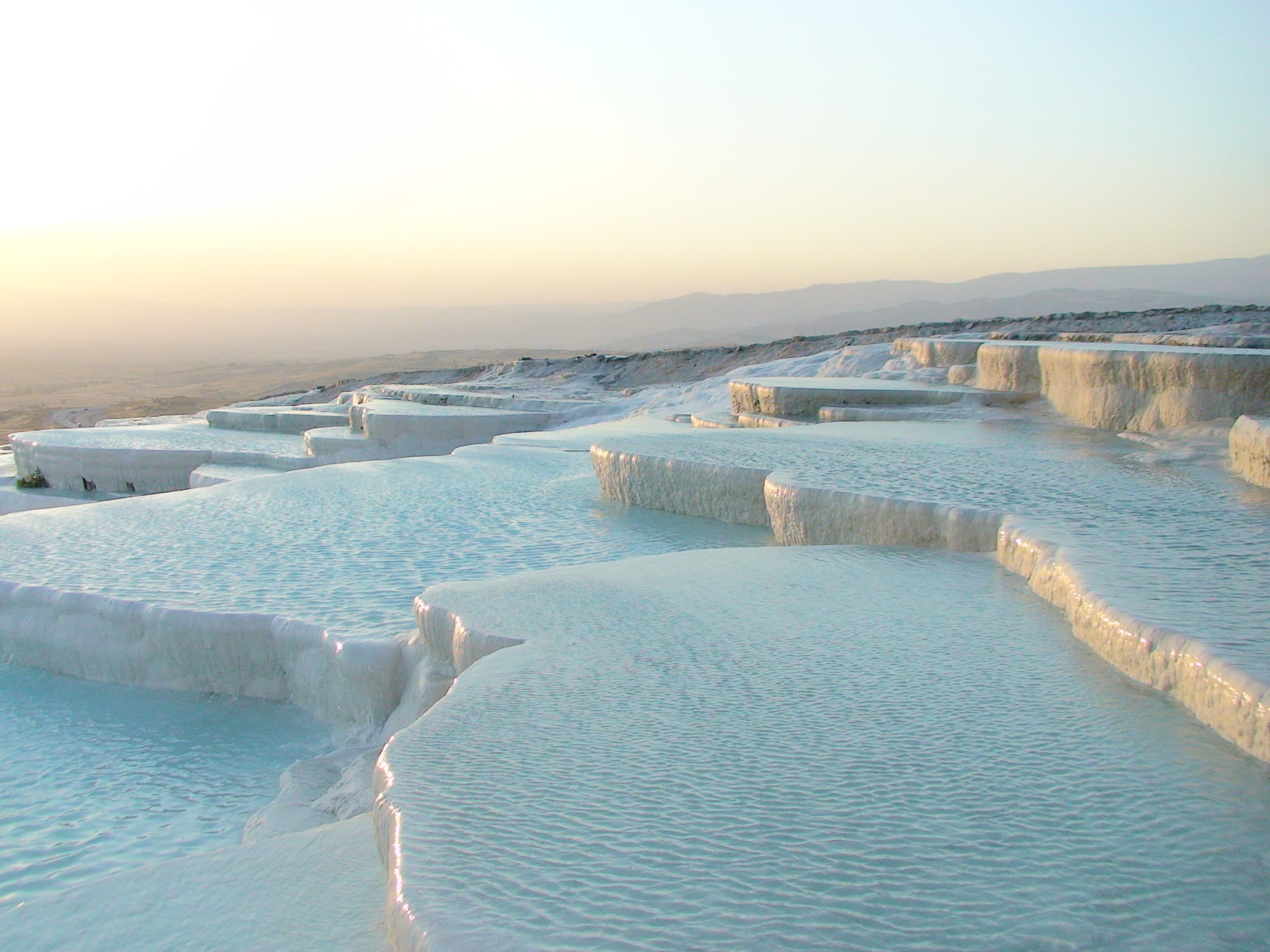
One of the planet's most extraordinary geological wonders: brilliantly white limestone terraces formed by 14,000 years of hot springs, combined with the UNESCO-listed Roman ruins of Hierapolis.
Pamukkale — literally 'cotton castle' in Turkish — is one of the world's most extraordinary geological sites, combined with a major Greco-Roman archaeological site. The landscape rests on a 2.7 km limestone plateau where carbonated hot springs (35-40°C) charged with calcium have been flowing for 14,000 years. As the water cools in the open air, it precipitates its calcium carbonate to form travertines — natural terraces of brilliant white descending in cascade over 200 m. The visual effect is striking: a snowy landscape in full Mediterranean sun, contrasting with the turquoise blue of thermal pools and the green of surrounding hills.
On the upper plateau, the Greeks then the Romans built from the 2nd century BC the ancient city of Hierapolis ('the sacred city') — prestigious thermal station of the Roman Empire, frequented by emperors Nero, Hadrian and Caracalla for its recognised curative properties. The site, UNESCO listed since 1988 jointly with the travertines, displays remarkable heritage: a Roman theatre of 12,000 seats (one of the best preserved in Turkey), monumental baths (now an archaeological museum), an exceptional necropolis (one of the largest in the ancient world, with more than 1,200 monumental tombs over 2 km), a nymphaeum and the Basilica of Saint Philip (5th century martyrium where the Apostle Philip is said to be buried).
The signature experience is Cleopatra's antique pool (Antik Havuz) — thermal pool at the heart of Hierapolis where one can swim among collapsed Roman columns underwater. The pool, fed by the same hot springs as the travertines (water at 35-37°C, rich in magnesium and bicarbonates), is said to have been offered to Cleopatra VII of Egypt by Mark Antony according to legend. Today, it is one of the most unique experiences in the world — swimming in ancient thermal waters surrounded by submerged remains. Supplement 350 TRY (€11) in addition to site entry (1100 TRY / €33). Bring swimsuit, towel, flip-flops.
The travertine visit obeys a strict rule: shoes forbidden (to preserve the fragile limestone, you walk barefoot). Some shallow pools are arranged for swimming (water at 35-40°C). The official trail descends from the upper plateau (Hierapolis) to the bottom (Pamukkale village) over 1.5 km — allow 1h-1h30 for descent. At sunset, the travertines take on pinkish and golden hues of exceptional beauty.
What we love
- ✅Geological landscape unique in the world: white cascading travertines, unmatched visual spectacle
- ✅UNESCO site: double inscription travertines (nature) + Hierapolis (culture)
- ✅Bathing in ancient thermal waters (Cleopatra's Pool, 35-37°C, mineral-rich water)
- ✅Ancient city of Hierapolis: Roman theatre, baths, monumental necropolis, Basilica of Saint Philip
- ✅Magnificent golden light at sunset on the white travertines
What to know
- ❌Extreme crowds in high season (July-August) — tourist buses from Bodrum and Antalya at 10am
- ❌Crushing summer heat (35-42°C) — burning ground on travertines, little shade
- ❌Pamukkale-village uncharming — Karahayit option (5 km) more authentic but limited
- ❌Site far from other Turkish destinations — 3h drive from Ephesus, 4h from Bodrum
Situation
Où se situe Pamukkale ?
Ouvrir la carte en grand sur OpenStreetMap →Frequently asked questions
How long do you need to visit Pamukkale?+
How to get to Pamukkale?+
Can you bathe on the Pamukkale travertines?+
Should you visit Pamukkale in addition to Ephesus?+
Where to stay to visit Pamukkale?+
Our verdict
Pamukkale is one of Turkey's most extraordinary sites — a world-unique geological landscape combined with major Roman ruins. Go ideally in April-June or September-October to avoid crushing summer heat. Visit at sunrise (opening 7am in summer) to photograph the travertines without crowds, or at sunset for sublime golden light. Imperatively combine with Ephesus (200 km, 3h drive) — it's the classic cultural pairing of the Aegean Coast. Stay one night in Pamukkale-village or in Karahayit (5 km, more authentic, spa hotels with thermal waters) to enjoy sunrise over the travertines. Allow half a day to full day for the complete site (travertines + Hierapolis + Cleopatra's Pool).
Nearby

"Frais Istanbul, neige Cappadoce."
Expert on Pamukkale · 1 contributions
 Mediterranean Desk — Mowando·Editor