site archeologique
Sigiriya
A palace-city perched 200 metres above the jungle, built in seven years in the fifth century — one of the most extraordinary urban feats of ancient Asia.
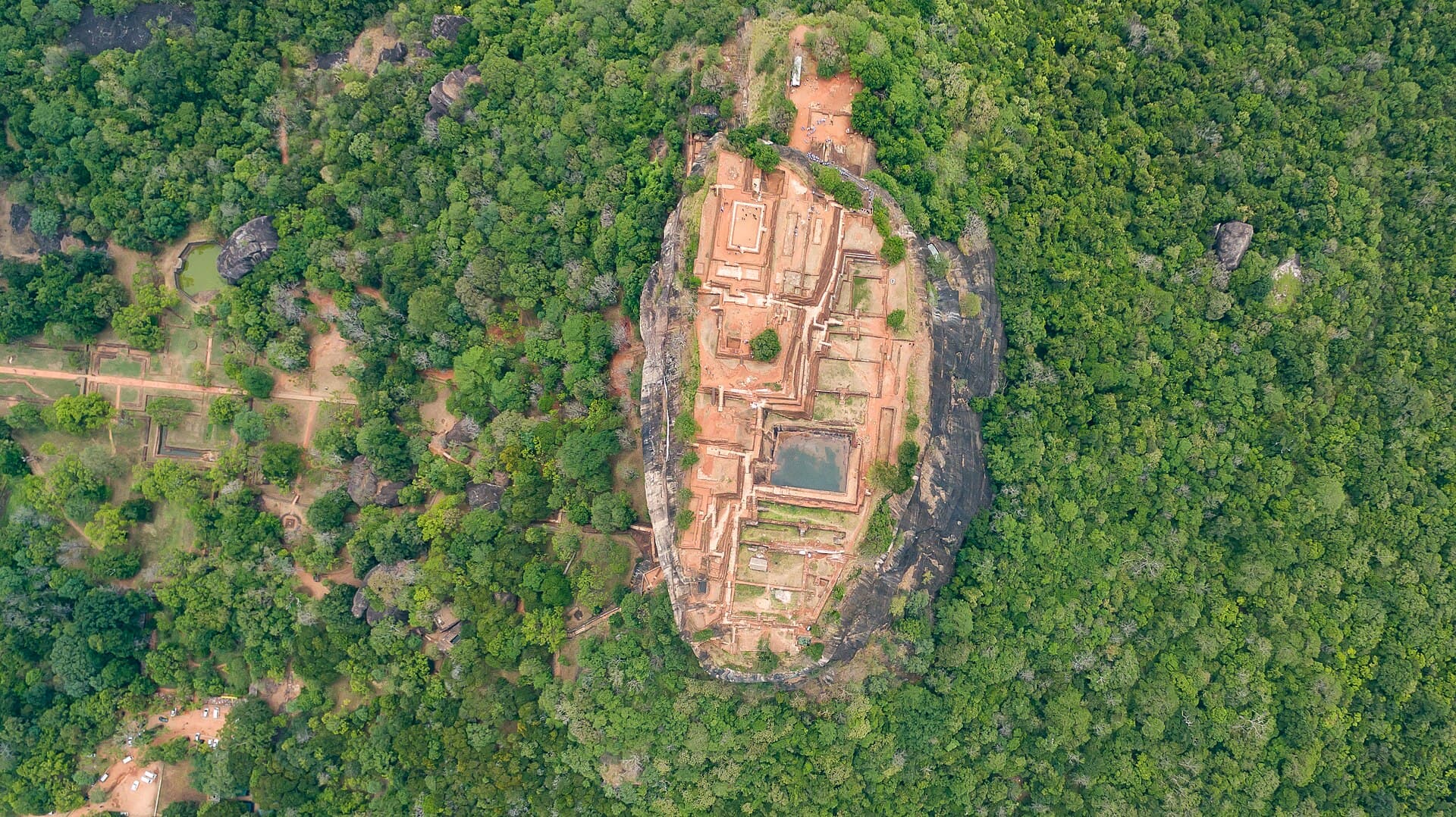
Sigiriya is arguably Sri Lanka's most spectacular site, and one of the most striking in South Asia. A rose-granite pinnacle, the remnant of an old volcanic plug, springs 200 metres above the Dambulla plain. On this unreachable rock, King Kassapa I — who had seized power by murdering his father and exiling his rightful heir half-brother — had an entire palace-city built between 477 and 495 AD: terraces, cisterns, audience halls, pleasure gardens. For eleven years Sigiriya was the capital of the Sri Lankan kingdom, before Kassapa was defeated and the Buddhist monks reclaimed the site, transforming it into a monastery until the fourteenth century.
The ascent unfolds via a monumental stairway with four major stages. First, the symmetrical water gardens at the base — among the oldest pleasure gardens still visible in the world, with their pools, fountains and irrigation canals. Then the rocky path that leads to the fresco gallery, where the famous Maidens of Sigiriya survive: 21 female figures painted in wax directly on the rock in the fifth century, their ochre and red pigments having weathered fifteen centuries. Higher up, the Lion Gate — today only the monumental paws sculpted in stone remain, which once framed the lion's head through which one entered the palace. Finally the vertiginous steel staircase that climbs to the summit plateau (1.6 hectares), where the ruins of Kassapa's royal palace unfold: terraces, a rock-cut bathing pool, royal apartment foundations and a 360-degree view over the surrounding jungle. Allow three hours for the full visit, ideally at dawn to escape heat and crowds.
What we love
- ✅Sri Lanka's most spectacular archaeological site, UNESCO-listed since 1982
- ✅Exceptional panoramic view from the summit 200 m above the jungle
- ✅Maiden frescoes: fifth-century pigments in remarkably preserved condition
- ✅Water gardens among the oldest in the world (fifth century)
- ✅Central position in the cultural triangle (1 hour from Dambulla, 2 hours from Polonnaruwa)
What to know
- ❌Significant crowds between 9 and 11 am in high season, queues on the steel staircase
- ❌Demanding climb: 1,200 metal steps, possible vertigo, not recommended for the unfit
- ❌Entry at €36/person — one of the most expensive sites in Sri Lanka
- ❌Very little shade on the route, suffocating heat after 10 am
Situation
Où se situe Sigiriya ?
Ouvrir la carte en grand sur OpenStreetMap →Frequently asked questions
How much does Sigiriya entry cost?+
How long should I plan for the visit?+
Is the climb difficult?+
Should I climb at dawn or in late afternoon?+
Where should I stay near Sigiriya?+
What else should I see in the cultural triangle?+
How do I get to Sigiriya from Colombo?+
Our verdict
Sigiriya is an absolute must on any Sri Lanka trip. The combination of the unique natural site — a rock pinnacle without equal in the world — and the fifth-century archaeological feat make it one of South Asia's most striking visits. The entry fee and the crowds can put visitors off, but a dawn ascent (the site opens at 7 am, aim to arrive by 6:45) solves both problems: minimal crowds, relative cool, perfect light on the frescoes. Combine the visit with Dambulla cave temples (45 minutes south, 1,500 Buddhist statues across 5 caves) and Polonnaruwa (2 hours east, ruins of the medieval capital) for a full day in the cultural triangle.
Nearby

"Pic touristique haute saison, mer calme sud."
Expert on Sigiriya · 1 contributions
 South-East Asia Desk — Mowando·Editor