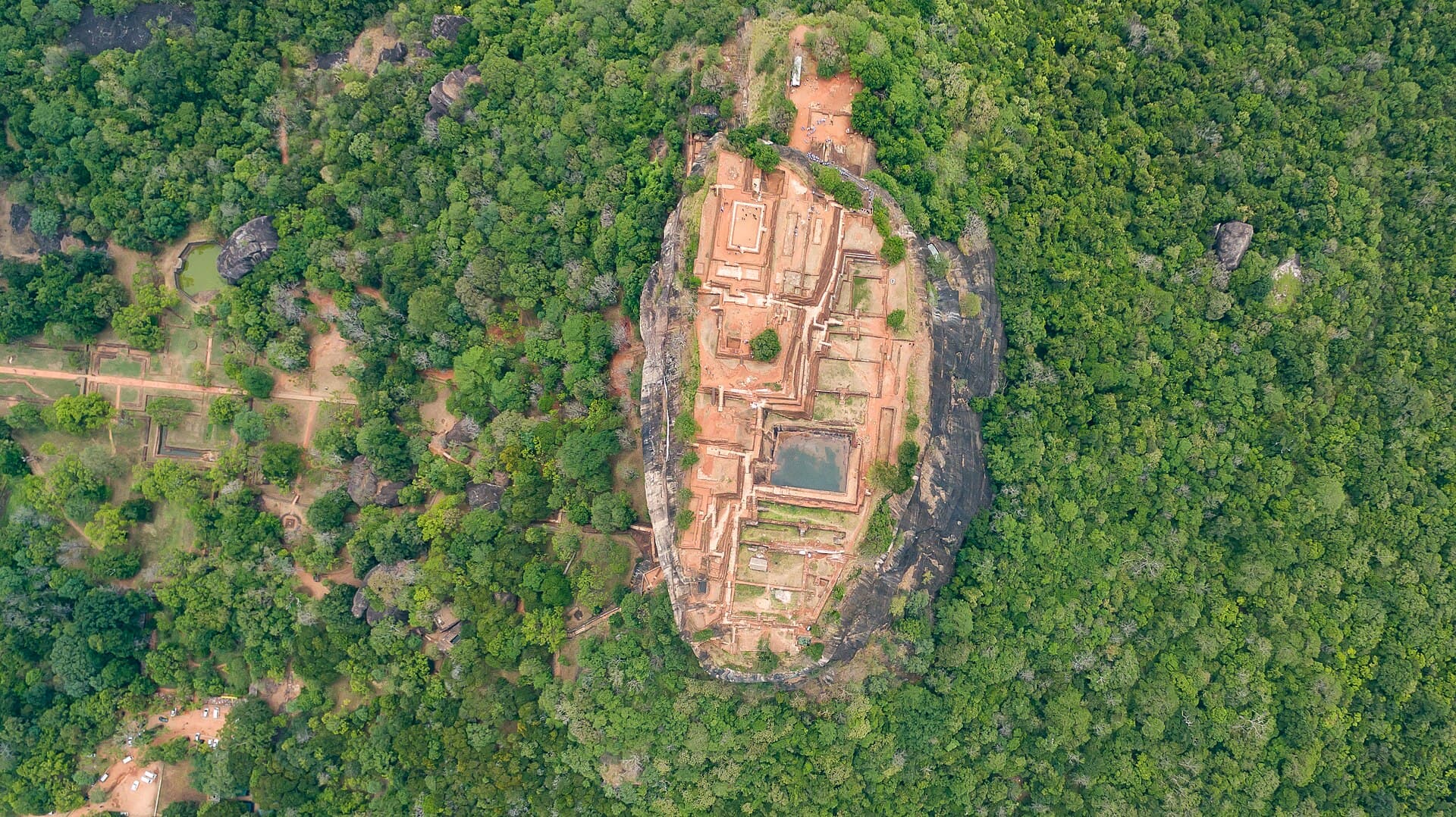
The ascent of Sigiriya unfolds in several stages worth savouring rather than rushing through. Allow 3 hours for the full visit.
Entry begins through the symmetrical water gardens at the base — among the oldest pleasure gardens still visible in the world, dating to the fifth century. Four rectangular mirror pools, fountains fed by an ingenious hydraulic system that still works under natural pressure, and broad alleys lined with century-old trees. This first stage is often overlooked by rushed visitors; take 30 minutes to linger, especially at dawn when the low light brings out the perfect geometry of the basins.
The path continues via a stone staircase that climbs the east face of the rock. Halfway up, you reach the fresco gallery, sheltered beneath a rock overhang. This is where the famous Maidens of Sigiriya are found: 21 female figures painted in wax in the fifth century, with ochre, red and green pigments that have survived fifteen centuries in remarkable condition. The faces have a striking grace. Originally, more than 500 figures covered the entire west face of the rock; successive vandalism (notably during the Portuguese Christianisation of the sixteenth century) left only this miraculous frieze.
Just after the gallery, you walk past the Mirror Wall — a plaster wall so finely polished it once reflected the image of the king who stood before it. On this wall, more than 1,800 graffiti were inscribed between the seventh and thirteenth centuries by medieval visitors: poems in ancient Sinhalese, of remarkable literary quality, celebrating the beauty of the Maidens or the majesty of the site.
Higher up, you reach the Lion Gate — Sigiriya's most iconic architectural element. Today only the two monumental paws sculpted in stone remain, 5 metres high, which once framed the lion's head through which one entered the royal palace. The head is gone (probably collapsed in the fourteenth century), but the effect remains striking.
The final stage is the spiral steel staircase, suspended on the cliff face above 60 metres of empty space. This is where many visitors hesitate: if you suffer from severe vertigo, you can stop at the fresco gallery. But the effort is worth it: the summit plateau (1.6 hectares) holds the ruins of Kassapa's royal palace — terraces, a rock-cut bathing pool, royal apartment foundations — with a 360-degree view over the surrounding jungle. On clear days you can see Pidurangala Rock to the north, the first foothills of the central mountains to the south, and the Dambulla plain stretching to the horizon.
To complete the day, two accessible alternatives from Sigiriya: Pidurangala Rock (3 km north) offers a spectacular view of Sigiriya itself for only £4/person entry — shorter climb (45 minutes) but also demanding. Dambulla (20 km south) houses the UNESCO cave temples, 5 caves with 153 Buddhist statues and frescoes painted between the 1st century BC and the 18th century.
Read also
- Sri Lanka — Full country guide: entry rules, budget, when to visit, itineraries.
- Cultural Triangle — Ancient capitals of Anuradhapura, Polonnaruwa and Sigiriya.
- Kandy, last royal capital — Temple of the Tooth and sacred lake, 2h30 south of Sigiriya.
- Ella, backpacker village — Nine Arches Bridge and Little Adam's Peak in the tea country.