ville
Arequipa
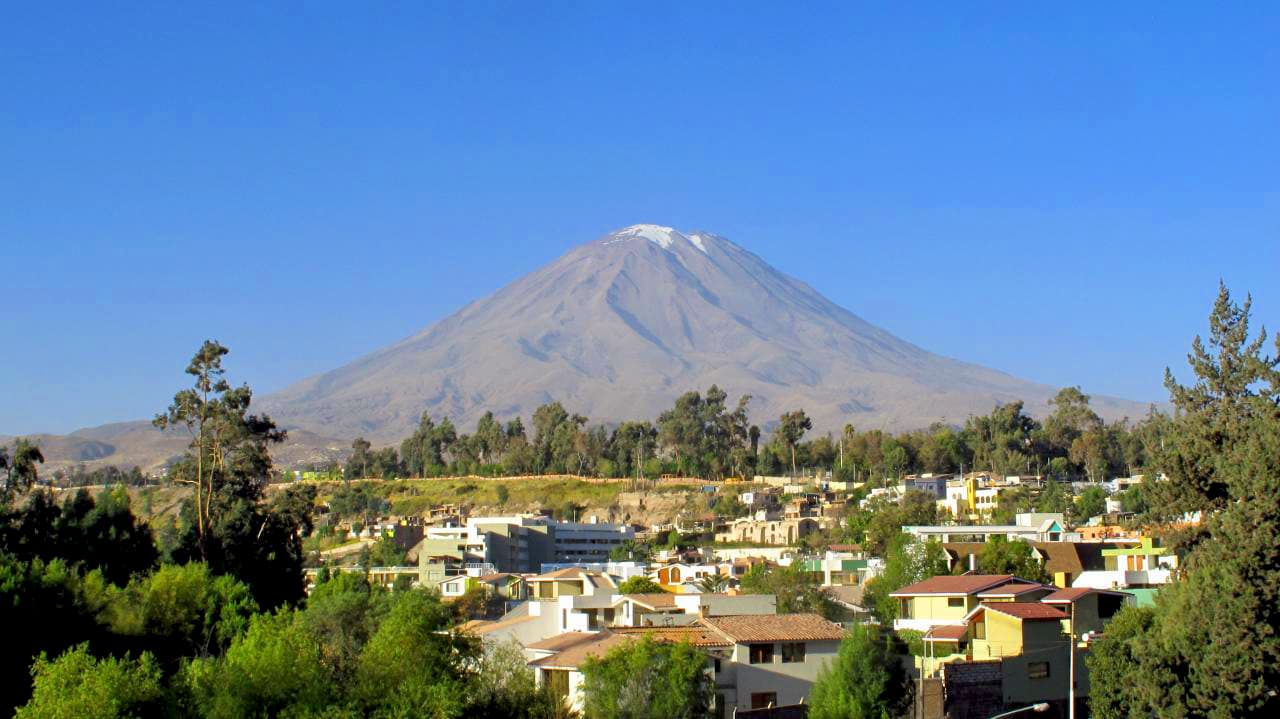
Peru's White City, historic centre entirely built in translucent white volcanic sillar at the foot of Misti volcano, UNESCO 2000, Santa Catalina monastery among South America's wonders.
Arequipa (the White City, 2,335 m altitude, 1 million inhabitants) is Peru's second city after Lima and one of Latin America's most beautiful. Founded in 1540 by Garci Manuel de Carbajal on pre-Inca Yarabaya-Chumbivilca structures, it developed in the 16th-17th centuries a unique colonial architecture entirely built in sillar — translucent white volcanic stone extracted from Misti rhyolitic flows, light, easy to sculpt, giving the city its nickname and unique luminosity. The historic centre was UNESCO-listed in 2000.
The city sits in the Chili River valley, at the foot of three iconic volcanoes: Misti (5,822 m, symbol-volcano perfectly conical, last eruption 1985, 2-day/1-night ascent possible), Chachani (6,057 m, highest, one of the world's 'easiest' 6,000 m) and Pichu Pichu (5,664 m, revered by Incas, place of discovery of Juanita mummy). This spectacular volcanic setting frames the urban silhouette everywhere in the city.
The Plaza de Armas is one of Latin America's most beautiful — bordered by the baroque cathedral (1656-1844), three sides of sillar arcades, clear view of Misti. The basilica of La Compañía (1573-1698, Jesuits, exceptional churrigueresque facade). The Santa Catalina monastery (founded 1579) is the flagship monument — a 5-hectare cloistered Dominican monastery in the city heart, operating in complete autarky for 400 years. A real 'city within a city' with named streets, squares, chapels, kitchens, gardens.
What we love
- ✅UNESCO 2000 White City: unique colonial architecture in white volcanic sillar
- ✅Santa Catalina monastery: 5 cloistered hectares, one of South America's most beautiful wonders
- ✅Exceptional Plaza de Armas: baroque cathedral, arcades, view of Misti
- ✅Ideal altitude acclimatization (2,335 m) before Colca, Titicaca and Cusco
- ✅Renowned arequipeña gastronomy (rocoto relleno, chupe de camarones, queso helado)
What to know
- ❌Cool nights (5-8 °C in dry season), sometimes limited hotel heating
- ❌Dense traffic in extended centre
- ❌Altitude sickness moderately possible (2,335 m) for direct Lima arrivals
- ❌Colca excursion requires minimum 2 days/1 night, logistics to organize
- ❌Urban pollution in peripheral zones
Situation
Où se situe Arequipa ?
Ouvrir la carte en grand sur OpenStreetMap →Frequently asked questions
How many days to visit Arequipa?+
How to get to Arequipa?+
Santa Catalina monastery, how to visit?+
Should you do the Colca Canyon excursion from Arequipa?+
Where to sleep in Arequipa?+
Our verdict
Arequipa is one of Latin America's most beautiful cities and the ideal gateway for the southern Andean extension of the Peruvian trip. Our recommendation: plan minimum 2 nights to visit the UNESCO historic centre (Santa Catalina monastery, Plaza de Armas, cathedral, Compañía, colonial houses), the Juanita mummy at the Andean Sanctuaries museum, and altitude acclimatization at 2,335 m before continuing to Colca (3,800 m), Puno-Titicaca (3,812 m) and Cusco (3,400 m). Combine with the 2-day/1-night Colca excursion (Chivay + condor observation at Cruz del Condor Mirador + La Calera hot springs) in dry season (May-September). Travel from May to September for optimal conditions (guaranteed blue sky on Misti) or April/October-November for best value. Imperatively taste the arequipeña cuisine — one of Peru's best.
Nearby

"Janvier : saison humide, pluies modérées Arequipa centre, plus fortes au Colca."
Expert on Arequipa · 1 contributions
 Africa & Americas Desk — Mowando·Editor