site archeologique
Jerash
A 2nd-century Roman city, member of the Decapolis, 80% intact: nowhere outside Italy do you walk through a Roman town that is still so much itself.
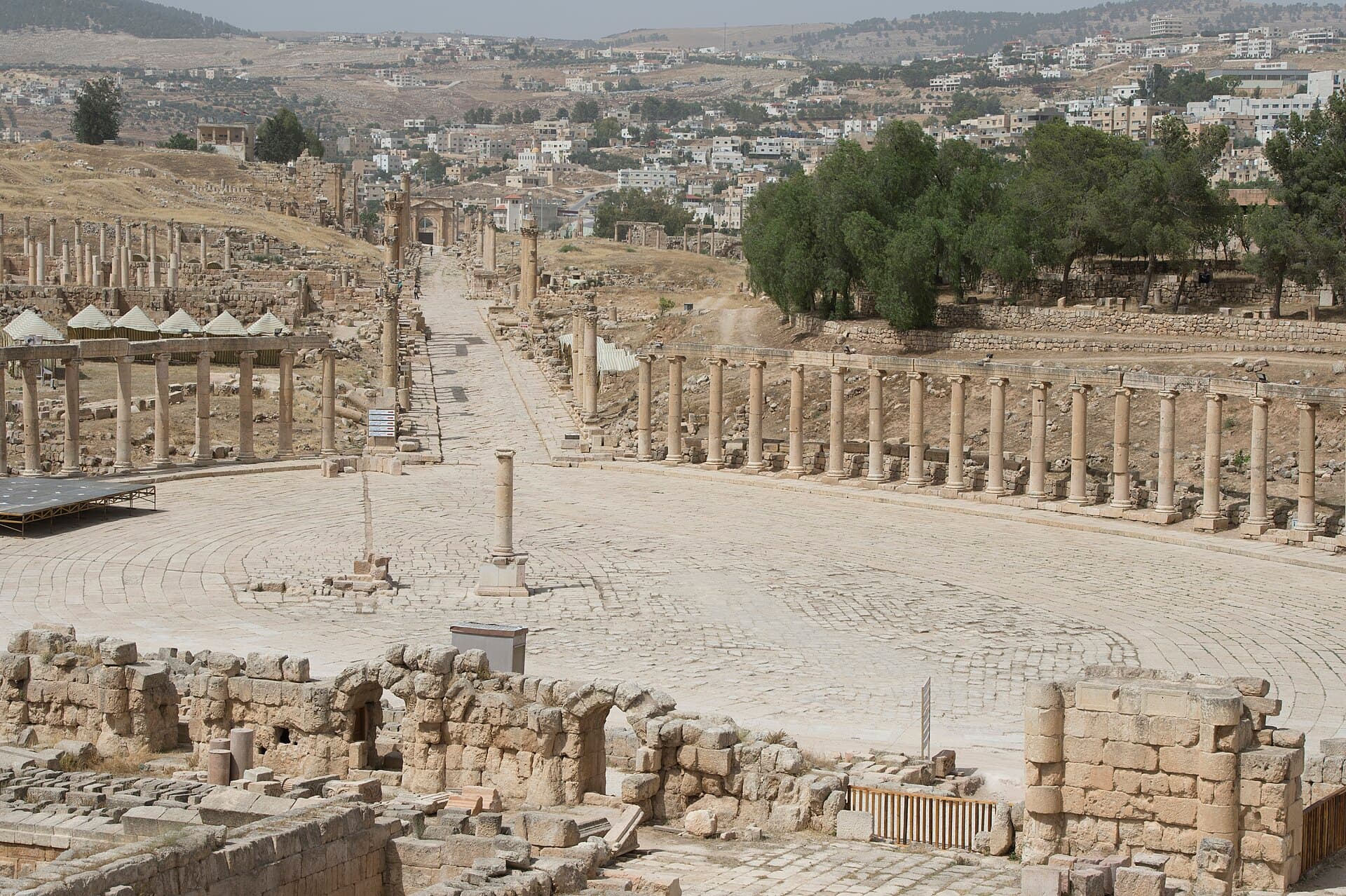
Jerash — the Roman Gerasa — is one of the most extraordinary archaeological sites in the Middle East and arguably the best preserved Roman city in the world after Pompeii and Ephesus. Located 50 kilometres north of Amman, in a green valley of the Gilead hills that descend towards the Jordan, it was in the 2nd century AD one of the ten great cities of the Decapolis, the federation of Greco-Roman cities of the Roman province of Arabia. Under emperor Hadrian (who visited it in 129-130 AD and had the arch which bears his name erected), Gerasa reached its peak: 20,000 inhabitants, two theatres, a hippodrome, ten major temples, monumental baths and the famous Oval Plaza — an elliptical forum surrounded by 56 Ionic columns, a configuration found nowhere else in the Roman Empire.
But it is the state of preservation that makes Jerash exceptional. Destroyed by an earthquake in 749, gradually buried under alluvial sediments and forgotten for eleven centuries, the ancient city remained hidden under wheat fields until its rediscovery by the German explorer Ulrich Jasper Seetzen in 1806. Systematic excavations led since the 1920s have uncovered close to 800 columns still standing, more than 1.2 kilometres of paved cardo maximus, two theatres whose acoustics still work perfectly, and a partially reconstructed hippodrome which today hosts daily historical re-enactments (RACE — Roman Army and Chariot Experience). To visit Jerash is to walk through a real Roman city, not scattered ruins: Hadrian's Arch, the Oval Forum, the Temple of Zeus, the Temple of Artemis and the great colonnade of the main street are connected by a cardo you cover on foot exactly as a 2nd-century Roman would have done. No serious traveller in Jordan should miss this site, which sometimes overshadows Petra for lovers of classical antiquity.
What we love
- ✅Best preserved Roman city in the world outside Italy: 80% of the ancient urban fabric intact
- ✅Oval Forum unique in the Roman Empire, exceptional for photography
- ✅Jerash Festival (July-August): concerts and theatre in the authentic Roman amphitheatre
- ✅Reconstructed hippodrome with daily historical re-enactments (chariots, gladiators)
- ✅Accessible as a day trip from Amman (1 hour drive)
What to know
- ❌No shade on the cardo and the Oval Forum, exhausting visit from May to September
- ❌Daily re-enactments are very kitsch (skip for purists)
- ❌Ageing interpretation centre, few explanation panels on site
- ❌Aggressive souvenir shops at the entrance and exit
Situation
Où se situe Jerash ?
Ouvrir la carte en grand sur OpenStreetMap →Frequently asked questions
How long do I need to visit Jerash?+
How do I get to Jerash from Amman?+
Does the Jordan Pass cover Jerash?+
Are the RACE historical re-enactments worth it?+
Is the Jerash Festival worth a detour?+
What can I see near Jerash?+
Do I need a guide to visit Jerash?+
Are there restaurants in Jerash?+
Our verdict
Jerash is probably the most underrated archaeological site in Jordan. Eclipsed by Petra's worldwide fame, the Roman city offers a radically different experience: where Petra is a unique Nabataean site carved into rock, Jerash is a real ancient city still standing, where you walk along Roman streets for nearly two kilometres. Our advice: plan a full day from Amman, arrive at opening (8am) to enjoy the golden morning light on Hadrian's Arch and the Oval Forum before the coach groups arrive, hire a qualified guide for the historical depth, and if possible time your visit with the Jerash Festival (mid-July to mid-August) to experience the Roman amphitheatre in its original function.
Nearby

"Frais (10°C), tarifs bas, Wadi Rum glacial."
Expert on Jerash · 1 contributions
 Mediterranean Desk — Mowando·Editor