ville
Kyoto
Seventeen UNESCO World Heritage sites within a single city — Kyoto is Japan's cultural and spiritual capital, largely unchanged across fourteen centuries.
Kyoto was Japan's imperial capital for more than a thousand years (794-1868), and that long continuity has left an imprint that no other Japanese city approaches. Seventeen UNESCO World Heritage sites, more than 1,600 Buddhist temples and 400 Shinto shrines, preserved neighbourhoods of traditional machiya wooden townhouses, and a culinary tradition — kaiseki — that is the Japanese equivalent of French haute cuisine. Kyoto is not an open-air museum: it is a living city of 1.5 million people that is also the world capital of Japanese intangible heritage.
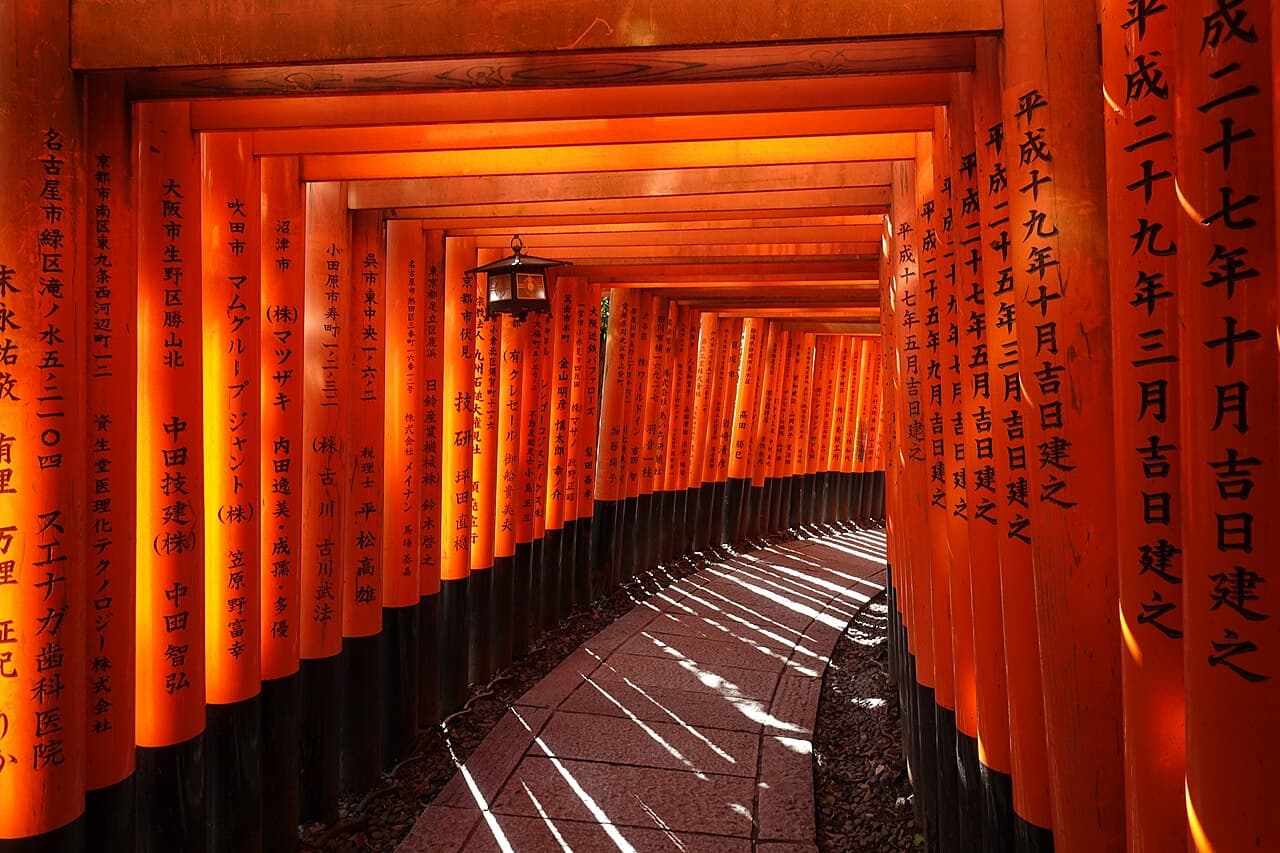
The contrast with Tokyo is striking and complementary. Where Tokyo overflows, Kyoto restrains. Where Tokyo reinvents itself every night, Kyoto remembers. The thousands of vermilion torii gates of Fushimi Inari climbing the mountainside, the golden pavilion of Kinkaku-ji, the bamboo grove of Arashiyama and the Gion quarter — where geisha (called geiko in local dialect) still move at dusk — are images that stay for life. But Kyoto also reveals a hidden face to those who linger: the gravel gardens of Zen temples, a traditional ryokan by the Kamo River, a kodo incense ceremony, a bowl of whipped matcha in a Nishiki tearoom.
Kyoto is two hours fifteen minutes from Tokyo by Shinkansen. The two cities are complementary and most naturally visited together.
What we love
- ✅Unmatched heritage density: 17 UNESCO sites, 1,600 temples and 400 shrines in a human-scale city
- ✅The Gion quarter, still home to working geiko (geisha) — the only city on earth where this tradition remains fully alive
- ✅Kaiseki cuisine: Japan's most refined gastronomy, built around seasons, local produce and visual beauty
- ✅Traditional ryokan: futon on tatami, onsen, hinoki wood bathtub — one night changes a traveller's relationship with the journey
- ✅Two hours fifteen minutes from Tokyo by Shinkansen — a natural fit in any Japan itinerary
What to know
- ❌Intense crowds in April (sakura) and November (momiji) — some temples reach saturation by 8am
- ❌Local transport less efficient than Tokyo: buses often overcrowded, metro network limited to two lines
- ❌Quality ryokan are very expensive (€200-500 per person) with strict rules and fixed schedules
- ❌Punishing humid heat in July-August, felt even more acutely in the narrow lanes of Higashiyama
Situation
Où se situe Kyoto ?
Ouvrir la carte en grand sur OpenStreetMap →Frequently asked questions
How many days should I plan for Kyoto?+
How do I get around Kyoto?+
Is it really worth staying in a ryokan?+
When is cherry blossom season in Kyoto?+
How do I avoid the crowds at Fushimi Inari?+
What exactly is kaiseki cuisine?+
Can tourists see geisha in Kyoto?+
Should I base myself in Kyoto or Osaka for exploring the Kansai region?+
Our verdict
Kyoto is one of those destinations that lastingly changes a traveller. It is not a city you visit: it is a city you experience, in the slow contemplation of Ryoan-ji's gravel garden, in the silence of Fushimi Inari's forest path at dawn, in the impeccable precision of a kaiseki meal. The constraints are real — peak-season crowds, the cost of the best ryokan, overcrowded buses — but they cannot diminish an experience that touches the very essence of what Japanese civilisation has produced at its most refined. Come in March-April for the sakura or November for the momiji, book your ryokan months ahead, arrive at Fushimi Inari before 7am, and allow yourself at least one tea ceremony in a Zen garden. Kyoto has to be earned — and it repays a hundredfold.
Réserver votre séjour
Liens partenaires — une commission peut nous être reversée, sans surcoût pour vous.
 HébergementAnnulation gratuite
Hôtels & ryokans au Japon
Business hotels efficaces dans les grandes villes, ryokans avec onsen privatif, capsules à Tokyo : tout le Japon comparé sans surprise.
ActivitéSans queueActivités au Japon
Cérémonies du thé à Kyoto, JR Pass, Mont Fuji, sumo, cours de sushi : réservez les activités phares sans queue.
VolComparateurVols vers Tokyo
Comparez Paris-Tokyo, Paris-Osaka et les vols low-cost intra-Japon. Saison épaule oct-nov souvent 30 % moins chère.
Nearby

"Janvier est le mois le plus calme de l'année à Kyoto. Les temples sont quasi déserts, la neige recouvre parfois les toits de Kinkaku-ji et Ryoan-ji dans un décor de carte postale. L'ambiance zen d'une Kyoto hivernale est une expérience rare que peu de voyageurs connaissent."
Expert on Kyoto · 1 contributions
 Japan Desk — Mowando·Editor