Kyoto concentrates an implausible number of first-rank cultural sights for a city of under two million people. Exploration organises naturally by geographic zone.
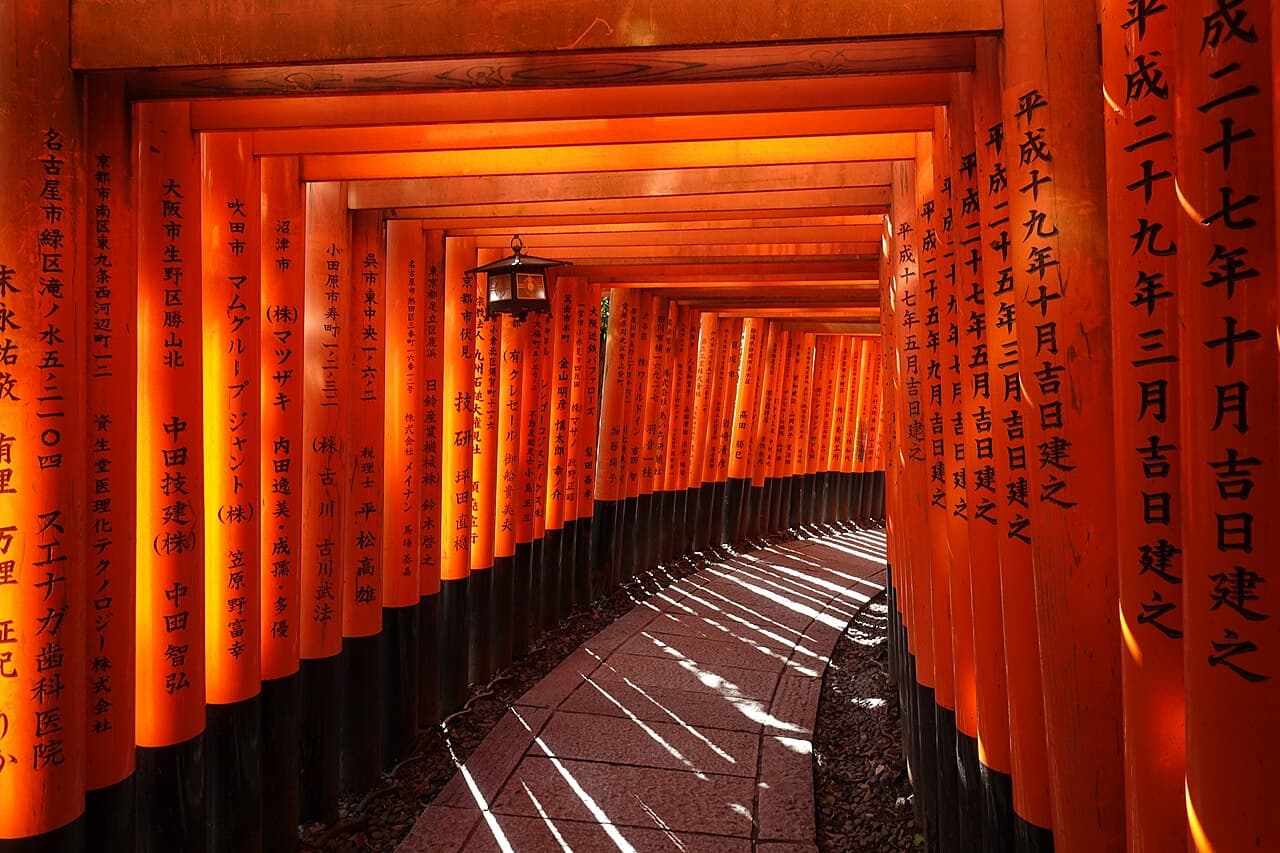
Southern Kyoto begins with Fushimi Inari Taisha, the Shinto shrine of thousands of vermilion torii gates ascending Mount Inari: one hour's walk to the midpoint, two hours to the summit (232 m). Visit at dawn absolutely — before 7am the paths are nearly yours alone and the early light through the gates is unforgettable. Daigo-ji, less visited, is a gem with its five-storey pagoda and exceptional cherry blossom gardens.
Western Kyoto is dominated by Arashiyama and the bamboo grove (Sagano Chikurin-no-michi): two hundred metres of pale green vegetable canyon filtering light in a way found nowhere else on earth. Directly adjacent, Tenryu-ji (UNESCO) and its Song painting-inspired gardens hold one of Japan's finest garden designs. The lesser-known monastery Jojakko-ji offers a plunging view over the Oi valley from its wooded heights. For a more intimate experience, the Hozugawa river boat descent from Kameoka to Arashiyama takes three hours through wild gorges.
North-western Kyoto holds the most famous temples. Kinkaku-ji (the Golden Pavilion) is the most reproduced image in Japan — its three gold-leaf-covered floors reflected in Kyoko-chi pond under clear skies. Unmissable and very crowded — arrive at opening (9am) to avoid the worst queues. Ryoan-ji holds Japan's most famous dry garden: fifteen stones arranged in a rectangle of raked gravel, a composition eight centuries of visitors have not yet exhausted. Ninna-ji and its rare five-petalled late cherry trees (omuro-zakura) complete the north-west trilogy.
Eastern Kyoto — Higashiyama, Gion, the Philosopher's Path — is picture-postcard Kyoto. The Higashiyama quarter (cobbled streets, craft and tea shops in restored machiya, views over Yasaka pagoda) is Japan's most photographed neighbourhood. Gion, the geisha quarter, is best explored at dusk on Hanamikoji street. The Philosopher's Path (Tetsugaku-no-michi, 2 km along a cherry-tree-lined canal) links Nanzen-ji to Ginkaku-ji — an essential walk, particularly beautiful in sakura season and momiji.
Intangible experiences round out the cultural visit. A tea ceremony (chado) in a Zen garden — several temples offer English-language introductory sessions (Urasenke, En tea ceremony). A ikebana (Japanese flower arrangement) class at a traditional school. A zazen (seated Zen meditation) session at Shunkoin or Kennin-ji, both open to foreign practitioners. An evening in a machiya dining room on Pontochō, the narrow restaurant alley that runs beside the Kamo River — one of Asia's most elegant dining experiences.
Read also
- The Kansai Region — Kyoto, Osaka, Nara and Kobe — Japan's cultural and culinary heartland.
- Tokyo, the City of the Future — Two hours fifteen minutes by Shinkansen: 14 million people, world-class dining and pop culture.
- Japan — Complete country guide: entry rules, budget, when to visit, regions.
- Nara and its Sacred Deer — Forty-five minutes from Kyoto: the great bronze Buddha and free-roaming deer.