Mowando

site historique

Taj Mahal

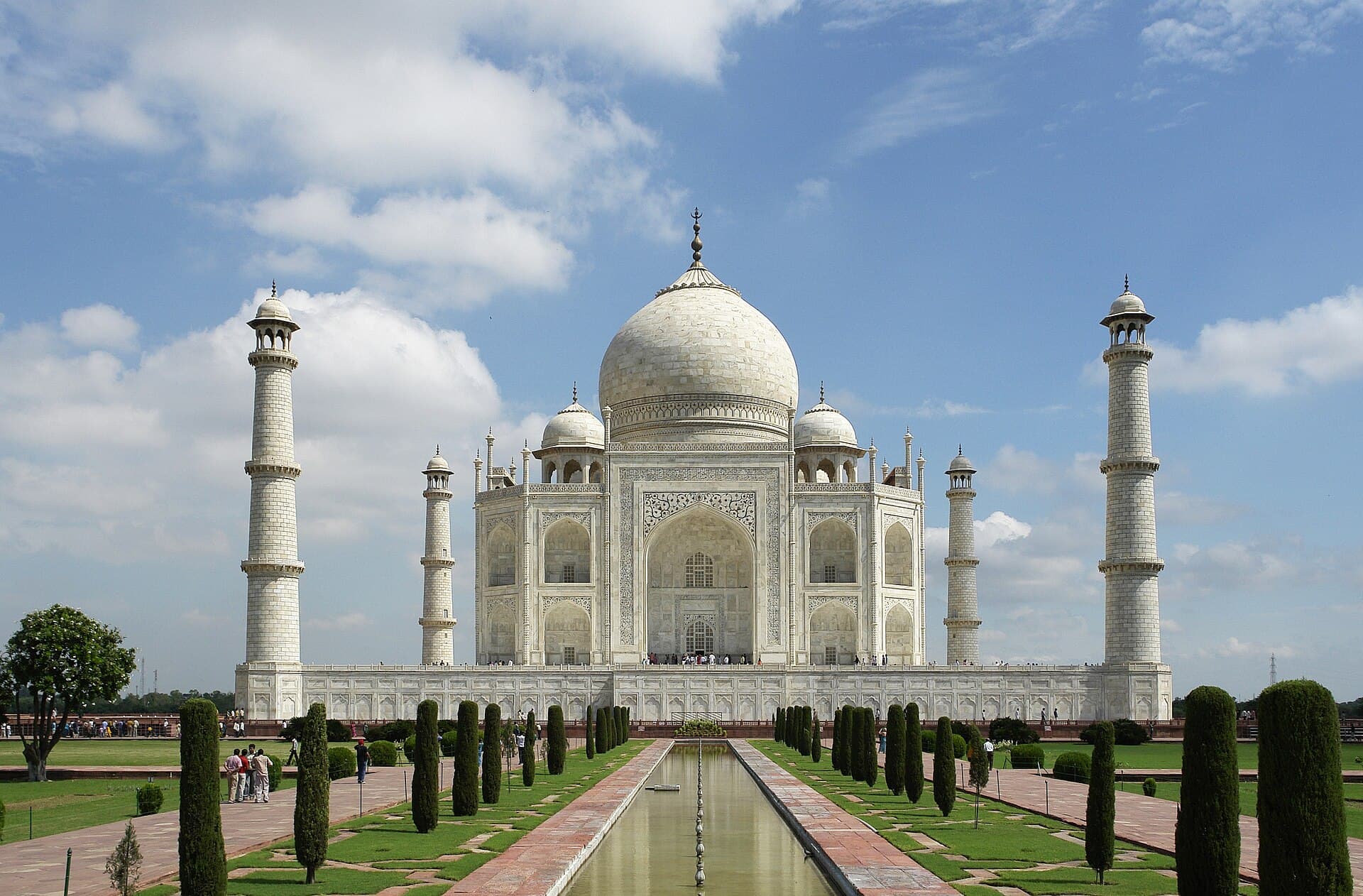
Humanity's absolute architectural masterpiece — white marble inlaid with 28 types of precious stones, perfectly symmetrical Charbagh Mughal garden, the most accomplished expression of classical Mughal art.

4.90Delhi & Rajasthan

The Taj Mahal ("Crown of Palaces" in Persian) is probably the world's most iconic monument — one of the planet's most visited sites (8 million annual visitors), UNESCO world heritage since 1983, designated among the 7 Modern Wonders of the World in 2007.

The history is known but worth recalling. The Taj Mahal is a funerary mausoleum commissioned by Mughal emperor Shâh Jahân (1592-1666, 5th Mughal emperor, reigned 1628-1658) for his 3rd wife Mumtaz Mahal (1593-1631, born Arjumand Banu Begum) — his favourite, his absolute love, who died at 38 from complications of her 14th childbirth at Burhanpur on 17 June 1631. Construction began in 1632, lasted 22 years (structural completion in 1648, finishes and gardens in 1653), mobilised 20,000 workers, 1,000 elephants. The main architect was Ustad Ahmad Lahori (Iranian origin).

The architecture is an absolute masterpiece. The complex extends over 17 hectares with near-perfect symmetry. Charbagh Mughal garden ("four gardens") 300 m long divided into 4 squares by water canals symbolising the 4 rivers of Muslim Paradise. The central mausoleum, in Makrana white marble (Rajasthan quarry), measures 73 m high, 56 m wide. Four minarets at the corners, slightly inclined outward (1.5° each) to avoid falling on the mausoleum in earthquakes. The white marble is inlaid (parchin kari technique) with 28 types of precious and semi-precious stones — jasper, jade, rock crystal, carnelian, lapis lazuli, turquoise, agate — forming floral and calligraphic motifs (Quranic verses in Arabic).

What we love

  • Absolute architectural heritage: UNESCO 1983, 7 Modern Wonders, one of humanity's most emblematic monuments
  • Golden light extraordinary at sunrise (5:45-7:30 am) on white marble — ultimate photographic experience
  • Perfect Mughal architecture: absolute symmetry, Charbagh garden, parchin kari inlays of 28 precious stones, inclined minarets
  • Accessible from Delhi: Shatabdi Express train 2h (700-1,200 INR Executive Chair Car), day excursion possible
  • Mythical Shâh Jahân and Mumtaz Mahal love story — one of the world's most powerful romantic symbols

What to know

  • Extreme crowds 10am-3pm in high season — 6am opening arrival imperative
  • Agra pollution: polluted chaotic city around the site, shocking contrast with monument perfection
  • Winter mist (December-January) may veil the Taj until 10-11am — bivouac to anticipate
  • Agra tourist scams: fake guides, fake "official" marble traders overcharging 5-10x
  • Closed on Friday (except interior for practising Muslims during prayer)

Situation

Où se situe Taj Mahal ?

Ouvrir la carte en grand sur OpenStreetMap →

Frequently asked questions

What time to visit the Taj Mahal?+
At opening (6am) — it's the absolute optimal option. Golden sunrise light on white marble is the day's most extraordinary, and crowd is minimal 6-8am. Buy tickets online on asi.payumoney.com or via your agency. Foreigners rate: 1,100 INR (€12) + 200 INR inner mausoleum. Closed Friday (except practising Muslims for Friday prayer). For sunset, observe from Mehtab Bagh (garden on north Yamuna bank, free, taxi 200-400 INR from Taj). A night visit at full moons (5 nights per month, max 50 people per group 30 min, book 24h ahead via Archaeological Survey India ASI) offers magical experience.
How long to plan on site at the Taj Mahal?+
2-3 hours minimum for a comfortable visit. Recommended plan: East Gate (main foreigner entrance), Charbagh Gateway crossing, descent to Lotus Pond (central reflection pool, classic photo), climb to marble platform (mandatory shoe removal — fabric foot covers provided), platform tour to observe minarets, parchin kari inlays, Quranic calligraphies (1h30 on platform). Inner mausoleum entry (additional 200 INR): cenotaphs of Mumtaz and Shâh Jahân. Exit via Charbagh gardens. For photographers, plan 3-4h. For real enthusiasts, consider 2 separate visits (sunrise + sunset from Mehtab Bagh).
Day trip from Delhi or overnight in Agra?+
Both options valid. Day excursion from Delhi: Shatabdi Express train departure Delhi 6am, arrival Agra 8am, Taj visit 8:30am-12pm, lunch, Agra Fort 2-4pm, return Shatabdi 4pm, arrival Delhi 6pm. Advantage: no need to book Agra hotel. Disadvantage: tight timing, less optimal Taj light. Overnight in Agra: recommended. Allows 2 visits of the Taj, adds Fatehpur Sikri UNESCO. Hotels: Oberoi Amarvilas (€600-1,500/night, rooms with direct Taj view at 600 m — absolute luxury experience), ITC Mughal Agra (5-star, €200-400/night), Trident Hilton Agra (€150-300/night).
Other UNESCO sites in Agra?+
Agra Fort (UNESCO 1983): red sandstone fortress-palace built by Akbar from 1565, expanded by Shâh Jahân (white marble apartments). Mughal emperors' residence before Shâh Jahân moved capital to Delhi in 1638. Shâh Jahân imprisoned here by his son Aurangzeb from 1658 to 1666 — he contemplated the Taj Mahal from Octagonal Tower (Mussamman Burj). 2 km from Taj. Plan 2h visit. Foreigners rate 650 INR. Fatehpur Sikri (UNESCO 1986): Mughal city built by Akbar 1571-1585 as capital, abandoned 14 years later (1585). Magnificently preserved ghost city: Buland Darwaza (54 m triumphal gate), Tomb of Salim Chishti (Sufi saint), Jama Masjid, Diwan-i-Khas. 40 km west of Agra, half-day excursion (taxi 1,200-2,000 INR round-trip).
How to avoid Agra tourist scams?+
Agra has justified reputation for sophisticated tourist scams. Main pitfalls: fake "official guides" approaching you at Taj entrance, fake "official Taj marble traders" taking you to marble workshops claiming descent from Taj Mahal artisans to sell reproductions at 5-10x real value, fake drivers offering "complete" tour at low price but adding shop stops where they earn commission. Tip: book your certified guide via your 5-star hotel or recognised French agency — costs slightly more but avoids all hassles. For marble purchases, go directly to 1-2 recognised emporiums (Subhash Emporium, Akbar International), compare prices, negotiate (50% of asked price generally).
Is the Taj Mahal whitening or degrading?+
Both. The Taj Mahal's white marble has been progressively yellowing for decades due to severe Agra air pollution. The Indian government and UNESCO have taken several measures: 50 km² protection buffer zone around the Taj (Taj Trapezium Zone, 1996), progressive closure of polluting industries, ban on petrol and diesel vehicles within 500 m of monument (only electric vehicles, bikes and horses allowed, free electric shuttle from parking). Periodic cleanings with mud-pack treatment (identical to that used for jewellery by Indian women) took place: 1994, 2001, 2008, 2014, 2018, 2023. Marble regains original whiteness for 1-3 years before yellowing again. The Taj remains in good general condition.
What else to see in Agra beyond the Taj Mahal?+
Agra (1.7 million inhabitants) deserves a full day beyond the Taj Mahal. Agra Fort UNESCO (2h visit, Taj view from Mussamman Burj, Shâh Jahân's prison). Mehtab Bagh (garden on north Yamuna bank facing the Taj, free, panoramic sunset view — less crowded). Itimad-ud-Daulah (tomb called "Baby Taj" built 1622-1628 by Empress Nur Jahan for her father, architectural precursor of Taj Mahal, white marble and parchin kari inlays, magnificent at small scale, 310 INR foreigners). Akbar's Tomb at Sikandra (8 km from Agra, Akbar the Great mausoleum 1605-1613, 310 INR foreigners, quieter atmosphere). Chini Ka Rauza (painted Persian ceramic tomb, lesser-visited, free). For textile lovers, Agra is famous for dhurries (traditional rugs) and zardozi embroideries (gold thread, Mughal heritage).

Our verdict

The Taj Mahal is the absolute must-see monument of any India trip — if you only visit one site in India, this will be it. Mughal architectural perfection, golden sunrise light on white marble, near-perfect symmetry, the love story of Shâh Jahân and Mumtaz Mahal make it one of life's most marking experiences. Our advice: arrive at 6am opening for golden light and minimal crowds, plan 2-3h on site, avoid 10am-3pm. Combine with Agra Fort UNESCO and Fatehpur Sikri UNESCO. Period: November-March. Stay in Agra one night (Oberoi Amarvilas €600-1,500/night with Taj view from each room, or ITC Mughal Agra €200-400/night) to visit the Taj twice (sunset from Mehtab Bagh + sunrise next day).

Nearby
The Editors
The Editorsauteur principal✓ Verified

"Janvier : haute saison, brume matinale fréquente jusqu'à 10h, fraîcheur agréable l'après-midi."

Expert on Taj Mahal · 1 contributions

Mowando Letter

Once a month: the right destinations for the right season + the best booking windows.

No spam. One-click unsubscribe. Your data is never shared.