Saint-Malo is the northern essential. The intra-muros corsair city, entirely rebuilt after the 1944 bombings, is one of France's most beautiful fortified cities. The rampart walk (1.8 km, free) offers exceptional panoramas over the archipelago and bay. Visit the Saint-Vincent Cathedral, the château (history museum), Chateaubriand's tomb on the Grand Bé islet (accessible at low tide). The Sillon and Bon-Secours beaches are magnificent. Nearby: Cancale (French capital of oysters, tasting at the oyster market facing the sea), Dinard (elegant Belle Époque seaside resort, accessible by boat from Saint-Malo), Cap Fréhel (red cliffs, emblematic lighthouse), Fort La Latte (spectacular medieval fortress).
The Pink Granite Coast is one of France's most singular landscapes. Between Perros-Guirec and Trébeurden, the coastline unfolds 25 km of pink granite chaos sculpted by erosion: the Customs Officers' path (GR34, 6 km between Ploumanac'h and Perros) is an absolute must of Breton hiking. Don't miss the Ploumanac'h lighthouse and Saint-Guirec Chapel perched among the rocks. Trégastel offers an original marine aquarium installed in natural caves.
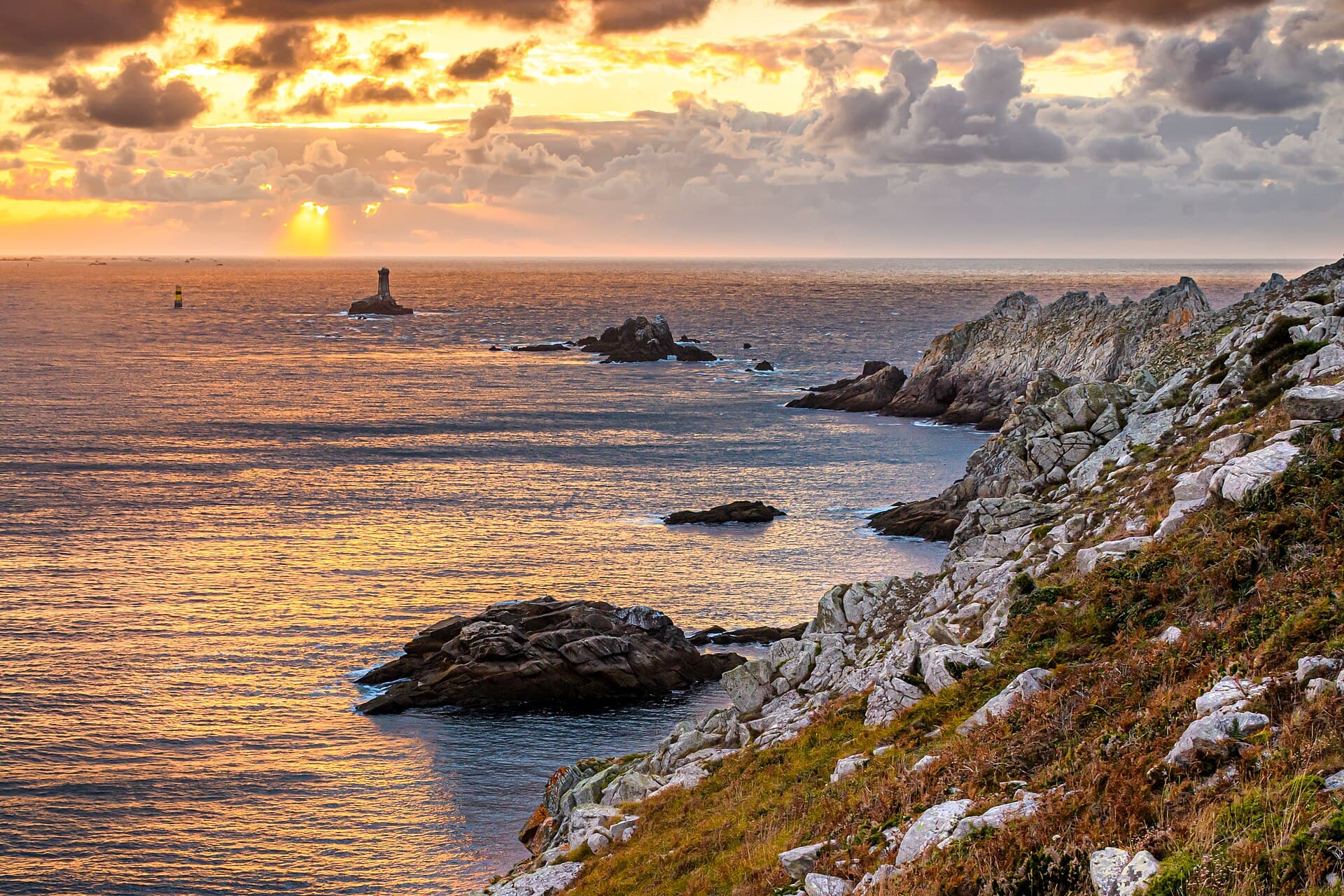
The Finistère point (Penn-ar-Bed in Breton, "end of the world") unfolds its wildest landscapes. Pointe du Raz (Grand Site de France) is one of the world's most impressive ends — 70 m cliffs, Raz de Sein with its dangerous currents, panorama of Sein Island. The Crozon peninsula offers the Pen Hir point and its Tas de Pois (spectacular rocks), the pointe des Espagnols (view over Brest), magnificent wild beaches (Île Vierge beach, Veryac'h). Brest has much to offer: Océanopolis (one of Europe's largest aquariums, 3 pavilions per climate), arsenal and military port, ferries to Ouessant and Molène islands. Camaret-sur-Mer with its traditional sailboats and lighthouse is a photogenic village. The pointe Saint-Mathieu and its ruined lighthouse-abbey is one of Brittany's most beautiful sites.
Cornouaille (south Finistère) is gentler and warmer. Quimper, historic capital, preserves its Gothic cathedral, medieval lanes and faience factories (Henriot, Faïenceries de Quimper). Concarneau and its fortified Ville Close, Pont-Aven (city of the painters Gauguin), Locronan (classified Most Beautiful Village), Bénodet (family seaside resort). The Glénan archipelago (off Bénodet/Concarneau) offers beaches with turquoise waters worthy of the Maldives — access by boat (1h30, €30-40 return).
The Gulf of Morbihan is one of France's most beautiful coastal landscapes: 42 islands in a 100 km² inland sea, classified Regional Nature Park. Vannes is the historic capital of the Morbihan: intact ramparts, medieval old town with half-timbered houses, port. Carnac: the megaliths (3,000 standing stones aligned over 4 km, erected around 4500 BC) are one of the world's major prehistoric sites. Guided tour (summer only, access to alignments for preservation) or observation from the outside path. Quiberon and its Côte Sauvage (panoramic road between Beg Rohu and Pointe du Conguel). Belle-Île-en-Mer (ferry from Quiberon, 45 min) is the largest Breton island — Port-Coton needles painted by Monet, Vauban citadel, wild coast cliffs.
The hinterland holds often-forgotten treasures: Dinan (preserved medieval city, one of France's most beautiful, limited parking), Josselin (Rohan Château), Brocéliande Forest (Paimpont, Arthurian legends, Merlin's tomb, Barenton fountain), Rance valley and its tidal dam (the world's oldest, 1966), Locronan (classified Most Beautiful Village).
Read also
- Saint-Malo, the corsair city — Walled ramparts, beaches, archipelago and one of France's most beautiful fortified cities.
- France — Complete country guide: entry rules, regions, budget, gastronomy.
- Normandy — Mont-Saint-Michel and D-Day beaches just east of Brittany.
- Loire Valley — Renaissance châteaux to explore further south, accessible by train from Rennes.