ville
Luxor
Ancient Thebes of the pharaohs: Karnak, Valley of the Kings, Valley of the Queens, Deir el-Bahari — the largest open-air museum on the planet, on both banks of the Nile.
Luxor is, alongside Giza and Cairo, one of the great rendezvous of any Egyptian journey — and probably the most enchanting. Built on the site of ancient Thebes, capital of the New Kingdom for five centuries (around 1550-1077 BC), the modern city holds on its two Nile banks the densest concentration of pharaonic monuments on the planet. Herodotus already called it in the fifth century BC 'the city of a hundred gates'; twenty-five centuries later, the wonder remains intact.
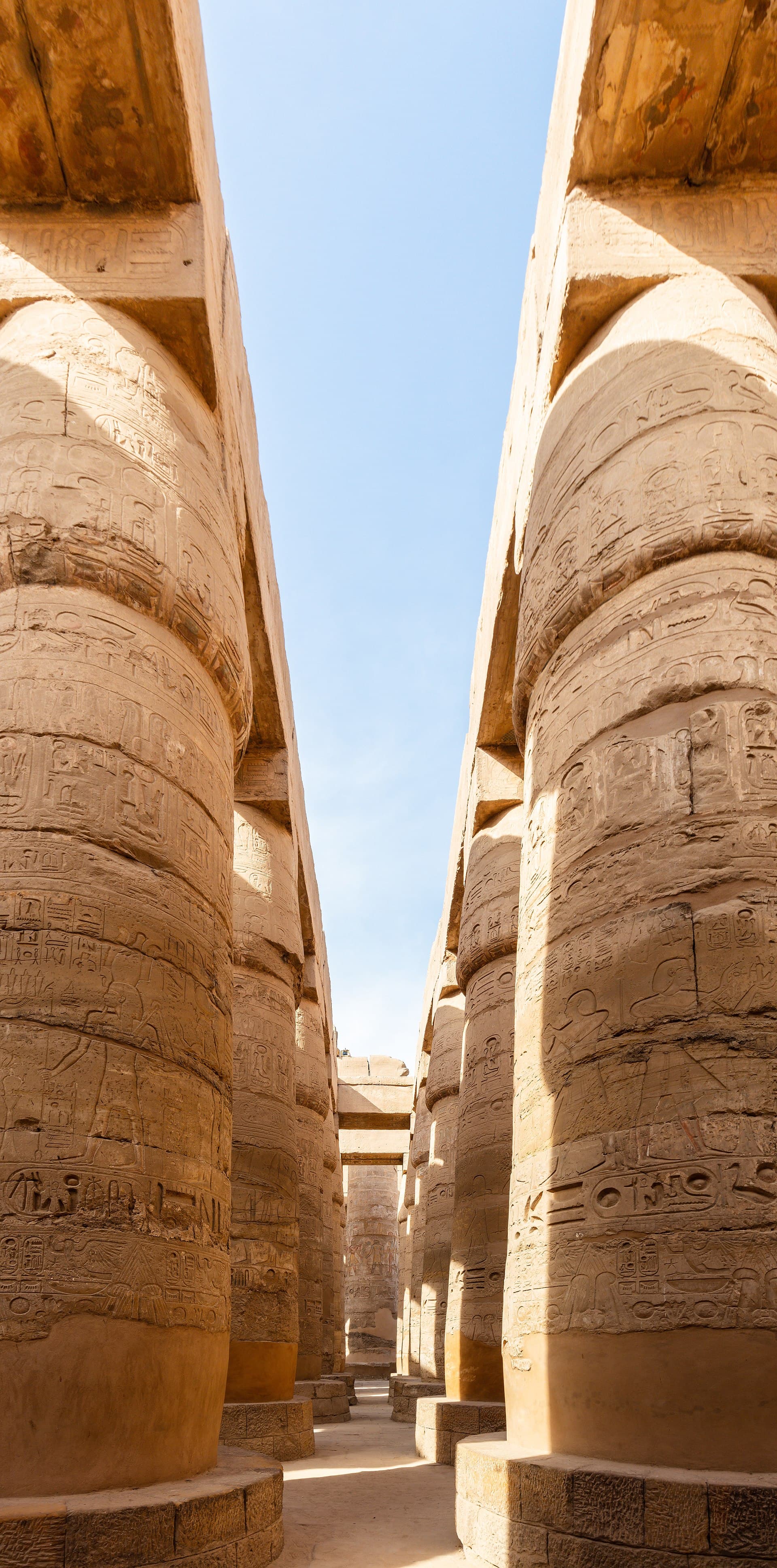
On the east bank (city of the living for the ancient Egyptians), two colossal temples rise: the Temple of Karnak, the largest religious temple ever built (123 hectares, equivalent to more than 80 Notre-Dame of Paris cathedrals), whose hypostyle hall with 134 papyrus-shaped columns 23 metres high leaves visitors literally speechless; and the Temple of Luxor, more modest but of rare elegance, linked to Karnak by a 2.7 km avenue lined with 700 ram-headed sphinxes (fully restored and reopened in 2021). On the west bank (city of the dead), the Valleys of the Kings and Queens shelter the tombs of New Kingdom pharaohs and queens — including that of Tutankhamun, discovered intact by Howard Carter in 1922, which revealed to the world the unsuspected richness of Egyptian funerary art. The Temple of Hatshepsut at Deir el-Bahari, carved into the cliff and forming a monumental three-terrace staircase, is one of the most striking architectural works of antiquity. Luxor is lived slowly, over 3-4 days, ideally combined with a Nile cruise to Aswan.
What we love
- ✅Pharaonic heritage without equal in the world: Karnak, Luxor, Valleys of the Kings and Queens, Deir el-Bahari
- ✅Karnak, largest religious temple ever built, incomparable architectural experience
- ✅Tomb of Tutankhamun discovered in 1922, mummy still visible in situ
- ✅Hot-air balloon flight at sunrise over the Valley of the Kings — a magical moment
- ✅Ideal starting point for Nile cruises to Aswan (3-7 nights)
What to know
- ❌Extreme heat from April to October (up to 48 °C in July)
- ❌Frequent commercial harassment on the east bank and around sites
- ❌Visible security (tourist escorts, checkpoints)
- ❌Modern city of limited interest outside pharaonic sites
Situation
Où se situe Luxor ?
Ouvrir la carte en grand sur OpenStreetMap →Frequently asked questions
How many days should I plan for Luxor?+
Hotel base or cruise in Luxor?+
Is the hot-air balloon over the Valley of the Kings worth the price?+
How many tombs should I visit in the Valley of the Kings?+
How do I get to Luxor?+
Do I need a guide in Luxor?+
Is Luxor a safe destination?+
Our verdict
Luxor is probably the cultural peak of any Egyptian trip. The density and quality of the sites — Karnak first, followed by the Valley of the Kings, Deir el-Bahari and Luxor Temple — have no equal in the world. Plan 3-4 days on site, ideally combined with a 3-4 night cruise to Aswan. Come strictly between October and March, start visits at 6-7 am to escape heat and crowds, treat yourself to the sunrise balloon flight (€80-130 well spent, an enduring memory), and accept that Luxor demands logistical effort to yield its treasures. One of those places you don't return from quite the same.
Nearby

"Saison sèche idéale, 22°C journée."
Expert on Luxor · 1 contributions
 Africa & Americas Desk — Mowando·Editor