ville historique
Quebec City
Only fortified city north of Mexico still intact, UNESCO Old Quebec since 1985, founded in 1608 by Samuel de Champlain — the most European of North American cities, direct heir to New France.
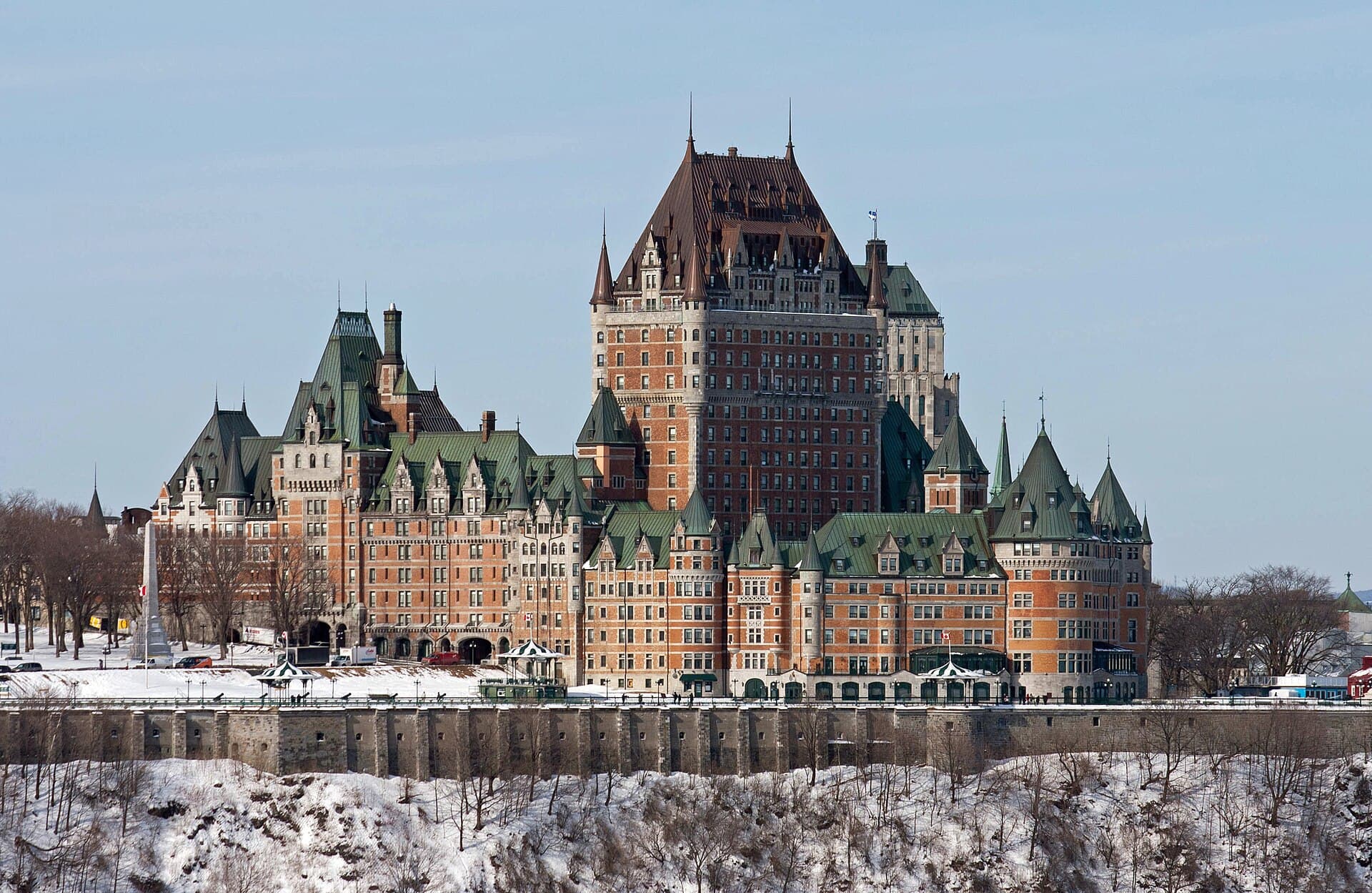
Quebec City, capital of the province of the same name (550,000 inhabitants with suburbs), is the only fortified city north of Mexico still intact and one of North America's oldest cities — founded by Samuel de Champlain in 1608, six years before the creation of the Company of One Hundred Associates. Its Old Quebec (upper and lower town) has been UNESCO-listed since 1985 — a maze of paved alleys, shaded squares and historic monuments of rare architectural coherence, where you'd think you were in a medieval European city transposed to the heart of the American continent.
The city is organised on two distinct levels. The upper town (Cap-Diamant, 100 m strategic cliff overlooking the St Lawrence River), surrounded by 4.6 km of historic ramparts (the only ones remaining north of Mexico), houses the iconic Château Frontenac (Fairmont, 1893, the world's most photographed hotel according to a 2014 Hilton study, its neo-Renaissance towers dominate the skyline), the Dufferin Terrace (wooden promenade facing the river, Château ice slides in winter, summer kiosks), the Plains of Abraham (98-ha historic park, site of the decisive 1759 battle where English General Wolfe defeated French Marquis Montcalm — defeat that sealed the end of New France), the Citadelle de Québec (1820-1850 star-shaped fortress, North America's largest active fortress, official residence of Canada's Governor General, daily changing of the guard in summer 10am), and Porte Saint-Louis (monumental entrance through the ramparts).
The lower town, accessible by the iconic funicular (CAD 4, 64 m drop) or the Breakneck Stairs, concentrates the historic origins of the city. Place Royale is the first permanent French settlement in North America (1608, Louis XIV statue in the centre, Notre-Dame-des-Victoires church from 1688, North America's oldest stone church). The Petit Champlain Quarter (North America's oldest commercial street, founded 1685) is one of the most charming districts on the continent — narrow paved alleys, stone façades, artisan shops, cafés, traditional restaurants. The Fresque des Québécois (1999, monumental 420 m² trompe-l'œil telling Quebec's history) and the Museum of Civilisation (one of Canada's best history and Indigenous cultures museums) complete the lower town experience.
The Quebec experience is lived in a unique atmosphere in North America — 95% francophone (the continent's most francophone city), vibrant traditions (Carnival since 1894, Summer Festival since 1968), authentic Quebec gastronomy (Aux Anciens Canadiens in a 1675 house for tourtière, pâté chinois, ragoût de pattes de cochon, sugar pie, all washed down with Caribou — traditional alcoholic drink), accent and Quebec expressions more pronounced than in Montreal. Plan 2-3 nights minimum to grasp Old Quebec — the compact city walks well, without useful car downtown.
What we love
- ✅UNESCO Old Quebec 1985: only fortified city north of Mexico still intact, founded 1608
- ✅Château Frontenac: world's most photographed hotel, Dufferin Terrace with St Lawrence view
- ✅Place Royale (1608) and Petit Champlain (1685, North America's oldest commercial street)
- ✅Quebec Carnival (1st fortnight of February, world's largest winter carnival)
- ✅North America's most francophone city (95%), unique European atmosphere
What to know
- ❌Tourist saturation: Old Quebec packed in July-August (up to 6,000 cruise passengers/day at peak)
- ❌Hotel rates rise sharply in high season (Château Frontenac CAD 500-1,200/night)
- ❌Extreme winters: -16/-7 °C average, specific gear essential (-25 °C minimum)
- ❌Less gastronomic and festival-rich than Montreal (more traditional)
Situation
Où se situe Quebec City ?
Ouvrir la carte en grand sur OpenStreetMap →Frequently asked questions
How many days for Quebec City?+
Where to stay in Old Quebec?+
When to come to Quebec Carnival?+
What's the difference between Quebec City and Quebec (province)?+
Should I climb to the top of Château Frontenac?+
Our verdict
Quebec City is the most European of North American cities — UNESCO Old Quebec since 1985, only fortified city north of Mexico still intact, founded by Samuel de Champlain in 1608. It's the essential historical stop of a Quebec trip, to absolutely combine with Montreal and Charlevoix-Tadoussac. Our advice: 2-3 nights minimum in Old Quebec — stay in the upper town (Château Frontenac for luxury, Hôtel Manoir Victoria for mid-range, Auberge Saint-Antoine for boutique in lower town) to enjoy the district in the morning before cruise passengers arrive (10-11am) and in the evening after they leave (5-6pm). Visit the Plains of Abraham, the Citadelle (daily changing of the guard in summer 10am), descend by funicular to Petit Champlain (North America's oldest commercial street), taste tourtière at Aux Anciens Canadiens (1675). Prefer June to September for climate (but book 3-4 months ahead) or February for the Quebec Carnival (world's largest winter carnival) — but plan -25 °C gear. VIA Rail train Montreal-Quebec in 3h, CAD 50-100 return.
Nearby

"Janvier : pic du froid (-16/-7 °C), neige abondante (90 mm). Préparation au Carnaval."
Expert on Quebec City · 1 contributions
 Africa & Americas Desk — Mowando·Editor