Mowando

ville historique

New Orleans

The most unique US city — jazz birthplace (1900-1920), French Quarter founded 1718 with Spanish colonial and creole architecture with wrought iron balconies, Bourbon Street legendary bars, Frenchmen Street authentic jazz, Mardi Gras parades, Cajun creole cuisine, Garden District antebellum mansions.

4.70Texas et Sud

New Orleans (Louisiana, 400,000 inhabitants city, 1.3 million metro) is the most unique US city. Founded 1718 by Jean-Baptiste Le Moyne de Bienville and named after Philippe d'Orléans regent of France, the city was French until 1762 (secretly ceded to Spain at Treaty of Fontainebleau), Spanish 1762-1803, briefly French again 1803 (Napoleon resold to Thomas Jefferson in Louisiana Purchase 1803, $15 million, doubling US size). Unique US heritage: Spanish colonial and creole architecture (famous wrought iron balconies are Spanish, not French contrary to popular belief), residual French-speaking culture (5-10% of Louisianans have French-speaking roots, disappearing Cajun dialect), Cajun creole cuisine (gumbo, jambalaya, étouffée, po'boy, beignets), massive Afro-American heritage (NOLA is jazz birthplace c.1900-1920 in Storyville and Tremé neighbourhoods, Louis Armstrong born 1901), voodoo spirituality (Haitian slave heritage, Marie Laveau voodoo queen 1801-1881).

Unique geography: city partly built below sea level (down to -2 m), between Mississippi River (south) and Lake Pontchartrain (north), surrounding bayous, spongy soils (above-ground cemeteries due to high water table, emblematic Lafayette Cemetery No.1 and Saint Louis No.1 with Marie Laveau's tomb). Hurricane Katrina (August 2005) flooded 70% of city when levees broke, killing 1,800 and causing $125 billion damage — a trauma the city is still recovering from (pre-Katrina population 484,000, today 400,000, some neighbourhoods like Lower Ninth Ward never rebuilt). Hurricane Ida (August 2021) also hit. Serious hurricane season June to November, peak August-September.

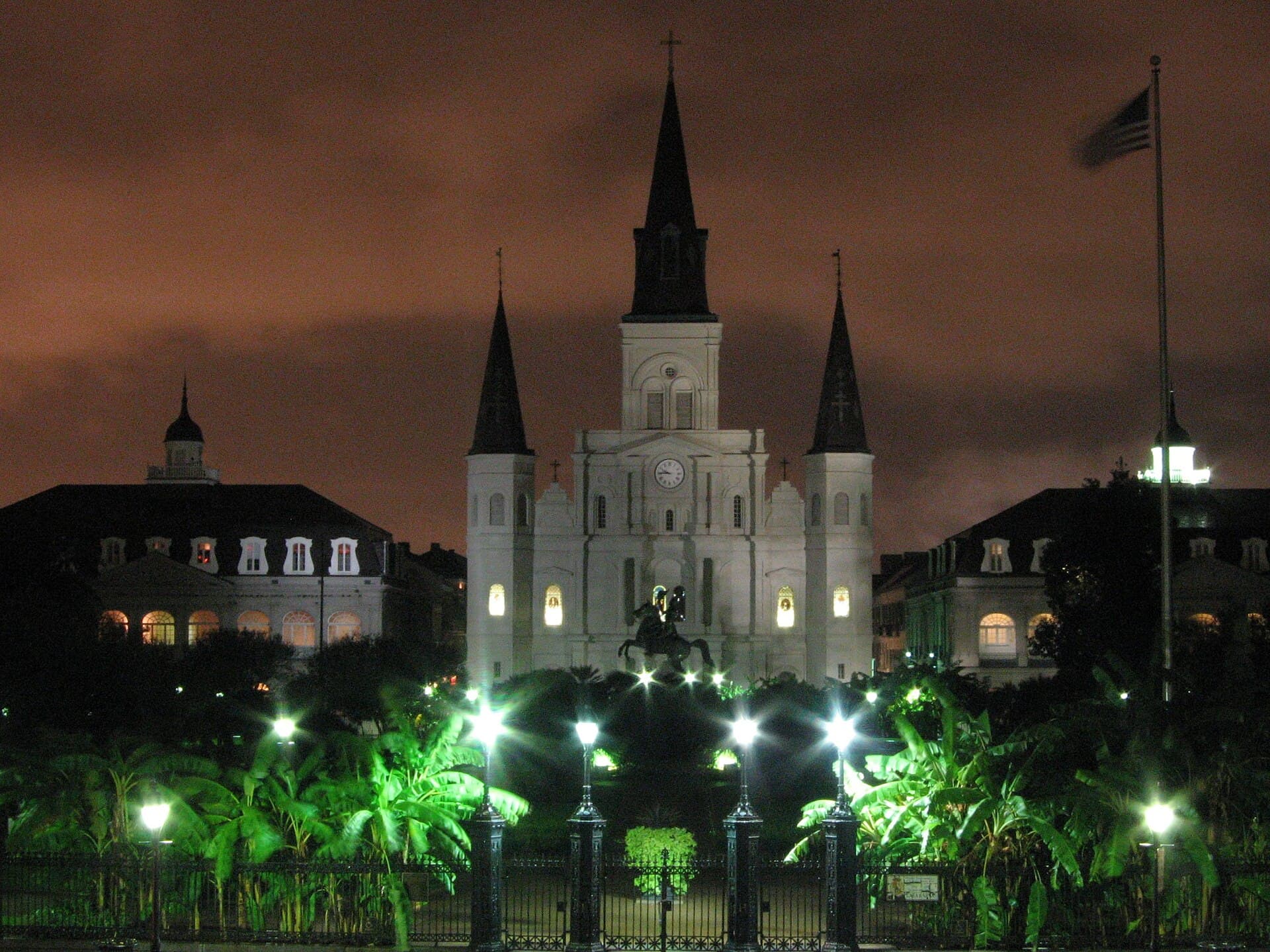
The city organises around French Quarter (Vieux Carré) — 1 km² historic quadrilateral founded 1718, listed National Historic Landmark District since 1965, ~1,100 historic buildings over 5 blocks (between Canal Street, Esplanade Avenue, Rampart Street and Mississippi). Jackson Square and Saint Louis Cathedral (1789, oldest active Catholic cathedral in US) are its heart. Bourbon Street (bars and nightlife street, alcoholic crazy vibe, daiquiris to-go), Royal Street (art galleries, antiques, street music), Decatur Street (Café du Monde beignets, French Market since 1791), Frenchmen Street (just east of Quarter, authentic jazz, Spotted Cat Music Club, The Maison, Snug Harbor — preferable to Bourbon). Other neighbourhoods: Garden District (Uptown, 19th century, antebellum mansions, Lafayette Cemetery No.1, Magazine Street boutiques), Bywater and Marigny (hipster east), Tremé (historic Afro-American, oldest free black neighbourhood in US, jazz birthplace, HBO series Tremé 2010), Mid-City (City Park 5 km², Spanish moss draped oaks, Museum of Art, Beauvoir Manor), St Charles (avenue 6 km, world's oldest streetcar line still in service since 1835).

What we love

  • Jazz birthplace (1900-1920, Louis Armstrong born here 1901) — authentic Frenchmen Street clubs, 1961 Preservation Hall live jazz
  • UNESCO French Quarter — Spanish colonial and creole architecture, wrought iron balconies, 1,100 historic buildings
  • Cajun creole cuisine — gumbo, jambalaya, étouffée, po'boy, 1862 Café du Monde beignets, Commander's Palace Brennan's gourmet
  • Mardi Gras — parades, costumes, beads, world-unique vibe 2 weeks preceding Lent (2026: February 17)
  • Unique spirituality — voodoo (Marie Laveau), above-ground cemeteries (tombs above ground), Haitian and African heritage

What to know

  • Crushing summer heat and humidity (32-36°C with 90% humidity, 45°C feels-like June-September)
  • Serious hurricane season June-November (Katrina 2005 1,800 deaths 70% city flooded, Ida 2021)
  • Variable safety outside French Quarter — Treme and 7th Ward with caution at night, high urban crime rate (US homicide Hot Spot)
  • Mardi Gras and Jazz Fest hotel rates +200-300%, 6-month-ahead booking, saturated vibe
  • No direct flight from Paris (mandatory Atlanta, NYC or Charlotte stopover)

Situation

Où se situe New Orleans ?

Ouvrir la carte en grand sur OpenStreetMap →

Frequently asked questions

How many days for New Orleans?+
Minimum 4 nights to grasp the city. Ideal 4-day programme: Day 1 French Quarter — Jackson Square + 1789 Saint Louis Cathedral + Cabildo ($8 museum) + Presbytère + 1791 French Market + Royal Street galleries + Decatur Street + Café du Monde beignets 24/7 since 1862; Day 2 Bourbon Street + Frenchmen Street — Bourbon evening (at least once for crazy vibe), Pat O'Brien's Hurricane iconic cocktail, then Frenchmen Street (real authentic jazz Spotted Cat Music Club, The Maison, Snug Harbor — no cover charge, 1-2 mandatory drinks $15-25); Day 3 Garden District — 1835 St Charles Streetcar (world's oldest streetcar line, $1.25/ride) + Lafayette Cemetery No.1 (free or $20-30 guided tour) + antebellum mansions Magazine Street boutiques; Day 4 Plantation + bayou excursion — Oak Alley Plantation (45 min, $28) OR Whitney Plantation (1h, $25, slavery explained), bayou airboat alligator tour ($35-70). In 5-6 nights, add Tremé guided tour (jazz birthplace, don't go alone at night), Mississippi Steamboat Natchez whale excursion ($35-55 live jazz), Audubon Park + Tulane University, Crystal Cathedral. Mardi Gras (2 weeks preceding Mardi Gras itself) requires minimum 4-5 days.
Mardi Gras in New Orleans: what to know?+
Mardi Gras is NOLA's most emblematic event — 2 weeks of parades, parties and colours from the 12th night after Christmas (Epiphany January 6) until Mardi Gras itself (variable date by Easter, between February 3 and March 9 — 2026: February 17, 2026). Peak activity: last 3 days before Mardi Gras itself (Saturday-Sunday-Monday-Tuesday). Iconic parades: Endymion (Saturday night, 80,000 spectators), Bacchus (Sunday night, celebrity grand marshall), Zulu (Tuesday morning, Afro-American heritage, controversial traditional blackface), Rex (Tuesday morning, King of Carnival since 1872). Bead tradition — floats distribute colourful bead necklaces to spectators (sometimes exchanged for exposed breasts in French Quarter, controversial but omnipresent tradition). French Quarter and Bourbon Street become unmanageable (crowds, alcohol, costumes, vomit sometimes) — prefer St Charles Avenue for historic family parades, or residential neighbourhoods (Magazine Street, Esplanade Avenue) for more authentic vibe. 6-month-ahead hotel booking, +200-300% rates, minimum 3-4 night stay required. King Cake (cinnamon king cake with purple-green-gold glaze with hidden baby Jesus figurine — whoever finds baby must buy next King Cake) is the seasonal pastry sold everywhere. Avoid Mardi Gras if you want to visit NOLA peacefully — prefer January, March (after Mardi Gras), April, October.
Where to stay in New Orleans?+
French Quarter for immersive experience — 1886 Hotel Monteleone (literary icon with Carousel Bar, Hemingway-Faulkner-Capote wrote there, €200-350/night), Royal Sonesta (€250-400), Bourbon Orleans (€180-300), Maison Dupuy (€180-300), Place d'Armes Hotel (€180-280), Olivier House (charm B&B €150-220). Marigny (east of Quarter, calmer, Frenchmen Street 5-min walk) — Frenchmen Hotel (€180-280), Lamothe House (€200-300). Garden District (Uptown, calm residential, St Charles Streetcar to French Quarter 25 min) — Henry Howard Hotel (€200-350), Pontchartrain Hotel (€180-300), Magazine Street B&B (€150-250). Central Business District (CBD/Warehouse) near Quarter — The Roosevelt (Waldorf Astoria 1893, €300-500), Ace Hotel (€200-350), Hotel Peter & Paul (€200-350 boutique). Avoid: hotels in Treme at night, parts of Esplanade Ridge north. For Mardi Gras and Jazz Fest, book 6 months ahead, rates +200-300%. Airbnb common French Quarter and Marigny €150-300/night (but strict SF limits, check beforehand).
Is New Orleans safe?+
New Orleans has above-average US crime rate (homicide rate 50/100,000 in 2024 vs US average 6), but tourism remains globally safe if you respect zones and rules. Safe by day: French Quarter, Garden District, CBD, Marigny, Frenchmen Street, St Charles Avenue, Audubon Park. Safe in evening until midnight: French Quarter (heavily patrolled NOPD, French Quarter Task Force), Frenchmen Street (jazz night spot, moderate crowds). Vigilance after midnight: Bourbon Street (alcoholic, dense crowd, pickpocketing, sometimes fights), Treme (historic Afro-American neighbourhood east of French Quarter, interesting by day with $30-40 Tremé Music Tour guided tour or audio guide, but avoid alone at night), parts of Mid-City. To avoid: 7th Ward, some sectors of Central City at night, eastern city neighbourhoods (Lower Ninth Ward), north of St Charles Avenue zones after 10pm. Tips: no flashy jewellery, bag worn across body in front, discreet phone, Uber/Lyft rather than walking late evening, keep limited visible cash budget, beware of hurricanes (June-November, cancellation-cover travel insurance essential).
What budget for New Orleans?+
Reference budget €150-200/day/person — more affordable than NYC or California. Flights Paris-NOLA via Atlanta (Delta direct CDG-ATL 9h + ATL-MSY 1h45) or NYC €700-1,200 return by season. French Quarter accommodation: B&B €150-220/night (Olivier House, Place d'Armes), boutique hotels €200-350 (Hotel Monteleone, Bourbon Orleans, Maison Dupuy), luxury €300-500 (Royal Sonesta, Windsor Court). Marigny and Garden District €150-280. Mardi Gras and Jazz Fest +200-300%. Food: Café du Monde beignet breakfast $8-12/person, Domilise's po'boy lunch $10-18, Mother's restaurant lunch $15-25, mid-range dinner $40-70/person pre-tip 18-20% (Coop's Place jambalaya $25-40, Acme Oyster House $30-50), gourmet Commander's Palace (200 St Charles, gourmet creole since 1893, $50 brunch jazz 25-cent martini, $100-180/person dinner, the experience), Brennan's (1946 creole, Bananas Foster invented here, $100-180), Galatoire's (1905 creole, dress code, $80-150), Cochon (modern Cajun, $60-100), Mosquito Supper Club (authentic Cajun, $100-150). Activities: Cabildo museum $8, Presbytère $8, Voodoo Museum $7, French Quarter Walking Tour $25-35, Frenchmen Street jazz club no cover charge (1-2 mandatory drinks $15-25/person), Preservation Hall (live jazz since 1961, $25 entry per 45-min show, 3 shows/night 5:30pm/7:30pm/9:30pm), Mississippi Steamboat Natchez cruise ($35-55, 2h, live jazz), bayou airboat alligator tour ($35-70 half day), Oak Alley plantation $28, Whitney Plantation $25. Transport: St Charles Streetcar $1.25/ride, RTA Bus, Uber $5-15 typical ride, taxi $10-25, Algiers Point watertaxi $4. MSY airport → French Quarter flat taxi $36 or Uber $30-50 (35 min). Total 4 nights for 2 people excl. flights: €1,800-3,500.

Our verdict

New Orleans is the most unique US city — combination of French + Spanish + African + Caribbean with no equivalent elsewhere in North America. Our advice: minimum 4 nights to grasp the city. Stay in the French Quarter (B&B and boutique hotels €150-350/night, iconic 1886 Hotel Monteleone, Bourbon Orleans, Maison Dupuy, Royal Sonesta) or Garden District (Magazine Street, calmer €150-280) or Marigny (east of Quarter, more authentic, Frenchmen Street, €150-280). Favour October-April for climate window, especially February-March for Mardi Gras (2026: February 17, 6-month-ahead booking) or late April-early May for Jazz Fest (2 weekends, major 250,000-visitor music festival). Avoid June-September (heat 32-36°C with 90% humidity, hurricanes). Paris-NOLA flight via Atlanta (Delta direct CDG-ATL 9h + ATL-MSY 1h45 = 12h total, €700-1,200 return) or NYC (12-14h via JFK). Classic 4-day programme: Day 1 French Quarter — Jackson Square + 1789 Saint Louis Cathedral + Cabildo + Presbytère + 1791 French Market + Royal Street + Decatur Street + Café du Monde beignets; Day 2 Bourbon Street + Frenchmen Street — Bourbon evening (at least once for crazy vibe) then Frenchmen Street (authentic jazz Spotted Cat, The Maison, Snug Harbor); Day 3 Garden District — 1835 St Charles Streetcar + Lafayette Cemetery No.1 + antebellum mansions + Magazine Street; Day 4 Plantation excursion — Oak Alley Plantation 45 min ($28, 300 m oak alley, slavery heritage explained) OR Whitney Plantation (1h, $25, first US plantation told from slaves' perspective, deeply moving) + bayou airboat alligator tour ($35-70). Book Mardi Gras and Jazz Fest 6 months ahead, gourmet restaurants (Commander's Palace, Brennan's, Pat O'Brien's) 1-2 months ahead.

Nearby
The Editors
The Editorsauteur principal✓ Verified

"Janvier : doux, parfois pluvieux, Sugar Bowl football américain."

Expert on New Orleans · 1 contributions

Mowando Letter

Once a month: the right destinations for the right season + the best booking windows.

No spam. One-click unsubscribe. Your data is never shared.