site naturel
Lake Titicaca
The world's highest navigable lake at 3,812 m, sacred to the Incas (mythology: Manco Cápac and Mama Ocllo emerge from waters), mythical totora reed floating Uros Islands and Taquile Island with UNESCO 2008-listed textile.
Lake Titicaca (3,812 m altitude, 8,372 km² surface i.e. 1.3 times Corsica, 281 m maximum depth, 190 km long, 80 km wide) is the world's highest navigable lake and one of South America's most powerful natural and cultural sites. Shared between Peru (60%) and Bolivia (40%), it was the cradle of Andean civilization according to Inca mythology — Manco Cápac and Mama Ocllo, founders of the empire, emerged from the lake's waters sent by the god Inti to found Cusco. This sacred dimension explains the importance of pre-Inca civilizations that developed here (Pukara, Tiwanaku, Colla) and the ceremonial role of the lake in all Andean cosmovision.
The Peruvian gateway is Puno (130,000 inhabitants, 3,827 m altitude), a base city without great architectural charm but the essential departure point for lake excursions. Puno port (5 min from centre) offers daily speedboat departures to the islands.
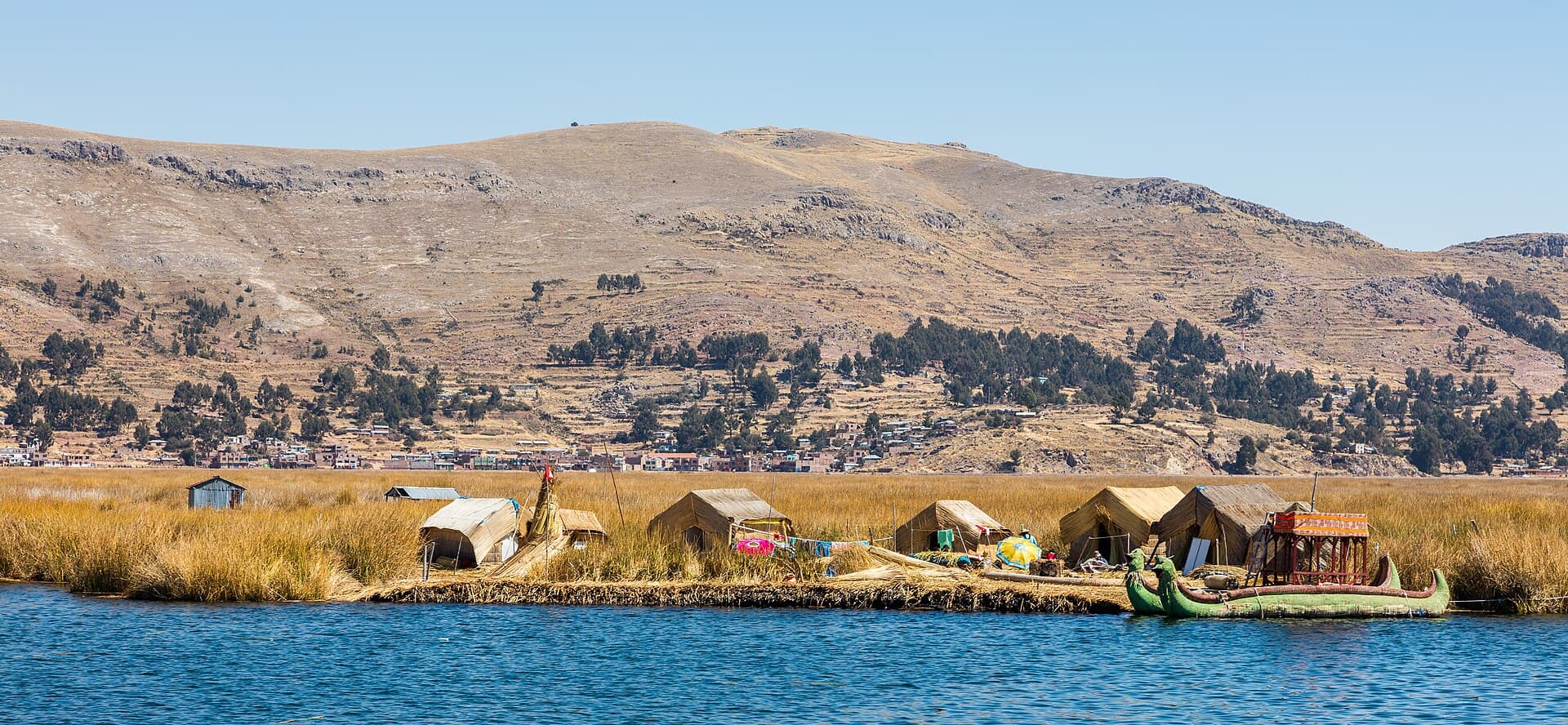
Main islands on the Peruvian side. Floating Uros Islands (5 km from Puno, 30 min boat) are the iconic Titicaca attraction — about fifty islands built and maintained by the Uros community since pre-Inca times. Islands are entirely in totora (aquatic reeds growing in the lake), 2-3 m thick, regularly renewed. Half-day excursion €30-50/person.
Taquile Island (45 km from Puno, 3h speedboat, 5.5 km² altitude 3,850-4,050 m, 2,200 Quechua inhabitants) is a preserved traditional island — globally recognized for its textile art inscribed UNESCO intangible heritage in 2008. Full day Uros + Taquile from Puno €50-80/person. Amantani Island (40 km from Puno, 3h speedboat, 9 km², 4,000 Quechua inhabitants, two sacred peaks Pachatata 4,200 m and Pachamama 4,130 m) is the choice for homestay and deep community immersion. Classic 2-day/1-night Uros + Amantani + Taquile formula (€90-130/person) is the most immersive.
What we love
- ✅World's highest navigable lake at 3,812 m — iconic Andean landscape, exceptional sky
- ✅Floating Uros Islands in totora reeds — unique experience in the world, preserved pre-Inca community
- ✅Taquile Island: UNESCO 2008-listed textile, traditional Quechua community, homestay possible
- ✅2-day/1-night immersive Uros + Amantani + Taquile formula (homestay with Quechua family)
- ✅Spectacular view of snowy Bolivian Royal Cordillera in clear weather (Illimani 6,438 m)
What to know
- ❌Altitude sickness at 3,812 m: imperative preparation, mandatory prior acclimatization
- ❌Glacial nights (-5 to 5 °C in dry season), no heating at Amantani homestay
- ❌Puno city without great architectural charm, only logistical stop
- ❌Uros excursions sometimes criticized (commercialization, paid photos, touristy atmosphere)
- ❌Long distances: 30 min to Uros, 3h to Taquile and Amantani
Situation
Où se situe Lake Titicaca ?
Ouvrir la carte en grand sur OpenStreetMap →Frequently asked questions
Which excursion to choose on Lake Titicaca?+
How to get to Lake Titicaca?+
Should you do the Amantani homestay?+
Lake Titicaca, what altitude sickness?+
What events not to miss at Lake Titicaca?+
Our verdict
Lake Titicaca is one of Peru's most powerful experiences — iconic Andean landscape, world's highest navigable lake at 3,812 m, unique pre-Inca cultural dimension (Uros, Taquile UNESCO, Amantani). Our recommendation: plan 2 nights in Puno with 1-day Uros + Taquile excursion (€50-80) or ideally 2-day/1-night Uros + Amantani + Taquile formula with homestay with Quechua family (€90-130) — it's the most immersive experience. Mandatory prior altitude acclimatization at Arequipa (2,335 m) then Colca (3,800 m) before arriving at 3,812 m. Travel from May to September for optimal conditions (blue sky, calm waters, Bolivian cordillera visibility) — imperatively bring warm clothes (nights -5 °C in July) and SPF 50 sun cream (very intense UV at this altitude).
Nearby

"Janvier : pleine saison humide, pluies fréquentes, eaux hautes."
Expert on Lake Titicaca · 1 contributions
 Africa & Americas Desk — Mowando·Editor